Posted in Other fiction, Reading Reviewed, Scottish Fiction at 20:00 on 14 March 2018
Headline Review, 2006, 213 p One of the 100 best Scottish Books.
This takes the usual form of the Sherlock Holmes story. A client comes to Baker Street to enlist Holmes’s help in unravelling a mystery, in this case a Dr Mortimer, friend of the late Sir Charles of that ilk, who relates the legend of the hound of the title, said to be the curse of the Baskervilles and apparently responsible for Sir Charles’s death and seeking Holmes’s protection for the heir, Henry, about to arrive in the country from overseas. After some preliminary shenanigans in London our narrator Dr Watson is packed off to the Devonshire countryside to seek information and act as a kind of bodyguard while Holmes does his thing, supposedly on other cases but in reality following his own path to the answer. Throw in a few red herrings like the light on the moor at night, disguises of various sorts, people who are not who they pretend to be, and the mix is complete.
The attractions of the form are readily apparent. The book is easy to read, comforting (Holmes rarely fails to set the world to rights,) as well as formulaic. It is not, though, literature of the highest quality. The prose never rises above the workmanlike, the characters are little more than stereotypes and it surely appears on that “100 best” list only because Holmes has become so familiar as a cultural reference point.
The piece of dialogue, “‘Interesting, though elementary,’ said he,” incidentally shows that Doyle did put that word into Holmes’s mouth (though without appending to it, “my dear Watson.”) It also illustrates Doyle’s irritating use of “said he” rather than “he said.”
Pedant’s corner:- “If he would, confine his energies to this all would be well” (surely has an extraneous comma,) rosterer (roisterer is the best fit.)
No Comments »
Posted in Reading Reviewed, Scottish Fiction at 12:00 on 4 September 2017
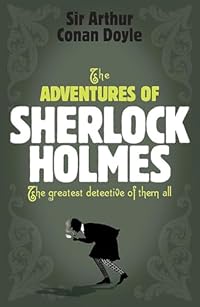
Headline Review, 2006, 352 p. First published in 1892. One of Scotland’s favourite books.
Being not much of a fan of crime novels I would not normally have picked this up but it is on that list – it even made the top ten – of Scotland’s favourite books (see link above) of which, having recently ticked off Willa Muir’s Imagined Corners – which is separately among the 100 best Scottish books while this is not – I have worked through all but four now. But it was available at a local Library.
So: how to account for the perennial attraction of these Sherlock Holmes stories? While they are easy to read they are not particularly well-written, being prone to exposition and, taken as a whole, remarkably repetitive in form. Nor are they particularly diverse. Not less than three of the ones here hinge on attempts to thwart possible inheritances. Moreover, our narrator, Dr Watson, is usually not present at the crucial points of an investigation, only for the reveal. And quite often the criminal – or malfeasant, there is not always a crime involved – ends up not being punished.
As to the stories themselves: A Scandal in Bohemia isn’t; either a scandal or set in Bohemia. The Red-headed League is an invented body whose advert is intended to attract applicants for the purposes of diversion from a crime. The perpetrator of the misdemeanour in A Case of Identity is obvious from the moment of its description by the victim. So too from early on is the murderer in The Boscombe Valley Mystery. The Five Orange Pips are the Ku Klux Klan’s equivalent of Treasure Island’s black spot while The Man with the Twisted Lip turns on an ingenious way to make a comfortable living. The Blue Carbuncle is a stolen diamond that ends up in the crop of a Christmas goose. The Speckled Band is a tale of murder by unusual means. The Engineer’s Thumb is barely a mystery at all. The Noble Bachelor’s bride does a bunk almost as soon as the wedding ceremony is over but Holmes soon divines why. The Beryl Coronet is a piece of jewellery entrusted to a banker as security for a loan and part of which is subsequently stolen while in his care. The banker’s dissolute son is given the blame until Holmes gets on the case. Once again the true perpetrator (or at least one of them) is not hard to pick out. The Copper Beeches is the house to which a governess is invited to work but there are odd conditions attached to the post.
Well, I can now say I’ve read Doyle’s Holmes (two years ago I reviewed for Interzone one of James Lovegrove’s homages) but I can’t say I’m keen to repeat the experience. The Hound of the Baskervilles, though, is on that 100 best list. I suppose I can always hope Doyle is better at novel length.
Pedant’s corner:- hurrah for encyclopædias! Otherwise – The King of Scandinavia (there is no such person; but I suppose Conan Doyle did not wish to name actual royalty.) “‘The form do so when the security is good,’” (ought to be “does so” but it was in direct speech,) shrunk (shrank.)
No Comments »
Posted in Edinburgh at 20:00 on 26 March 2016
In the loosest sense.
This is one of the many sites in Edinburgh associated with men of letters of which the most prominent is of course the Scott Monument.
It’s the statue of Sherlock Holmes which stands in Picardy Place; erected in memory of his creator Arthur Conan Doyle who was born in 1859 near to this site. The Conan Doyle Pub is just over the road in York Place. The childhood home of Robert Louis Stevenson is less than a stone’s throw away from here.

No Comments »