Death is a Welcome Guest by Louise Welsh
Posted in Other fiction, Reading Reviewed, Scottish Fiction at 12:00 on 1 February 2022
John Murray, 2015, 380 p.
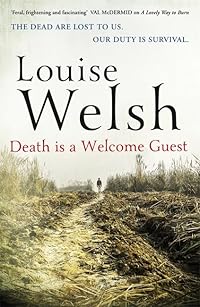
This is the second in Welsh’s Plague Times trilogy (see here for my review of the first) written pre-Covid. To read it in the midst of a pandemic is odd but the similarities are outweighed by the differences. “The sweats” is at once both more virulent but more forgiving than Covid. Those who die succumb quickly, those who survive do not experience lingering symptoms.
Avoiding the usual hazard of middle books of three Welsh cleverly has a different viewpoint character from A Lovely Way to Burn. This is Magnus McFall, sometime comedian, who witnesses the first manifestations of “the sweats” while playing down the bill to a much more successful comic. His reflection that “London had not closed for the Blitz, the IRA, or al-Qaeda. It would take more than a few germs to shut down the city” is of course not borne out by our own pandemic experience.
On his way home after a gig he prevents the rape of a girl but is himself mistaken for the rapist and so finds himself in jail awaiting trial. Not a good place to be at the outset of a pandemic. When his cellmate dies he is placed in with Jeb who is in the sex offenders wing and garb. It later transpires Jeb is in solitary because he was a policeman found guilty of murdering the woman whom he had a relationship with on an undercover assignment.
Their breakout of jail is brutal – not least to other inmates – and they make their way into the country on motor bikes using back roads, with Magnus aiming to return to his home in Orkney. Several close encounters ensue before the pair end up at Tanqueray Hall, a big house containing a small religious group led by the elderly Father Wingate. We have here almost the perfect closed community, the setting for many a crime story. And the murders have already started.
The breakdown of civil life is a staple of apocalyptic tales, as is attempts to restore order by harsh actions. To a certain kind of mind catastrophes are soon latched on to as a manifestation of God’s punishment for wickedness. The ideas that a Supreme Being could be benevolent and that disasters can occur to the innocent, are beyond that mind set. The fact of survival is no guarantee of innate goodness, and it can of itself unhinge the survivor.
Character is a tricky aspect of the post-apocalypse tale. Norms of behaviour may change as a result of the event, but some human constants will remain so. Welsh’s scenario is the classic one of the SF so-called ‘cosy’ catastrophe, albeit with a modern twist and an added dash of crime (which itself is a concept liable to undergo change in the aftermath.) There are inevitable echoes of John Christopher in Death is a Welcome Guest even if Welsh has never read him (though I suspect she has.) She certainly knows how to keep the reader turning the pages. It remains to be seen whether in the third of the trilogy the expectations of that sub-genre are fulfilled.
Pedant’s corner:- “(how many hours ago?).” (that full stop after the bracket is unnecessary. The question mark acts as a marker for the end of the sentence.) “A series of tabloid headlines were riffling through Magnus’s mind” (A series was riffling. Extra points for ‘Magnus’s’ though.) “Wylie Coyote” (that cartoon character is Wile E Coyote,) “vodka and tonics” (tonic is an adjective here so cannot be made plural; ‘vodkas and tonic’, or ‘vodkas with tonic,) snuck (sneaked. Please,) “hooching with them” (usually spelled ‘hoaching’ or sometimes ‘hoatching’,) staunch (stanch.)
