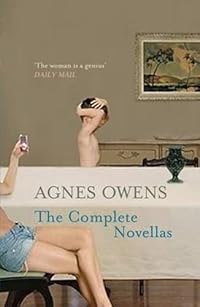
Polygon, 2009, 499 p.
Various encomia adorn both the back cover (“Agnes Owens is one of Scotland’s best yet most overlooked writers,”) and the before-the-title pages of this book. Owens is someone of whose name I’d been aware but whose work I’d never sampled till now, an omission a chance encounter in a local library enabled me to rectify.
Like Birds in the Wilderness1 is a rather rambling tale of an unemployed bricklayer with a fondness for drink who moves to a northern city seeking work, meets a girl, encounters a military type who cryptically offers him unspecified employment, goes hiking in the highlands, returns home.
A Second World War childhood/adolescence figure in both A Working Mother2 and For the Love of Willie.
Betty is the titular working mother, the focus around which the events of the novella orbit. She is married to a war hero, but the only things she and her husband, Adam, have in common are alcohol and two children. As her husband is unemployed she goes back to work to help support the family. Her job takes her into the office of widower Mr Robson. This relationship, like hers with Adam’s friend Brendan, is not what propriety deems it should be. A few final scenes undercut the reliability of the previous narrative by revealing Betty is telling her story to a fellow mental patient.
Any unreliability issues are addressed at the start of For the Love of Willie where Peggy is an inmate in a psychiatric ward who announces to fellow patient, the duchess, her intention to write a novel based on her own life, scrounging or stealing paper to do so. The two phases of Peggy’s life are then told in parallel describing how her wartime employment in the shop of Willie Roper led to her present state. Peggy’s mother tells her warningly, “No man’s as nice as he looks” and also that (men) have habits worse than dogs. Peggy herself tells the duchess that love is only sex with a sugar coating round it. I note here that this novella’s title may be a crude pun.
Bad Attitudes3 revolves around the doings of the Dawson family – recently decanted from a condemned terrace to a new council flat – the busybody downstairs, her across the close neighbour, the local councillor they both consult, the one man who refuses to leave the old terrace, the tinkers who have squatted there and their sister/in-law. It takes a strange turn near the end when two murders are committed in the terrace.
In Jen’s Party Jen lives penuriously with her mum, Maude, and Aunt Belle. Her father is in jail but she thinks he merely left and is well off somewhere with another woman. Belle is a force of nature, blithely careening through life while Maude feels the struggle. Belle organises a party for Jen’s fourteenth birthday which, on the day, brings all sorts of things to a head. The dialogue between Maude and her sister in this story is immensely readable and sparkles with authenticity.
One of Scotland’s best writers? I’m not wholly convinced yet, but she is certainly worth reading. I’ll look for more.
Pedant’s corner:-
1 encyclopedias (why the US spelling?) inadvertantly, skuttled, fruit wellies (jellies,) proprietory, stoney.
2 sprung – though sprang is used later, before I could take if off, dotary – which I’ve only ever seen as dottery before.
3 if she hadn’t seen it for her own eyes. For? It’s usually with.