Archives » A S Byatt

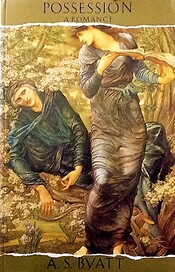
Possession: A Romance by A S Byatt 

Chatto & Windus, 1990, 517 p

Insecure academic Roland Michell finds in a pile of unsifted-through papers relating to Victorian poet Randolph Henry Ash unfinished drafts of a letter from Ash to a hitherto unknown possible female lover, a relationship which would overturn the prevailing view of Ash’s life.  For reasons obscure even to himself Michell removes the drafts from the pile and resolves to investigate further. He begins to suspect the intended recipient was the female poet Christabel LaMotte and enlists the help of LaMotte expert Dr Maud Bailey to delve into the mystery. With her help he comes across a complete set of letters between the two poets which reveal the extent of their affair.

There are several other academics interested in Ash – Fergus Wolff, Mortimer Cropper, James Blackadder – one of whom has obsessively obtained items belonging to Ash for his Stant Collection and would pay a large sum for such letters.

All this is set against a background of the present-day circumstances of Michell and Bailey.

This set up allows Byatt to deliver to us examples of the poetry of both Ash and LaMotte as well as a frankly tedious laying out of their letters to each other in their entirety. While these are all accomplished pieces of literary ventriloquy on Byatt’s part (and of which some would arguably be necessary) they do not help to advance the plot by much. I note that in Babel Tower she did something analogous with an internal story written by one of the characters in the main narrative.

Among all this there is an explanation in dialogue of the arcana of copyright law as regards letters between the writer and the recipient – or their descendants.

Byatt is here playing games with the reader and with literary critics. At one point, “Roland thought, partly with precise postmodernist pleasure, and partly with a real element of superstitious dread, that he and Maud were being driven by a plot or fate that seemed, at least possibly, to be not their plot or fate but that of those others.” It strikes me that having a character think that s/he is being manipulated by an external force is laying it on a bit thick and also tends to haul the reader out of the narrative, destroying suspension of disbelief.

Byatt’s intentions with the sentences contained in, “He was in a Romance, a vulgar and a high Romance simultaneously ….. a Romance was one of the systems that controlled him, as the expectations of Romance control almost everyone in the Western world, for better or worse, at some point or another,” are more forgiveable, being more general.

In an example of the pathetic fallacy writ large there is a scene taking place during the so-called Great Storm of 1988 where Blackadder and Cropper attempt to remove illicitly from Ash’s grave a box containing further correspondence between the poets. (This is also an explicit reference to an incident in the lives of the Pre-Raphaelites.)

What the book is really about though is the impossibility of knowing the full intricacies of people’s lives from their letters or artistic works, no matter how comprehensive their scholars’ knowledge of them might be.

Illustrating this, and divorced from the rest of the text, are several passages with straightforward narrative depictions of Ash and LaMotte either together or at significant moments of their connected lives. Crucially, these feel real, felt experiences.

Fiction gets to the nub; biography does not.

Pedant’s corner:- woud (would,) an extraneous end quote mark, focussed (focused,) gas-mantels (gas mantles.) “Roderick Random, an English work,” (Roderick Random may have been written in English but its writer, Tobias Smollett, was a Scot,) “as though she was liquid” (should that not be ‘as though she were liquid’?) wistaria (wisteria,) “snuck off” (USian, the British phrase is ‘sneaked off’,) “the sound of the Mercedes’ angry purr” (Mercedes’s,) scarey (scary.)

Babel Tower by A S Byatt

Chatto and Windus, 1996, 622 p.

I noted when Byatt died that I had only read one book by her and perhaps ought to remedy that so when I saw this in a second-hand bookshop (in Ulverston as it happens) I snapped it up. However only after I started reading it did I check her back catalogue and found this is the third novel in a sequence featuring Frederica Potter as the main character. Not that it matters because the book stands alone.
In this one, set in the nineteen sixties, Frederica is regretting marrying Nigel Reiver as she finds life in his grand home – dominated by his two sisters and his housekeeper – even with her son Leo, less than fulfilling. She had thought she might be allowed to work (she had met Nigel when she was at Cambridge – though he wasn’t – and still hankers after the intellectual life.) But Nigel is a traditional husband and though his work often takes him away for extended periods (with corresponding sexual encounters which Frederica only finds about later) thinks she should stay at home and resents any contact with her former University friends, all of them male of course. Her unhappiness turns into despair when he becomes violent towards her. He is a former soldier trained in violence and throws an axe at her when she tries to run away.

Some of the passages deal with members of Frederica’s extended family one of whom fields phone calls in a Samaritan-like service. They chat amongst themselves as they wait for calls and when questioned why the Church seems obsessed by sex a bishop says, “‘The Church has always been about sex, dear, that’s what the problem is. Religion has always been about sex. Mostly about denying sex and rooting it out.’” Apart from the odd visit later in the book to Frederica’s parental home this is a very minor strand.

Interleaved with Frederica’s story in the early stages here are extracts from a book called Babbletower, where an aristocrat leads a group of people away from their home land to a place named La Tour Bruyarde, to found a culture in which its inhabitants will be free to do as they wish without hindrance. This connects with Frederica after she finally escapes Nigel (her son Leo insisting on coming with her though he loves his father) when she gets a job – nepotistically through her old friends – as a publisher’s reader then teacher of English in the Samuel Palmer School of Art and Craft. Babbletower is one of the books she recommends for publication and its author, Jude Mason, an ill-dressed, ill-kempt and smelly individual, turns out to be a model for the life class at the School.

Byatt uses this and Frederica’s peripheral involvement with the Steerforth Committee on the teaching of English (and specifically whether grammar ought to be taught in schools) to have discussions about literature, especially E M Forster and D H Lawrence, as well as the usefulness of cut-ups in condensing meaning.

George Murphy, one of Frederica’s students, says novels are obsessed with sex and love and God and food (which he agrees most people are) but they are also obsessed by work, commodities, machines and property on which they do not lavish the contempt and loathing which novelists tend to. At one point a character realises that it is possible for human beings to spend the whole of their lives on nonsense.

From time to time the ferment of the sixties is noted parenthetically. The Lady Chatterley trial, the 1964 General Election, the abolition of the death penalty, the decriminalization of homosexuality, the Moors murders, Sergeant Pepper’s Lonely Hearts Club Band, the beginning of colour TV transmission all get a nod.

There are two main set pieces in the novel, both describing court cases, Frederica’s divorce and Babbletower’s trial for indecency. Byatt uses these to demonstrate how the legal system distorts the truth.

In entering various liaisons after leaving Nigel, Frederica seems to be very naive in her conduct as it never once occurs to her that her husband will be having her watched.

A nice touch comes when Jude Mason opines in court – “‘The English vice is not what is said to be but, precisely, indignation. We get furiously upset about everything ….. It is indignation that has put my book on trial.’”

At 622 pages Babel Tower is something of a marathon read but it has its moments.

Pedant’s corner:- a missing end quote mark after a piece of dialogue, staunch(es) (x 2, stanch(es),) genii (the plural of genie is genies,) aureoles (areolae,) (behalves?) “Moor Murders” (Moors Murders which is used elsewhere,) “which neither of them quite understand” (neither of them understands,) “he has not read Babbletower, as a teacher, she is now” (he has not read Babbletower. As a teacher,) “marmelade skies” (marmalade.)

A S Byatt

I saw on the TV news last night that the author A S Byatt has died.

She won the Booker Prize in 1990 for her novel Possession: A Romance, and the James Tait Black Memorial Prize for The Children’s Book in 2009, but the only work of hers I have read is Ragnarok: the end of the Gods.

I really ought to have got round to at least those two award winners.

So many books, and only 365 days a year to read them in.

Antonia Susan Duffy (A S Byatt;) 24/8/1936 – 16/11/2023. So it goes.

Ragnarok: the end of the Gods by A S Byatt

Canongate, 2012, 179 p – including bibliography and 15 p on Thoughts on Myths.

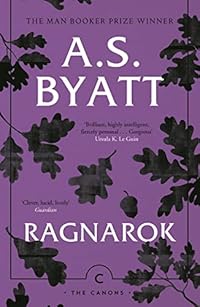
 Ragnarok cover

This is Byatt’s retelling of the myths of the Norse/Germanic Gods, an interest in which she had indulged during her childhood and rekindled often in the time since. As an author so many years later her entry into the tale is via “the thin child in wartime,” a child who may be a barely disguised version of the young Byatt, a child who reflects on the copies of Asgard and the Gods and Pilgrim’s Progress she had available to read.

That these myths should have resonated with the young Byatt is not too surprising. A child growing up during the Second World War (and who was convinced her father would never return from it) may well have thought the end times were upon her. Adults may have thought so. The contrast with Christian mythology – so milk and water in comparison – perhaps presented the greatest interest. As the child reflects, “It was a good story, a story with meaning, fear and danger were in it, and things out of control.”

It is in the nature of the beast that a myth has to be told. Hence we are not shown anything here except, perhaps, in the sentences relating to the thin child. As Byatt says in her “Thoughts on Myths” afterword, Gods do not have psychology, they have – at most – attributes. Hence in the main body of the book incident is piled on incident. Things happen; but they have a driving force. “Stories are ineluctable. At this stage of every story, something must go wrong, be awry, whatever the ending to come. It is not given, even to gods, to take foolproof, perfect precautions.”

Ragnarök (the word is always spelled this way in the text but in the title has no umlaut) means judgement of the gods; judgement as in trial, not sagacity. For her notional thin child and for Byatt herself the bleak end to the Norse tales is more satisfactory than a return to, or a resurrection of, what had gone before (with which some cleaned up versions end.) “This is how myths work. They are things, creatures, stories, inhabiting the mind. They cannot be explained and do not explain.” In this they may be the opposite of novels, which by and large do.

Some new words to me were eft, gage – as in a gage of honesty – and chaunting as a (not very opaque) variant of chanting but for Pedant’s Corner we had a shrunk count of 1, plus iceflo without its terminal e, stove in (staved in,) and beseeched (besought.)

free hit counter script