Archives » Andrew Crumey

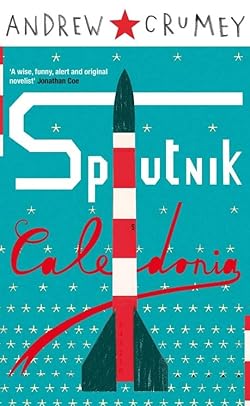
Sputnik Caledonia by Andrew Crumey

Picador, 2008. 553 p.

In the first part of the novel a shy boy called Robbie Coyle is growing up in a village called Kenzie in 1960s Scotland with the ambition of going into space. Since his father is an ardent socialist and anti-American Robbie therefore wants to be a cosmonaut. A frequent attender at his local library, he devours knowledge about the Soviet Union and discovers that “Russian is a language where some letters are written back to front and others are completely made up.” Quotes such as this display Crumey’s excellent ability to inhabit the world of a pre-adolescent. As he matures he starts to hear a voice in his head. The section ends with that voice saying, “I guess we’re not in Kenzie any more.”

The story then flips into a scenario of a Soviet-style Britain where a young adult Robert Coyle has been recruited into a space project to reach, before the wicked capitalists do so, what is possibly a black hole travelling through the solar system. The secret “Installation” where Robert is in training is suitably grim, the illustrations of the many compromises people have to make in such a society convincing, though whether dissidents could flourish there is another question. Perhaps this exists in the same British Democratic Republic which featured in the author’s Mobius Dick.

This central section could be considered an Altered History novel where the Jonbar Hinge lies in whether or not a man named Deuchar died while trying to rescue twins from drowning many years before the time the action is set. Yet its juxtaposition with the preceding and following parts, set in the “real” world, argues against this. And Crumey’s treatment of his subject matter does not have the feel of SF. The Soviet section can be read to be implicitly a figment of Robbie’s imagination. The subtlety of the point of divergence also marks this out from SF treatments of Altered Worlds. While Crumey pushes credibility a little by having characters in the central section behave and speak, or have the same names as, those in the book-end segments he does certainly avoid the trap into which Philip Roth fell in The Plot Against America of restoring the altered world to normal by the end.

The coda, a (present day?) exploration of the situation of Robbie’s ageing parents and a young boy who meets a mysterious stranger on a mission (which he is unwilling to explain) provides counterpoint and a resolution of sorts.

Sputnik Caledonia is excellently written and engaging, with convincing characters, but not quite as full of verve as Mobius Dick. I will look out for more Crumey, though.

Mobius Dick by Andrew Crumey

Picador, 2004, 312p

This book was not marketed as Science Fiction but in any straightforward reading of the term would be so, as it is fiction about Science, specifically quantum mechanics and wave functions. Science Fiction as understood, though, is not generally thought of in this light but rather as extrapolative. However, Mobius Dick fits the bill in this sense also, as its background involves a set of experiments to produce a vacuum array which can generate energies in excess of 1000 Eka-electronvolts which could lead to wave functions not collapsing on being observed and the end of the world as we know it. Fear not if you know nothing about the behaviour of subatomic particles, the necessary details are lucidly set out by Crumey in the appropriate places. (Or did I just find it lucid because I had encountered most of these ideas already? Studied them, even, when a student.)

The narrative is multi-stranded, beginning with an enigmatic text message to a physicist, John Ringer, reminding him of a lost love. Another strand is set in a hospital where patients are being treated for Anomalous Memory Disorder, AMD, a condition in which they appear to have false memories. A third contains extracts from a book by a certain “Heinrich Behring” but which is copyrighted “the British Democratic Republic 1954” and which focuses on Erwin Schrödinger. An Altered History too, then.

It is, as well, a consciously literary endeavour featuring in addition to the above; Bettina von Arnim, the composer Schuman and a letter from an unsuccessful Herman Melville to Nathaniel Hawthorne. No surprise it’s not marketed as Science Fiction. The John Ringer sections are Ballardian in tone and when he ventures into rural Scotland also have a tint of the testament of Gideon Mack, which I reviewed recently.

Crumey never pushes the connections between the sections. We are left to ourselves to infer that AMD is a manifestation of superimposed quantum states and the many worlds of uncollapsed wave functions. The characters, on opening doors etc, by and large treat any incursions into or from other worlds as if they are hallucinations, which interpretation is also entirely adequate.

The afterword, also by “Heinrich Behring,” like the sections featuring Schrödinger and Schumann, is written from the perspective of a world where Goebbels replaced Hitler, Britain was invaded but after liberation became a socialist/communist state and neither Melville nor Thomas Mann achieved critical acclaim. “Behring” depicts Schrödinger – who never amounted to much in this altered history – finding his famous (in our world) equation HΨ = EΨ in the scribblings of a madwoman.

What makes Mobius Dick ineluctably Science Fiction (whether it is labelled as such or not) is this looking in at our world, where a woman can become Britain’s PM, an actor President of the US and the many worlds theory is taken seriously, and finding it absurd.

But to label the book at all is to do it an injustice. It hums with ideas and wit, and not a few literary puns.

I haven’t been so impressed by an author new to me for a long time.

free hit counter script