Archives » Other fiction

Child of Fortune by Yūko Tsushima

Penguin, 2023, 182 p. Translated from the Japanese, 寵児, (Choji,) Kawada Shobo Shinsha, 1978, by Geraldine Harcourt

Kōko is a divorced mother of eleven-year-old daughter Kayako. She is struggling with her life and her job giving piano lessons is not really enough to sustain them both. For this and other reasons Kayako has moved in with her Aunt Shōko, Kōko’s sister, who thinks of herself as the responsible sibling. Kōko’s memories of her handicapped brother who died when he was twelve colour her feelings towards both Kayako and Shōko. Since her relationship with Kayako’s father, Hatanaka, ended, she has had a long-standing (but now finished) affair with Doi, with whom she also became pregnant but aborted the child. She now feels she would have liked a child to Doi but has embarked on an on-off liaison with Hatanaka’s friend Osada, who acted as intermediary between him and her.

Child of Fortune is a portrait of a woman pulled and pushed between her past and present, and the future she devoutly wishes but is somehow unable to grasp, acutely conscious of the way in which society views women like her. The signs of pregnancy she notices precipitate her crisis.

The novel, though unmistakably Japanese, is not specific to Japan. Kōko’s troubles could be those of a woman anywhere in a judgemental world.

Pedant’s corner:- Dialogue which Kōko remembers is indicated by dashes, in the novel’s “present” (written in the past tense) it is rendered in the usual way. There was also a missing comma before one piece of direct speech.

Best of 2025

Only twelve works are on my best list this year; eight by women, four by men. Five were in translation – plus two more if you count Elif Shafak.

Troubling Love by Elena Ferrante

Queen Macbeth by Val McDermid

Hex by Jenni Fagan

Under the Glacier by Halldór Laxness

The Flea Palace by Elif Shafak

The Voyage Home by Pat Barker

The Photograph by Penelope Lively

One Day in the Life of Ivan Denisovich by Alexander Solzhenitsyn

The Bastard of Istanbul by Elif Shafak

Shanghai Nights by Juan Marsé

The Children of Jocasta by Natalie Haynes

Death and the Penguin by Andrey Kurkov

Gliff by Ali Smith

Hamish Hamilton, 2024, 280 p.

Even without reading a word, a glance at the interior of this book would immediately let you know it is by Ali Smith. It has her usual unjustified right margin, giving the text a ragged appearance, the Sabon MT Pro font, and the uncapitalised section titles (here horse, power, lines) rendered in bold type.

As to the novel itself, it is a kind of follow-on to Smith’s Seasons quartet (quintet if you include Companion Piece)  Set in an unspecified future in an apparently authoritarian state (though one never explicitly spelled out as such) where people can be designated UV (unverifiable) it tells the story of Briar (Bri, the non-binary male who narrates it) and their sister Rose.

Their mother kept them off-grid, therefore unverified. She refused them smartphones, told them, “There are different realities, and the net is a reality with designs on general reality, and I’ll prefer it if you both experience the real realities as your foremost realities.”

They had lived with their mother and her man friend Leif before their mother left to look after her sister’s interests. After visiting her one day, they come home with Leif to find the house surrounded by a red painted line, rendering them personae non grata. They have to leave in their campervan. That night the campervan also has a red line painted round it while it is parked. Leif takes off, ostensibly to find their mother and the siblings are left to fend for themselves.

As they are travelling the pair come across a field with horses in it and are accosted by a boy named Colon who says the horses belong to his father. Colon notices their bare wrists and wants to know where their educators are (pointing to where his is) and is confused when they say they don’t have any.

In a later encounter Colon’s brother, Posho, spouts all sorts of mysogynistic nonsense to Rose but lets her know of the Adult retraining centres, Arks, and child retraining centres, Circuses, where the unverified are set to work, on “majorly foul jobs” and, if they refuse, they disappear. Rose takes to one of the horses, calling it Gliff (a word meaning glimpse, or glance, a fright, a brief moment or a gleam of light – or everything and nothing at the same time.)

In later sections it becomes clear Bri is narrating this in retrospect when he has been separated from Rose but accepted into the authoritarian system and is trying to subvert it from within.

Gliff is a propulsive book about forced alienation and the difficulty, as well as the need, to resist it.

The people who need to read Gliff almost certainly won’t. The people who do read it will most likely be convinced of its message before they do.


Pedant’s corner:- No entries.

Death and the Penguin by Andrey Kurkov 

Harvill Press, 2001, 234 p. Translated from the Russian Смерть постороннего (Smert’ postoronnego; Death of a Stranger) by George Bird

This book is an example of why I find translated fiction so attractive. It is difficult to see its premise appearing in a book by an Anglophone author.

Viktor Alekseyevich Zolotaryov lives alone – except for a king penguin named Misha. The local zoo in Kyiv had been giving animals away to anyone who could feed them and Viktor obliged (with fish he keeps in his freezer.) Misha has an enigmatic existence in the book, wandering about the flat lugubriously. But his presence is treated matter-of-factly. No-one bats an eyelid at him: all accept the situation as normal.

Viktor has aspirations to being a writer or at least to seeing his writings in print. Opportunity comes his way through a man called Misha (to prevent confusion referred to as Misha-non-penguin.) This Misha has a murky background but puts Viktor in touch with the editor of a paper for whom he is to write obituaries of people of VIP calibre, from State Deputies to Ministers and factory managers, people who were shady in some way but not liable to normal justice – either through immunity or corrupt judges. After a few of the subjects have died it becomes clear to Viktor that his pieces are the basis for a hit list by an organisation he has no clue about.

Then he is left in charge of Misha-non-penguin’s daughter Sonya, after her father has to disappear for a while, leaving Sonya a large sum of money. Eventually Viktor hires a nanny, Nina, for the child, and she, Viktor and Sonya in effect become a family.

Warnings come from the paper’s editor to lie low for a while and as a result Viktor thinks he may be being followed: Sonya and Nina definitely are. Viktor’s reactions to this read as a hangover from the Soviet era. He knows instinctively what to look for to discern someone  tailing him.

In the meantime he is prevailed on to attend the funerals of some of his obituary victims. Accompanied by Misha, he does so. Soon Misha becomes a desirable accessory at burial ceremonies. Where in an Anglophone novel would anything so bizarre as this appear?

A touch of meta fiction intrudes when Viktor confronts the “fat man” who has been following Sonya and Nina, and he is given his own obituary to read. “His contribution to the political history of Ukraine may well become a subject for research not only by a Committee of Deputies, but by his fellow writers also. And who knows, a novel on that theme may enjoy a longer and more successful life than that of Viktor Zolotaryov.” Is this an invitation to assume that Death and the Penguin is that novel?

However, Misha has become ill and needs a heart transplant. For which the heart of a three to four year old child would apparently be suitable. Viktor arranges for the operation and also to transport Misha to the Ukrainian research station on Antarctica.

Kurkov’s treatment of this surreal scenario is resolutely straightforward; there are no flights of fancy, no purple prose. This, of course, only heightens the surreality of the scenario. Or is the perception of that surreality a result of being a reader from a country whose history has not been authoritarian nor overtly corrupt?

Note: this edition uses the pre-Russian invasion spellings Kyev, Kharkov, Odessa, Donyetsk and Lvov rather than the now preferred Kyiv, Kharkiv, Odesa, Donetsk and Lviv.

Pedant’s corner:- a missing comma before a piece of direct speech, a missing end quotation mark after a piece of direct speech, two new paragraphs were unindented, “where he came from and he was after” (where he came from and what he was after,)

All Passion Spent by Vita Sackville-West

Virago, 1990, 303 p, including xii p Introduction by Victoria Glendinning. First published in 1931.

When the book opens, Lord Slane, former Ambassador, Viceroy of India and an ex-Prime Minister, has just died. His – mostly unappealing – children gather round to dispose of the estate and decide on what rotation to house their mother in her widowhood. Lady Slane (now the dowager Lady, I suppose,) has other ideas. After a lifetime of following her husband’s path, dutifully performing her roles as Ambassadress and Vicereine, she has no desire to conform to their wishes. Instead, she will take a house in Hampstead – one she saw years ago and has always hankered after.

As a youth she had seen a future for herself as a painter but Henry Holland’s marriage proposal had put an end to that. In the Hampstead house she remembers her confusion at the proposal and the swiftness with which her parents and sisters welcomed it; “never had the rays of approval beaten down so warmly upon her.” But “there was only one employment open to women.” (That would certainly be so for women of her class.)  And the painting never materialised. Ruefully she had reflected that, “It would not do, in such a world of assumptions, to assume she had equal rights with Henry.”

With Genoux, her French maid, she passes the time in Hampstead with desultory visits from her children but more frequent ones from Mr Bucktrout, the housing agent who let it out to her, Mr Gosheron, a builder necessary for renovations, and Mr FitzGeorge, a connoisseur whom she had met in India decades ago and who still holds a torch for her, but withholds that information, with all of whom she has more common ground than with her children. She feels more affinity with her great granddaughter, Deborah, who desires to be a musician and will – perhaps – have more chance of pursuing a career than she did.

Indicative of the times, Lady Slane’s thoughts on her life at one point touch on, “Labour, that new and alarming party.”

Though Sackville-West apparently disliked the term this is undoubtedly a feminist book -outlining as it does the constrictions women endured in the Victorian and Edwardian eras, freed from them only when old age and a husband now gone finally allowed.

Pedant’s corner:- In the Introduction “Keats’ house” (Keats’s house,) concensus (consensus.) Otherwise; “the French government were sending a representative” (the French government was sending,) “a Cabinet Minister of England” (there is no – and never has been an – English Cabinet. That system of government was only introduced well after the formation of the UK in 1707,) “in Genoux’ imagination” (Genoux’s – which was used later. In any case, Genoux surely is not even pronounced with a terminal ‘s’ hence its possessive must have one. There was also a later instance of Genoux’,) “oblivious of” (oblivious to,) “‘me who love him better than anything in heaven or earth’”  (‘me who loves him’ seems more natural,) tight-rope (nowadays ‘tightrope’,) “Keats’ house” (Keats’s house.) Balmy (it meant ‘slightly off his head’, so: Barmy,) “a confidant” (the confidant was female, so ‘confidante’.)


The Children of Jocasta by Natalie Haynes

Mantle, 2017, 344 p, including 1 p Author’s Note, 7 p Afterword and 2 p Acknowledgements.

Greek myth is still a fertile ground for novelists. Both Madeline Miller and Pat Barker have recently revisited the Trojan War from the perspective of hitherto minor characters. This book is Haynes’s take on the three Theban plays of Sophocles (though in her Afterword Haynes tells us each play is in fact a sole survivor of three different trilogies written decades apart) and tells the stories of Jocasta (or Epicaste,) Oedipus and their children.

After the Prologue, set many years before the main narratives during a time of plague known to the characters as the Reckoning, we are given two interleaved viewpoints; a third person account focused on Jocasta and a first person one as written by her youngest daughter, Ismene.

The start of Jocasta’s tragedy is that at fifteen she is made to marry the King, Laius, even though he is ten years older than her father. Laius then proceeds to ignore her (in this account he prefers men) and the necessary heir is provided by his attendant, Oran, but the boy child is taken away at birth with Jocasta told he did not survive by Laius’s maidservant Teresa.

This is where the prophecy of which Laius is so afraid – and on which the whole story depends – (that he will be killed by his son,) for me unravels, since the boy is not Laius’s. I doubt it was Haynes’s intention to undermine the legend and she is free to put whatever spin on it she wishes especially since the sources she is drawing on do not all agree with each other on the details. Nevertheless, it is a noteworthy discrepancy. Then again, and the point is made in the text, Greek oracles were notoriously imprecise. But the prophecy concerned seems much more clear cut.

When Oedipus turns up at Thebes with the news of Laius’s death Haynes makes his part in that much softer and inadvertent than the myth would have it – though it is only his word we have for it – and he is presented throughout as a sympathetic character. And what evolves is also his tragedy as much as Jocasta’s.

Four children later (Polynices, Eteocles and Antigone along with Ismene,) the Reckoning returns and the people of Thebes look for blame, finding it in the thought that Oedipus, coming as he did from the not to be trusted Outlying, the lands beyond Thebes, is indeed the son taken from Jocasta many years before and that their relationship is thereby incestuous. Here Haynes allows the reader room for doubt about Oedipus’s parentage, the question remains open, possible but not proved. Moreover, Jocasta’s subsequent suicide is not shown as an act of guilt but rather one of sacrifice as she recognises signs of plague in herself and wishes not to pass it on to her children.

On her death the kingship passes to her two sons by Oedipus. In Ismene’s account they have been rotating possession of the office yearly. But their uncle Creon, Jocasta’s brother, is a jealous man bent on revenge for one of Jocaata’s actions during the Reckoning and also on achieving the crown for himself. Further tragedy is inevitable.

Haynes evokes the world views and belief systems of the ancient Greeks all but effortlessly. The source material is all an author could wish for by way of inspiration, containing as it does love, jealousy, ambition, betrayal; perennial themes in literature.


Pedant’s corner:- hisown (his own,) facethe (face the,) brotherwould (brother would.) Thecity (The city,) Jocastaand (Jocasta and.) There are more examples of words inexplicably run together like this. Helios’ (Helios’s,) “the scene of my both my brothers’ deaths (omit that first ‘my’,) “staunch my tears” (stanch,) Polynices’ (Polynices’s.) In the Acknowledgements: Oedipus’ (Oedipus’s,) “an audience who doesn’t know” (an audience which doesn’t know,) Sophocles’ (x2, Sophocles’s.)

Runaway Horses by Yukio Mishima

In The Sea of Fertility, Penguin, 1987, 247 p. Translated from the Japanese 奔馬 (Homba,) Shinchosha Company, 1960, by Michael Gallagher.

It is the early 1930s, a time of political uncertainty and assassination in Japan. Thirty-eight year old judge Shikeguni Honda comes to believe Isao Iinuma, a promising practitioner of kendo and also the son of a former tutor of Honda’s teenage friend Kiyaoki Matsugae whose unfortunate life was portrayed in Snow Country, is in fact Kiyaoki reincarnated. This is a thought Honda keeps to himself, though.

Nevertheless he takes an interest in the young man, who after one conversation gives him a booklet titled The League of the Divine Wind. This chronicles a failed revolt in the eighteenth century of a group of that name who felt the Western influence on Japan was inimical and ought to be overturned. Unfortunately, they believed only swords were suitably condign weapons to enact the divine will and so fell to defeat. In that revolt’s aftermath one of its leaders is said to have given voice to the spirit of the Samurai: “Were we to have acted like frail women?”

This incident is an illustration of the tension that existed in Japan between the traditional and the modern and which was in many ways Mishima’s overriding concern. At one point a minor character says, “‘That’s just how things are here in Japan. All one has to do is plunge one’s hand in, intent only on a bit of amusement, and there’s a poisonous snake in there waiting.’”Iinuma also hatches a plot, this time to kill the men whom he believes are leading Japan to ruin, or at least to a neglect of the old ways. When this, too, fails due to the authorities getting wind of it (not through one of the co-conspirators though) Honda gives up his judge’s job to defend Iinuma.
The political background appears from time to time in conversations but is never foregrounded but still the forces which would propel Japan into conquest – and ultimate disaster – are in evidence. The adventure in Manchuria, about which some of the characters have misgivings, is about to begin.
Mishima’s sympathies seem to lie with the traditionalists and Iinuma’s desire for purity and unease at the Japan in which he lives perhaps matches the author’s own.

Pedant’s corner:- Translated into USian. “In 1933, the third year of the Genko era” (the third year of the Genko era was in 1333,) a missing comma before a piece of direct speech, “‘one should keep them until lay them reverently on the family altar’” (is missing some words between ‘until’ and ‘lay’,) “the cry of cicadas” (cries of cicadas surely?) “England’s going off the gold standard” (Britain that would be, not England,) hiccough (there’s no such thing. It’s a hiccup,) “it’s being not all likely” (it’s being not at all likely,) “a green finch” (a greenfinch,) “scarlet-leafed forest” (scarlet-leaved.) Benzine (petrol,) “somewhat tasteless” (somewhat distasteful,) “having spent the New Year’s in a police cell” (having spent the New Year in a police cell.) “The whistle of a freight passing through Ichigaya Station” (of a freight train – though in British English that’s ‘goods train’,) “the groans … had nothing of kendo about it” (the groans … had nothing of kendo about them,) “but these was limited to” (these were limited to,) “none of those … were” (none … was,) “with his fingertips of his left hand” (with the fingertips of his left hand.)

The Return of the Soldier by Rebecca West

In Virago Omnibus II, Virago, 1987, 90 p plus 9 p Introduction. First published in 1918.

On reading this I remembered watching a dramatised adaptation of the story at some point in the past. Not that it mattered: only the broad outlines were familiar and it’s the detail that counts.

Our first person narrator, Jenny Baldry, lives at Baldry Court at Harrowweald with Kitty, the wife of Jenny’s brother Chris. Life there is saddened by both the absence of Chris, away at the Western Front, and remembrance of his dead son. Thinking of Chris Jenny tells us of “That detached attention, such as an unmusical man pays to good music, which men of anchored affections give to attractive women.”

Jenny’s and Kitty’s relatively tranquil existence is disturbed by the visit of Mrs William Grey, once Margaret Allington, with the news that Chris is in hospital, not physically injured but suffering from shell shock (not actually named as such in the book and in any case now known as PTSD) and has lost his recent memory. He is convinced that he is in love with Margaret, whom he met over fifteen years ago and spent time with (remembered idyllically by him) at her father’s Inn at Monkey Island on the Thames, and only seeing her will satisfy him. His wife and son he remembers not at all.

The narrative is taut and claustrophobic, all three women’s behaviour restricted by the manners of the time, but notable for its focus on women affected by the Great War rather than the traumas of the trenches.

It’s also a little overwritten – and tinged by snobbishness “Wealdstone … the name of the red suburban stain which fouls the fields three miles nearer London than Harrowweald,” “‘I fancy it’ll do for a person with that sort of address,’” “the doctor (a very nice man, Winchester and New,)” with a touch of racism (“little yellow men”.)

As in that dramatisation the resolution seems a bit trite and too easily achieved.

Pedant’s corner:- plus marks for ‘rhododendra’, a missing comma before a piece of direct speech, “with her head one one side” (on one side,) “cottage ornée” (cottage orné,) “She brought the punt across the said very primly” (across then said,) “‘something here that many interest you’” (that may interest you,) “I slid off the tree-truck” (tree-trunk makes more sense,) “to staunch a wound” (it’s ‘stanch a wound’.) “For it we left him in his magic circle there would come a time” (For if we left him in.)


Shanghai Nights by Juan Marsé

Vintage, 2007, 202 p. Translated from the Spanish El embrujo de Shanghai (Plaza & Janés, 1993,) by Nick Caistor.
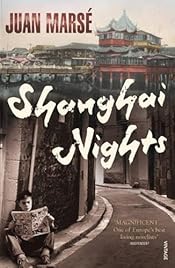
There is a certain quality to translated fiction – or at least to the best translated fiction – which marks it out. That sense of subtle strangeness, other ways of seeing, perhaps even other ways of being, and yet, reading it, the essential qualities of human interactions still shine through.

Shanghai Nights is set in Barcelona in the immediate aftermath of the Second World War and both that conflict, and more importantly the then also recent Spanish Civil War, hang over the book, an understated but permeating presence.

Narrator Daniel is a young adolescent whose father never returned from that Civil War, and several of the characters are subsumed by it, most obviously Captain Blay – called the Invisible Man for the bandages he wears to conceal his wounds but also Nandu Forcat, on whose initial furtive appearances everyone expects to be arrested at any moment. How much more so for those characters who are, or have been, in exile in France, at least one of whom is exiled permanently.

Blay is obsessed by a smell he attributes to a gas leak underneath a local pavement and ropes Daniel in to help him canvas for signatures on appetition against the leak and a chimney which spouts noxious smoke. Blay’s ineffectiveness is such that only about 14 people ever sign up.

Daniel falls into the orbit of Señora Anita’s daughter Susana, a consumptive (Marsé makes frequent mention of the Koch bacillus) girl whom Blay wants Daniel to draw as a victim of the smoke from that chimney but whom Daniel sees in a different light. She is the daughter of Joaquim (Kim) Franch, one of those exiles.

Forcat worms his way into Señora Anita’s graces and apparently has some sort of healing/heating powers. He begins to tell Susanna and Daniel a tale of her father’s adventures in the Far East, sent to Shanghai by the exiles to kill a man suspected of being a German Colonel guilty of war crimes in France and to retrieve a book with yellow covers, a book with revealing secrets. This is a lurid tale of unlikely encounters and an attractive Chinese woman named Chen Jing. It is sometimes couched in racial terms, (lousy chink, slant-eyed, a blackamoor) and clichés (dresses slit to the waist.)

Doubt is cast on this story by the appearance of Luis Deniso Mascaró (‘Denis’) a returned exile who has a grievance against Kim and whose revelations and influence alter Susana’s life.

This is a fraction of the contents of a book full of vivid characters such as the above as well as Blay’s wife, Doña Conxa, and the Chacón brothers, and which builds to a climax which is at once sordid but touched with nobility, and entirely true to its essence.

In it we read “everything passes, and it is all exactly the same, masks and the faces beneath, sleep and waking” and “however much we grow and look towards the future, in fact we are reaching back towards our past, in search perhaps of our first moment of awareness.”


Pedant’s corner:- “vocal chords” (vocal cords,) focused (focused,) “‘Denis’s’ parents’ home” (several times the possessive of ‘Denis’ appeared as ‘Denis’s’, surely it must be ‘Denis’’s,) “the waitress’ skirt” (waitress’s skirt,) “to smoothe down” (x 2, smooth down,) “fo’castle” (either ‘forecastle’ or ‘fo’c’sle’, not fo’castle,) “you’ll know you seen so much” (you’ve seen so much,) (Captain Tu Szu’s words” (elsewhere the Captain is always Su Tzu,) “to traffick arms” (to traffic arms,) “shammy leather” (technically it’s chamois leather.) “He was in the Peace Hotel can remember” (He was in the Peace Hotel and can remember.) “It is true then that …….. betrayal?) (Is it true then that …….?) “Contrary my mother’s expectations” (Contrary to my mother’s expectations.)

 

The Longings of Women by Marge Piercy

Penguin, 1995, 541 p.

I bought this because Piercy normally writes SF (or what can be interpreted as SF) but this is a contemporary mainstream novel – for 1998 values of contemporary.

This is the intertwined tale of three women living in Boston, Massachusetts; Leila Landsman, Mary Burke and Becky Burgess. Leila is a professional woman, a college teacher whose theatre director husband has an ongoing philandering streak, serially having affairs with his – always younger – leading ladies.  Mary is Leila’s cleaner but had lived a reasonably comfortable existence until her marriage broke down: she is now homeless but conceals this from her cleaning agency employers and the clients whose houses she cleans. Becky is a working-class woman who has pulled herself up from her origins by getting an education, for which her family made sacrifices, a desk job at a media company and a marriage to Terry, a man of rather better off means but who is lazy as a result and suffers from an unjustified sense of entitlement.

Leila’s and Becky’s lives intersect when Leila is asked to write a book about the court case in which Becky is accused of murdering her husband with the assistance of her teenage lover, Sam Solomon. Becky’s treatment by the press has been unrelentingly critical.

Leila’s and Mary’s stories are unfolded in the present of the novel (with flashbacks memories of their origin stories,) Becky’s is given to us in chronological order as it occurred. This has the effect of presenting us with different pictures of Becky from the two time streams. At first Mary’s story also seems to be divorced from that of Leila but does give us an alternative perspective on her life.

Mary’s is a salutary tale, about how easy it is to fall from security, how necessary it is not to appear homeless – especially when you are. She sleeps where she can – airport lounges, empty buildings – but preferably in her client’s houses when they are away from home and is eternally grateful to the (black) woman who showed her the ropes of homelessness, the ways to avoid danger, when she first arrived on the streets.

There is a degree of character development to Leila as her marriage disintegrates slowly then precipitously. Mary, perhaps hardened by the streets, undergoes less change. Becky’s descent into murderousness is not quite so convincing, though.

This is a decent enough novel which doesn’t reach the heights of Piercy’s earlier books Body of Glass and Woman on the Edge of Time.

Pedant’s corner:- thier (their,) “less alternatives (fewer alternatives,) “Mrs Coreogio” (elsewhere always ‘Coreggio’,) “they dozed of to” (dozed off to,) blond (blonde.) “‘I’m wondering if Sam will remind me of him in person is much as he does when’” (in person as much as he does when,) “cole slaw” (coleslaw,) rendez-vous (this was in the middle of a line, no need for a hyphen; rendezvous,) “Sorts Illustrated” (Sports Illustrated?) “had interviewed murderers and battered woman” (battered women.) “‘I’ll never seen you again’” (never see you again,) “happy to be notied” (noticed.) “They’d hadn’t an ambition among them” (either ‘They’d hadn’t had an ambition’ or ‘They’d hadn’t an ambition’,) “none of the three families were communicating” (none of the three families was communicating,) “in her own behalf” (on her own behalf,) ambiance (ambience.)

free hit counter script