Archives » Reviews published in Interzone

Interzone 278 (Nov-Dec, 2018)

TTA Press

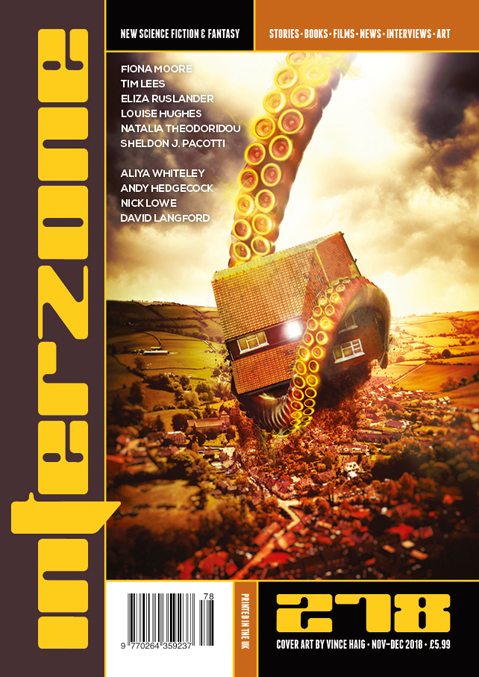
Interzone 278 cover

Tim Lees takes the guest Editorial where he ponders truth and realism in fiction and welcomes more inclusiveness – more truths – in SF. Andy Hedgecock’s Future Interrupteda wonders about the preponderance of negative perceptions of crowds in SF – and more generally – compared to their positive potential. Aliya Whiteley fills the gap left by Nina Alan’s columnistic departure in Climbing Storiesb, arguing that SF tales have no set structure like romances or horror stories do. Instead SF steals from everywhere. In Book Zonec Tade Thompson laments the failure of The Evolution of African Fantasy and Science Fiction edited by Francesca Barbini to treat African Sf&F on its own terms rather than Western ones, Daniel Carpenter says Aliya Whiteley’s The Loosening Skin will haunt the reader long after it is read (and also interviews the author,) John Howard appreciates Gary Westfahl’s reappraisal of Arthur C Clarke in the latest Modern Masters of Science Fiction series, Val Nolan discusses Christopher Priest’s “September 11th” novel An American Story, Duncan Lunan finds The Song my Enemies Sing by James Reich enjoyable hard work – up to a point – and considers carefully E M Brown’s Buying Time, I characterise Death’s End, the culmination of Cixin Liu’s Remembrance of Earth’s Past trilogy, as a bracing intellectual tour-de-force but emotionally unsatisfying, Andy Hedgecock finds Adam Roberts’s By the Pricking of her Thumb too self-indulgent, Stephen Theaker says Unholy Land by Lavie Tidhar is quite terrific – a corker – and Hazards of Time Travel by Joyce Carol Oates to be heavy-handed satire but arguably what this moment needs.

As to the fiction:-
Soldier’s Things1 by Tim Lees tells of a soldier invalided out from an ongoing conflict journey back home only to find nothing familiar, his memory untrustworthy – about anything.
In Doomed Youth2 by Fiona Moore an infestation of giant ants occurred sometime in the 1950s with intermittent rises and falls in their population ever since. The story is supposedly narrated by a Chinese American called Kara Chong in a chatty style that didn’t sit well with the content. The background of a world elsewhere falling apart has led to distrust of foreigners.
The Path to War3 by Louise Hughes sees a storyteller whose audience finds her lacking take a mountain path between two newly-warring countries (after a litany of wars) rather than the coast road in the wake of the army.
In Heart of an Awl4 by Eliza Ruslander an AI that was a car is bequeathed its owner’s body after his death. It and his widow go on a road trip.
Zero Day5 by Sheldon J Pacotti is the story of an off-duty cyber soldier who meets a girl on a bus. Tracking her later online he misses the big cyber attack.
The SF premise of Birnam Platoon by Natalia Thoeodoridou is much the same as that of Green Troops by William King, ie the development of soldiers capable of photosynthesising by themselves. This lot take their mission of promoting world peace seriously though. The story is framed via the post-war trial of one of their commanders for war crimes.

Pedant’s corner:- aZamyati’s (Zamyatin’s.) b“in the same way that there are” (in the same way that they are,) Roberts’ (Roberts’s.) cMaurits’ (Maurits’s,) “And it’s becoming clear is that” (and what’s becoming clear is that,) Roberts’ (Roberts’s,) 1fit (fitted,) 2“I made a final effort” (“I finally made an effort” makes more sense,) “someone beating a tympani” (tympani is plural, one of them is a tympanum.) 3snuck (sneaked,) “stood like marketplace crowds” (standing like marketplace crowds.) 4Written in USian, “she pulls up the hand break” (hand brake.) 5Written in USian, “and diffuse the situation” (defuse.)
Interzone 280 Has Arrived

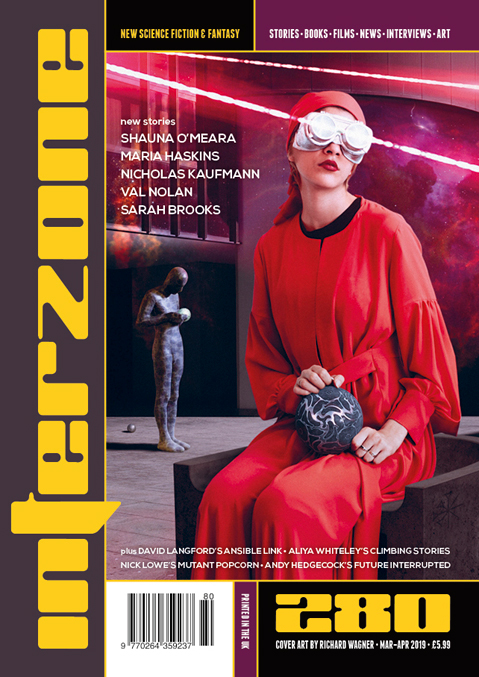
Interzone 280 cover
The Orphanage of Gods cover

On the doormat this morning: Interzone 280.

This one contains – among all the other goodies – my review of The Orphanage of Gods by Helena Coggan.

My review of The City in the Middle of the Night by Charlie Jane Anders, due in issue 281, has been despatched.

Interzone 277

Sep-Oct, 2018. TTA Press

In her guest editorial Aliya Whiteley wonders who owns a story as influences can colour story telling as if by osmosis. Andy Hedgecock’s Future Interrupted notes a new approach to doorbell ringing by those under 25 in his consideration of the changes wrought by the internet and the false sense of agency fostered by advertisers and data brokers. Nina Allan’s last Time Pieces muses on what a difference four years can make, in politics, in Doctor Who, in the inclusiveness of SF as a whole. In Book Zonea Duncan Lawie welcomes the wide perspective in the anthology Twelve Tomorrows edited by Wade Roush, Ian Sales appreciates Hannu Rajaniemi’s latest novel Summerland despite its lack of SF bells and whistles but is slightly more critical of Liminal by Bee Lewis, I wax lyrical over Francesco Dimitri’s The Book of Hidden Things but less so with Supercute Futures by Martin Millar, John Howard approves of the anthology Infinity’s End edited by Jonathan Strahan, Andy Hedgecock describes Literature® by Guillermo Stitch as a promising debut and Julie C Day’s first collection Uncommon Miracles (can there be common miracles?) as not merely promising but astonishing while Stephen Theaker enjoyed Pasi Ilmari Jääskeläinen’s Secret Passages in a Hillside Town.

In the fiction:-
Inscribed on Dark Waters by Gregor Hartmann has a student on a work experience programme on an ocean world at a factory producing liquid hydrocarbons biochemically being befriended by an inspector who has her own agenda. The student has an idea to improve the processing.
The Sea-Maker of Diarmid Bay1 by Shauna O’Meara is another sea-based tale. Four boys on a fishing expedition on a global-warmed, polluted planet come across a mythical creature, a sea-maker.
The narrator of Joanna Berry’s The Analogue of Empathy2 is a robot, a Cognitive Intelligence Personhood Emulating Robot to be precise. Doctor Harris is developing its – her – consciousness in an attempt to save humanity from itself. Since its structure, form and feel so closely resemble Daniel Keyes’s Flowers for Algernon I would be amazed if this story did not take its inspiration from that source.
Territory: Blank3 by Aliya Whiteley is a journal based story but the entries are presented to us out of order. Narrator Saffron enters one of the domes; simulated environments designed as entertainment for the masses. Either she goes mad or the domes generate inimical entities by themselves. The third explanation – that Saffron is the experimental subject – is vitiated by the manner of her second dome excursion.
Samantha Murray’s Singles’ Day4 – Singles’ Day is like Black Friday but only for the partnerless – is a multi-viewpoint tale of four winners of a Singles’ Day lottery (via Smile to Pay) for passage aboard a starship intended to travel through The Rift to the planet of Zorya to escape an overcrowded Earth. The story does not need the info-dump of its preamble.

Pedant’s corner:- aStokes’ (Stokes’s,) one book title is given as Infintiy’s End (the book’s cover has Infinity’s End,) Watts’ (Watts’s,) Dickens’ (Dickens’s,) “reflections on these parallel projects show remind us” (either show or remind, not both.)
1a missing comma before a piece of direct speech, vortexes (vortices,) miniscule (minuscule.) 2Harris’ (Harris’s,) terphthalate (terephthalate,) chassis’ (chassis’s.) 3“Each has their own way” (Each has its own way,) maw (it’s a stomach! Not a mouth.) 4“to not live,” “to not be,” (not to live, not to be,) “there were even a couple of birds” (there was even a couple,) fit (fitted.) “The latest crop were blooming” (the latest crop was blooming,) wracked with pain” (racked.) “The team of seven photographers were” (the team was.)

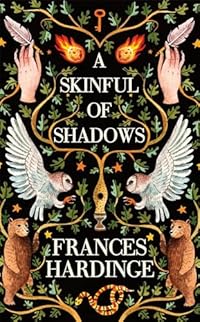
A Skinful of Shadows by Frances Hardinge

Macmillan, 2017, 423 p. Reviewed for Interzone 273, Nov-Dec 2017.

 A Skinful of Shadows cover

A YA novel with the usual quota of incident this is also a book written with a pleasing clarity and focus.

Makepeace Lightfoot is brought up as a Puritan in her aunt’s house in Poplar, sleeping on a straw mattress shared with her mother. More unusually her mother frequently forces her to spend nights in a church so that she might learn to ward off ghosts. Her lack of knowledge of her origins and the conflict this produces induces Makepeace to run off after a man her mother lets slip came from Grizehayes, her father’s home. This leads Makepeace into a mob heading for Lambeth Palace, protesting against the influence Archbishop Laud has over the King. In the confusion her chasing mother loses touch with her. Makepeace encounters wisps emanating from the body of a mistreated dancing bear, whose presence, as Bear, will be with her for ever. When Makepeace’s mother dies in the disturbances the classic ingredient for a children’s story, no parents, is in place but there is a moment of horror as Makepeace battles off her mother’s ghost.

Quickly packed off to Grizehayes, the ancestral seat of the powerful Felmotte family where the patriarch Lord Felmotte is a malevolent presence, calling her ‘the by-blow’, Makepeace is despatched to work in the kitchen where she befriends the domestic animals, despite Bear’s reluctance, and in turn is taken up by her half-brother James, another Felmotte by-blow who tells her a Felmotte’s character changes for the worse when he comes into his inheritance. While the reader has already divined the phenomenon it is only slowly that the extent of Makepeace’s genetic disposition – beyond the Felmotte cleft chin – becomes fully apparent to her.

That the waters we swim in colour our attitudes is indicated by Makepeace’s observation that, “Back in Poplar, everyone had known that the king was being led astray by evil advisers and Catholic plots. …. in Grizehayes it was just as obvious … that a power-hungry Parliament driven to frenzy by crazy Puritans was trying to steal power from the rightful King.”

Up to this point that background conflict seems only colouring but Hardinge integrates it into her plot with the revelation of the existence of a charter bearing the King’s seal acknowledging the Felmottes’ unique strangeness in return for their financial support.

The relatively kindly Sir Thomas Felmotte, who has not yet inherited, reveals to Makepeace, “‘There is a …space inside us. We can host more than ourselves.’” Makepeace realises, “‘We’re hollow. And dead things can get in.’” On death, the Elder Felmottes pass on their personalities to their chosen heir’s body, which acquires exceptional skills as a result. As Sir Thomas rationalises, “‘Imagine how great a family would be, if no experience, no skills, no memories were ever lost.’” The downside? Only the strongest personalities survive among the mix.

Makepeace ponders their toleration by the Elders and begins to understand the danger she and James are in, telling him, “‘We are spares,… somewhere to put the ghosts in an emergency!’”

The dispute between King and Parliament has by now erupted into full blown war, “The world was turning cartwheels … and nobody was sure which way was up any more,” providing Makepeace with the opportunity to flee when that emergency does arise. But James has meanwhile succumbed to Felmotte infiltration.

“Humans always betrayed you sooner or later,” Makepeace reflects, but embarks on a search for a way to restore James to himself and destroy the Felmottes forever. Along the way she incorporates a doctor, a Parliamentary soldier and a Felmotte sent ahead to take her over. These talk to her in a different, lighter font. Her travels take her to the King’s court at Oxford and capture by a Parliamentary detachment where she is accused of witchcraft. She speaks again to our times with the thought, “Humans are strange, adaptable animals, and eventually get used to anything, even the impossible or unbearable. In time, the unthinkable becomes normal.”

Towards the end Hardinge has a playful stab at the author/reader relationship with the doctor’s ghost’s rumination, “I am nothing but a bundle of thoughts, feelings and memories, given life by someone else’s mind. But then again, so is a book.”

The author’s touch is assured and her execution admirable. Apart from some dialogue which (arguably necessarily) doesn’t quite have a 17th century feel there is little to find fault with here.

The following did not appear in the published review.
Pedant’s corner:- Remarkably for these times I found only one typo, “she had had unexpectedly halted” (only one “had”.) Yes the book had a few examples of collective nouns being given a plural verb but these were in dialogue and therefore possibly true to the character – except for “a murder of Crowes were gathered around Lord Felmotte” (was gathered.) The phrase, “‘I had a ringside seat’” is hardly a 17th century expression, I’d have thought, and unfortunately we had an explosion occurring at an “epicentre” (centre.)

Interzone 278

Interzone 278 cover

The latest copy of Interzone has arrived. Issue number 278, Nov-Dec 2018.

This one does contain my review of Cixin Liu’s Death’s End the last in his Remembrance of Earth’s Past trilogy.

Despite my doubts about managing to meet the time scale (the book was over 700 pages long) the review obviously did arrive on time to be included.

Interzone 277, To Be Read

Interzone 277 cover

The latest issue of Interzone, 277, arrived last week.

As well as the usual fictional goodies and commentary on SF this one contains two of my reviews.

The Book of Hidden Things by Francesco Dimitri and Supercute Futures by Martin Millar.

The Switch by Justina Robson

Gollancz, 2017. Reviewed for Interzone 271, Jul-Aug 2017.

On Harmony, isolated from the rest of the Diaspora, balance is everything. It is ruled by a theocracy known as the Alchemy. Driven by its founder, Tecmaten, the Alchemy seeks to create, by non-technological manipulation of DNA, the pinnacle of human development; people called Exalted who have special powers. It teaches everything is twofold, arising from twinned energy flows; it preaches light must always be balanced by dark. Consequently it has a sister dark-side city, Chaontium, to which – since rejects must be treated with mercy – they are consigned.

Instead of a tidy sun and moon, one such reject, narrator Nico Perseid, a male homosexual, is composed of two suns. Even in Chaontium consummation of such sexuality is illegal as it would be a meeting of four suns and so burn through the fabric of reality.
We first encounter Nico when he is on trial for the murder of Chaontium gang boss Dashein VanSant, a rap for which he has been promised escape from the death penalty. This is not his first such deliverance. Chapter two flashes back to his childhood in Chaontium’s state orphanage where he met his lifelong friend Twostar Fae. They seized a chance to flee but Nico was hit by a car. Seemingly dead, he was revived by a bystander whom Twostar thinks was an Exalted. Nico, though, doesn’t believe in the theology of the Alchemy or its woo – “spooky bullshit nobody can prove”. In a kind of foreshadowing that is slightly over-egged he also occasionally sees a minotaur.

For Nico and Twostar life in Chaontium is a continual struggle till they are taken in by a gang. He is kidnapped by VanSant for a career in a variety of kickboxing which reads more like lethal cage-fighting. Under the guise of a wetware upgrade to prevent him dying in the ring Nico undergoes an operation to insert a pilot switch – provided by Twostar’s lover Tashin DeKalfu – a piece of Diaspora tech capable of synching with a starship; the only way out of Harmony except death. He wakes up to the murder charge and Tashin’s betrayal, the presence in his head of a Forged Interface, a Chimeric Avatar Switch, a Transhuman converter which can interface with anyone else and allows “Tek or Forged ships to pilot human or other biological avatars”. In other words, telepathy and remote sensing with a gloss of rationalisation.

An awful long time is spent on this set-up but from hereon in the focus is on Tashin’s agenda, the penetration of the Alchemy to try to prove it has been trading illegally offworld. Finally, we have the revelation of where and what Harmony actually is.

Nico is an engaging enough narrator, albeit overfond of expletives, but naturally impatient of the world he inhabits, “Cisnormativity. That isn’t even a word. It shouldn’t even be an idea. It should be destroyed in hellfire.” Despite his disparagement of woo and The Alchemical Wedding (the locus where mysticism, symbolism and reality meet to give rise to a new kind of being,) his encounter with the powers of mind of the Exalted and witnessing an apparent resurrection (or, “reanimation by goldlight intervention”) leads to some musing on the possibility of souls, of energy that exists above and beyond that of body and mind.

There is an idiosyncratic approach to chapter titling (One: is the loneliest number; Seven: sins; Three Threes – the charm; Light the Blue Touchpaper and Count to – Ten; Thirteen. Triskaidekaphobia can kiss my ass,) but these also give a flavour of Nico’s irreverent narrative style. There are times when the information dumping tends to be ad hoc but Robson has deployed a good coinage in the word datmosphere. There are some instances of odd syntactical choices, verb tense anomalies and phrases like “coins down the back of the sofa” and “Defcon One” which hauled me back out of Nico’s frame of reference into our own.

The setting is undeniably Science Fiction but, since the Exalted’s abilities are never truly explained hence might as well be magic, the whole seems an odd blend with outright fantasy and we don’t see enough of Nico’s early relationship with Twostar to make his enduring attachment to her entirely credible.

Fittingly there is a claustrophobic feel to the novel but it all feels rather breathless. Interesting but flawed, The Switch somewhat ironically suffers from a lack of balance.

Pedant’s corner:- a missing comma before a quote, (x 2,) “you do the math” (it’s maths,) ass (arse,) “a host of burning issues were eating him up” (a host was,) Daylus’ (Daylus’s,) “than I would’ve betted he could” (than I would’ve bet.) Dashein spelling varies with Dashain.

Future Reading Delight

No less than three future items of reading came through my letter box between yesterday and today.

 The Book of Hidden Things cover
 Shoreline of Infinity 12 cover

 Interzone 276 cover

Firstly Shoreline of Infinity 12 arrived yesterday – I know I’ve not yet read issues 8-11 but I will get round to them – then both Interzone 276 (which contains my review of Close your Eyes by Paul Jessup) and the latest novel for review in Interzone, The Book of Hidden Things by Francesco Dimitri. Mr Dimitri is another author new to me. An Italian writer of Fantasy, this is the first book he has written in English.

Interzone 275, May-Jun 2018

TTA Press

Interzone 275 cover

Steven J Dines’s Editorial describes the unlikely role of father figure which fiction took in his young life. Andy Hedgecoock takes over Jonathan McCalmont’s Future Interrupted column and hopes to continue his search for SF “that is of value and worthy of our time”. In Time Piecesa Nina Allan looks at the abiding relevance of Mary Shelley’s Frankenstein.

In Book Zone Maureen Kincaid Speller found herself disappointed and frustrated by Annalee Newitz’s Autonomous, Duncan Lunan reviews two anthologies edited by Mike Ashley Moonrise: The Golden Age of Lunar Adventures and Lost Mars: The Golden Age of the Red Planet welcoming some of the choices made and questioning others and laterb looks very favourably on Sisyphean by Dempow Torishima, Duncan Lawiec says he won’t persevere with any sequels to Tristan Palmgren’s Quietus, Ian Hunter findsd The Oddling Prince by Nancy Springer hindered by its first person narrative, Andy Hedgecock warmly welcomes Ursula Le Guin’s collection of non-fiction Dreams Must Explain Themselves, Stephen Theaker laments the enduring topicality of Middle-Eastern woes in his look at The Map of Salt and Stars by Jennifer Zeynab Joukhadar, Elaine Gallagher praises Kirsty Logan’s The Gloaming while I myself find Chris Barnham’s Fifty-One diverting and Andrew Crumey’s The Great Chain of Unbeing totally accomplished. Finally Ian Sales says the stories in the Australian Sean McMullen’s collection Dreams of the Technarion do what SF ought to as it contains a wide range of ideas thoroughly worked out.

In the fiction, Erika L Satifka’s The Fate of the World Reduced to a Ten-Second Pissing Contest is set in a bar which has been abducted into a gap in reality – contents, patrons and all – by aliens with a taste for alcohol.
In Looking for Landau1 by Steven J Dines a man wanders the earth in search of Landau, who introduces people to the gateway to the next world.
The Mark2 by Abi Hynes can be read as a comment on how women are perceived in some quarters as not quite being human. A member of a seemingly uniform far future community (where reproduction has been a technological process now failing) flees up a mountain to escape the consequences of deformity. It soon becomes apparent she has given birth and the bundle she is carrying with her is the child.
The Purpose of the Dodo is to be Extinct3 by Malcolm Devlin is a quasi-philosophical piece centred round a man who dies at the same time in every separate reality (though in different ways depending on each.)
The Christ Loop4 by Leo Vladimirsky is narrated by a Jesus who undergoes every kind of execution possible, and is debriefed after each one in order to discern which will finally be enough to satisfy God.
It is a bit odd that these last two stories both feature the multiple deaths of their main character.

Pedant’s corner:- adescendent (descendant.) bOne Day in the Life of Ian Denisovitch (Ian?) Star Trek – Next Generation (Star Trek – The Next Generation) cIain M Banks’ (Iain M Banks’s,) populus (populace.) d“will not except him as a son” (accept.) 1stood (standing,) focussed (focused.) “A pair of women’s panties sit on the crumpled roof” (a pair sits.) 2“They lay Uncle down” (laid.) 3Iron Bridge (Ironbridge,) “the manner of Prentis O’Rourke’s deaths were documented” (the manners …. were documented,) Mechano (Meccano,) busses (buses.) 4Written in USian, “if they just left all the other me” (all the other me’s,) a question mark at the end of a statement.

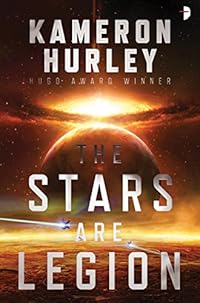
The Stars are Legion by Kameron Hurley

Angry Robot 2017, 397 p Reviewed for Interzone 270, May-Jun 2017.

The Stars Are Legion cover

Lit by an artificial sun, the worlds of the Legion hang in space. Massive orbs, they are living things covered externally by tentacles that simultaneously reach out but also offer protection to their world’s inhabitants. Their interiors are sticky and moist, biology taking the functions of such things as floors, walls and lifts. The worlds, though, are dying, with patches of rot blotching their surfaces. Beyond the misty veil that shrouds the sun lies the Mokshi, the only world to have moved out from the usual orbits of the Legion. As a result the Mokshi is an object of envy and conquest; but it is defended fiercely. Anat, Lord of Katazyrna, has a metal arm whose power is lost and she wishes to conquer the Mokshi in order to restore it and (literally) make a new world.

Each chapter here is prefaced by an aphorism by-lined, “Lord Mokshi, Annals of the Legion”. The narrative viewpoint, though, is shared between Zan and Jayd, once lovers, neither of whom are particularly sympathetic characters. At least twice as many chapters are devoted to Zan, who has lost her memory but is the only one of Katazyrna’s army ever to penetrate the Mokshi and survive. She is told she has made the attempt and returned many times.

The first set piece is a fairly standard piece of military SF as Katazyrna’s latest army attacks the Mokshi. However, the prospect this holds out of endless space battles is misleading. Hurley’s attention is more on the somewhat complicated relationship and backstory between Zan and Jayd.

It doesn’t take very long to work out that there are only women on these worlds. Hurley does not make anything of this – except in her afterword – it is merely a factor of this scenario, the society she has decided to portray. The mechanics of how their inhabitants become pregnant are obscure, though; even the mothers seem in the dark. Also, the birth products may be non-human, “Each world produces what it needs.” But in a strange mix of this magical-seeming biology with hi-tech, womb transfer can be effected surgically. Indeed we find Zan has donated hers and its contents to Jayd.

Neither does Lord Mokshi’s identity remain a mystery to the attentive reader, becoming obvious long before Hurley confirms it.

Interference from the forces of Bhavaja makes the attack fail and Anat decides on an alliance with these erstwhile enemies. To this end she arranges a marriage between Jayd and Rasida, Lord of Bhavaja. Jayd’s pregnancy is an important aspect of the deal. Bhavaja has not had a birth for some while. For a long time, to help Zan penetrate the Mokshi, Jayd has been working secretly towards this end.

The wedding is accompanied by a human sacrifice. This is only one of the many gory incidents in the book exemplified by Rasida’s despairing philosophy expressed later, “There’s no such thing as love in the Legion. There is birth and there is death. That’s all.” By this time Rasida has not kept her word, destroying Ana in the process, while Zan was thrown into Katazyrna’s recycler.

Which is where things begin to get bogged down. As well as what are in effect no more than monsters devouring the material to be recycled (Hurley seems to relish the details but they are oddly uninventive) Zan finds a woman living in the belly of the world, Das Muni, who helps her to escape to the next level.

The main body of the book is taken up with Zan’s journey up through the strata of the living world where the obstacles she meets are overcome perhaps a little too easily and she picks up another two handy companions.

One of Gene Wolfe’s prescriptions for writing fiction is that if your hero(ine) goes on a journey you must describe it. Well, there’s describing and then there’s overdoing it. The journey here is certainly important to the outcome as it provides Zan with clues to both her past (she has done all this before, remember) and future but it reminded me of the seemingly endless trek across the Ringworld in one of Larry Niven’s series of novels; it’s there more to show us the author’s invented world rather than advance the plot. Together with the emphasis on violence here that, for me, reduced engagement. It may be more to others’ taste.

The following did not appear in the published review.

Pedant’s corner:- “I change directions” (direction,) auroras (aurorae.) “The security crosses their arms and puts their backs to me” (its arms, its backs,) “a bevy …. begin” (begins,) “the whole of Katzyrna pour out” (the whole pours out,) in the hopes (in the hope,) maw in sense of mouth (sigh; it’s a stomach,) “a hunger than no meal can satisfy” (that no meal,) “fearful that the council will change their mind” (its mind,) the moths become less and less (fewer and fewer,) a missing start quote when a chapter began with a piece of dialogue, “I motion to Das Muni to lower the litter …… I motion to Das Muni to lower our own load” without the load being picked back up in the meantime, “I … try to see the where it’s fallen from” (no “the” needed,) “lined in row upon row” (by row upon row,) “if it is was my child” (if it was,) “that something had happened to her leg” (the narration is always present tense; so, something has happened to her leg,) “One is full of clear liquid. The other is full of purple liquid.” (clear here is contrasted with a colour; since clear does not mean colourless, the purple liquid could equally have been clear,) “Zan gets up now and wipe her hands” (wipes.)

free hit counter script