Palestine + 100, stories from a century after the Nakba. Edited by Basma Ghalayini
Posted in My Interzone Reviews, Reading Reviewed, Reviews published in Interzone, Science Fiction at 12:00 on 9 September 2020
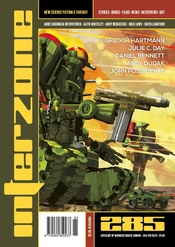
Comma Press, 2019, 235 p, including viii p Introduction by Basma Ghalayini, v p About the Authors, ii p About the Translators. Published in Interzone 283, Sep-Oct 2019.

It is over seventy years since what Palestinians call the Nakba (Catastrophe) and this collection was inspired by the notion of what Palestine might look like 100 years after it. (Not so long now, really.)
In the Introduction,1 Basma Ghalayini describes the Nakba as an ethnic cleansing. Some may disagree with this but it is an understandable Palestinian perspective. She also says Palestinians write about their past knowingly or unknowingly (this can also be true of other peoples who feel themselves to be suppressed) but for Palestinian writers the past is everything. SF, then, does not look to be fertile ground, a luxury to which they cannot afford to escape. But one of the defining features of Palestinian fiction is absence, and SF is well equipped to deal with isolation and detachment as well as to interrogate the present by reframing it.
In Song of the Birds by Saleem Haddad2 an adolescent girl whose brother has committed suicide finds herself slipping between two realities, one where the Israeli occupation has been overthrown and a harsher one where it hasn’t and in which the first is a simulation.
The Dr Eyal Schott of Sleep it Off, Dr Schott3 by Selma Dabbagh is a scientist thrown out of Israel for being less than 50% Jewish, now working in Gaza but under surveillance in case he is forming an inappropriate relationship with his co-worker Professor Mona Kamal.
N* by Majad Kayal4 posits a novel two-state solution. Palestinians and Israelis occupy the same land but in parallel worlds. Only those born after The Agreement are allowed to travel between the two. VR ‘realities’ are still a source of isolation, though.
Anwar Hamed5 sets The Key* in an Israel which restricts entry by constructing a gravity wall through which only people with the right chip (keyed to a person’s genome and embedded in newborns at birth) can pass. Psychological problems connected to this begin to manifest themselves in the narrator’s family.
Digital Nation by Emad El-Din Aysha6 is also set in Israel, where a bemused head of the cybercrime unit finds his worst imaginings of hacking and Palestinian take-over of the digital realm coming true.
Abdalmuti Maqboul’s7 Personal Hero* also features a virtual reality theme as a Palestinian hero is resurrected by a simulation in which time is reversed.
Vengeance by Tasnim Abutabikh8 suffers from being told rather than narrated. Set against a background where CO2 in the atmosphere has ballooned and lifemasks for safe breathing are in effect rationed, Ahmed plans revenge on the descendant of a man who supposedly stole his family’s land generations ago.
A Palestine broken up into a series of independent city states connected only by tunnels is the premise for Application 39 by Ahmed Masoud9 which chronicles the aftermath of a surprisingly successful application to hold the 39th Summer Olympics made by pranksters from the IT Department of the Republic of Gaza City.
Samir El-Youssef’s10 The Association* is set twenty years after the Agreement (to forget all about it) ended the Eighty Years War. The story is set in train by the murder of an obscure historian.
In Commonplace by Rawan Yaghi11, Adam’s sister, Rahaf, was all but killed in an ill-advised trip into the Eastern Lands. He has been planning his revenge ever since.
In Final Warning* by Talal Abu Shawish,12 the sun fails to rise, every electronic device has failed and cars won’t start. Isaam, a film buff, correctly predicts the form the alien intervention causing all this will take.
In The Curse of the Mud Ball Kid* by Mazen Maarouf,13 Palestinians have been wiped out by a biological weapon. All save the narrator, who somehow stores the pure energy of these dead within him and is thus kept in a glass cube designed to absorb it when released on death. Some of it is leaking out, though.
Whether the brief, or the allotted word count, was somehow too restricting or the authors are uncomfortable with the form, many of the stories have a tendency to be overloaded with information dumping and often resort to telling rather than showing. Striking too, is the preoccupation with sisters, usually dead or comatose, shown by several of the authors. Overall, the collection is notable for the way in which Israeli domination of Palestinian life is still manifesting itself in these futures, or has only been overthrown by frankly unlikely means. Perhaps even imaginative fiction has its bounds.
The following did not appear in the published review.
*Translated works. I assume the authors of the other stories wrote them in English.
Pedant’s corner:- 1“is a kind of a dystopia” (is a kind of dystopia,) ‘are issued ID cards … that keeps track” (that keep track.) 2“The string of hotels and restaurants were replaced by” (the string was replaced by, “inside of:” (inside; just ‘inside’,) “ ‘I should probably take a small sleep’” (‘I should probably take a nap’,) sunk (sank,) snuck (sneaked,) faucet (tap,) “‘You know how us Arabs are’” (‘You know how we Arabs are’, but it was in dialogue,) baby carriages (prams,) “is it a cynicism borne out of loss?” (born out of loss, ‘borne means ‘carried’.) “The sea and her are like two cats” (She and the sea are like two cats.) 3“since I was a young” (since I was young,) “to only recognise Ethocoin as an international currency (to recognise only Ethocoin as….,) “The General Assembly weren’t just nosey” (I prefer ‘nosy’,) “how many canons were used in the battle of Waterloo” (cannons, a canon is a clergyman.) 4Has some USian but then, manoeuvre; “he was in secretly love with” (he was secretly in love with,) “it was old café” (it was an old café,) “with it’s blinding light” (its blinding light.) 5“she was sat” (sitting.) 6“His aid continued to stand there” (aide, several more instances,) “a woman to lay on top of” (to lie on top of,) “hit singles from 1948” (hit songs, maybe, but there were no hit ‘singles’ in 1948, it was mostly sheet music which people bought,) “humous fests” (hummus; humous or humus is a component of soil) “The county was in no position to go on the offensive” (The country,) “‘You must have me mistaken for someone else’” (You must have mistaken me for someone else’,) “‘Me, are you kidding.’” (requires a question mark not a full stop.) 7“In a house in al-Qastal sit the Army of the Holy War” (in a house … sits the Army.) 8“a group of children were plying” (a group was playing,) “his boss’ design” (boss’s.) 9“seemed to only contain a long series” (seemed to contain only a long series,) “had not be possible” (been,) “36th Summer Olympics” (previously given as 39th Summer Olympics,) “‘Look its one of’” (it’s,) “to hold the such a” (no ‘the’,) antennas (antennae,) “it’s left leg” (its,) ditto “It’s cheek screens” (Its,) “outside of” (outside, no ‘of’,) sprung (sprang,) “spilled it’s guts” (its,) northern-most but then southernmost (use the hyphen both times or neither time,) “its shoulder-antenna and crossed them” (if them, then shoulder-antennae.) 10“snuck in” (sneaked in,) “the Jozoor’s” (the Jozoor, it was a plural for an organisation known as the Jozoor. Perhaps Jozoors, but certainly no apostrophe,) “ditto the Jidar’s” (the Jidar,) “it was too was obvious” (it was too obvious,) publically (publicly,) “‘just one group that knows their rights’” (that knows its rights.) 11“seven hundred hours” “twenty-one hundred hours” (military usage usually written as 0700 hours and 2100 hours and seemingly out of place here,) “a group of young men…. were caught” (a group …. was caught,) “she went in day light” (daylight.) 12 “in Rahel’s flat” (I’ve no idea why that apostrophised ‘s’ is in italics,) “take the edge of the darkness” (off the darkness,) Michael Renie (Rennie, spelled as such later,) “and reviewing them a film critic” (as a film critic.) “Everyone started shielding their eyes from the sun” (the sun hasn’t risen, an alien spaceship has, though,) “and bellowing commands to soldiers outside, insisting they join him” (insisted they join him.) 13“look forwards to” (look forward to.)
In ‘About the authors’; “He was …. and currently based in Lisbon” (and is currently based,) “is a Palestinian novelist, poet and literary critic born. With a master’s degree..” (born where? When? And it’s Master’s degree,) “for whom he has written wrote and directed” (omit ‘wrote’.)