Archives » Arthur C Clarke

Clarke Award Winner 2024

This year’s Clarke Award winner is In Ascension by Martin Macinnes.

Macinnes’s novel deals with the ocean depths as well as outer space. Appropriate really as Arthur C Clarke was also interested in both. As well as many outer space works he also wrote The Deep Range.

The Clarke Award 2024

I don’t know when they were posted (perhaps when I was away) but the nominees for this year’s Arthur C Clarke Award are listed on its website.

They are:-

Chain-Gang All Stars by Nana Kwame Adjei-Brenyah

The Ten Percent Thief by Lavanya Lakshminarayan

In Ascaension by Martin MacInnes

The Mountain in the Sea by Ray NaylerS

Some Desperate Glory by Emily Tesh

Corey Fah Does Social Mobility by Isabel Waidner

I have read none of them.

The Magazine of Fantasy and Science Fiction, November 1962

Edited by Avram Davidson, British Edition, Atlas Publishing and Distribution by arrangement with Mercury Press, 112 p.

Note: the cover painting shown right is the one on my copy but the contents differ from those listed on the image which was for the US edition for April 1962. The British editions obviously did not match the US ones.

In those days the magazine had no Editorial column nor was the text of its stories – except the title page for Uncle Arly here – laid out in two columns as it would be in later years.

Isaac Asimov’s SCIENCE column was going strong. Here in Hot Stuffa he considers the highest* temperature possible in the universe (the interior of a star about to go supernova.)

Saturn Rising by Arthur C Clarke.1 A veteran of the first two trips to Saturn on a lecture tour is buttonholed by the hotel owner, an enthusiast for that planet, eager for commercial opportunity.

Brown Robert by Terry Carr2 is both SF and a horror story. Arthur Leacock assists young Robert Ernsohn, brown Robert, to make the first trip through time. This is one of the few SF stories to deal with the fact that time travel must also involve space travel.

My Dear Emily by Joanna Russ is a vampire story set in 1880s San Francisco. As well as the Emily of the title another of its characters is named Charlotte; two names obviously chosen to invoke thoughts of the Brontë sisters. Yet the overall effect is far from that template.

The Man Without a Planet by Kate Wilhelm.3 The titular man carried on with a space voyage despite that meaning the death of his companions. The sympathies of the story’s narrator are somewhat like the protagonist of Robert Silverberg’s To See the Invisible Man.

Darfgarth by Vance Aandahl. The titular character is a wandering minstrel whose mandolin has a magical effect on the locals he stops to serenade. Until he goes too far.

Stanley Toothbrush by Carl Brandon.4 One morning, while shaving, viewpoint character Herbert thinks the word ‘shelf’ is ridiculous and all his shelves disappear. Later his girtlfriend teases him about a (non-existent) new boyfriend and he turns up on her doorstep. The have great problems with him – till she imagines him away.

In Uncle Arly by Ron Goulart5 the uncle of an ex-girlfriend has begun to haunt Tim Barnum’s television set, every Tuesday evening for half an hour. He also pops up on the radio.

Subcommittee by Zenna Henderson.6 Talks to end the war between humans and the alien Linjeni are going nowhere. Serena’s husband Thorn is on the talks committee. Their son Splinter finds a way through the fence between the two communities and makes friends with Doovie, a Linjeni child. The rest of the story more or less writes itself but 60 years on it is striking how the cultural assumptions of the time were entrenched even in SF: the Linjeni females in this story are as bound to their families as human women were in those days. Of course it may not have been possible to get anything else past a male editor.

*as known then.

Pedant’s corner:- awave length (now is one word, wavelength.) Centigrade (that unit of temperature is now designated Celsius,) “56 hydrogen nuclei … are converted into 1 helium nuclei” (the nuclei is plural, so the ‘1’ is wrong. Context and the subsequent text suggests ‘14 helium nuclei’.) Later we have 19 helium nuclei where again 14 makes more sense.
1Ingalls’ (Ingalls’s,) “It took me awhile” (a while.) 2Mr Lewis’ assistant (x 2, Lewis’s.) 3zombi-like (zombie-like.) 4focussing (focusing,) “‘An what do you mean’” (And,) a miising full stop at the end of a sentence, a double quote mark at the beginning of a piece of direct speech when elsewhere there are only single ones. 5 “and pointing at the fat man on the set who was singing again. ‘And who’s this guy?’” (is missing a ‘said’ before ‘And who’s this guy?’) “before go to the bank” (before I go to the bank.) “Jean left them” (elsewhere she is Jeanne.) 6 “and felt of the knitting” (and felt the knitting.)

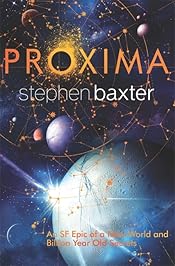
Proxima by Stephen Baxter

Gollancz, 2013, 485 p.

Proxima cover

Proxima is set in the mid-twenty second century after the Heroic Generation has been demonised in retrospect. Yuri Eden was cryogenically stored by his parents till better times arrived. He wakes up on the Ad Astra, a starship bound for Proxima Centauri, one of many caught up in a sweep (press-ganged) to provide colonists for an Earth-like planet tide-locked to that system’s third sun.

Meanwhile back in the solar system — where, on Mercury, mysterious artefacts known as kernels have been discovered and are proving a revolutionary power source — Stephanie Penelope Kalinski is forging her career as a physicist.

Life on Proxima c, dubbed Per Ardua by the colonists, is harsh and brutal. Soon, out of his group of thirteen colonists, only Yuri and Mardina Jones, a ship’s officer of Australian aboriginal lineage, delegated/dragooned/abandoned by her commander to fill a gap in the manifest as the best genetically diverse replacement available, are left, along with an AI robot known as a ColU. Together they watch the local life forms – stick-like creatures they call builders – while trying to scratch a living from the surface. Despite mutual misgivings they have a daughter, whom they name Beth. Despite strict orders to remain where they were set down they have to migrate as their water source – a lake – is moved by the builders. Eventually, meeting other groups along the way they gravitate towards the point on the Per Ardua’s surface immediately below the sun.

On Mercury a further apparently alien device is discovered under a hatch in the bedrock. When it’s opened Stephanie finds a twin, Penelope Dianne, previously unknown to her, and her name has become Stephanie Karen, but everyone else thinks this is how it has been all along. The hatch has altered reality, created ragged edges like Steph’s memories or her mother’s headstone where Steph’s original name remains inscribed. The hatch sequences were somewhat reminiscent of Arthur C Clarke’s The Sentinel (which provided the germ for 2001: A Space Odyssey.) The link between the two narratives is then established.

This is all good, solid Science-Fictional stuff but the characters are not very engaging, limited in scope, mostly at the mercy of the plot, present only to push the story along.

Pedant’s corner:- The edition I read was a proof copy so some of these may have been corrected in the final printing. “People moving around him wearing in green shirts and hygiene caps and masks” (wearing in?) like cvNissan huts (Nissen huts – unless Baxter is essaying a pun.) “A women” (woman,) “‘And we are going -’ He pointed straight up … There.’” (that’s a continued sentence the “he” should not be capitalised,) “she understood that that the” (only one “that”,) “from Earth and moon” (traditionally Earth’s [principal] satellite is afforded proper noun status, Moon.) “The throng gathering …. were” (the throng was,) “not as fast as it would in Earth” (on Earth.) “He’d known here on Mars,) He’d known her on Mars,) “a position were the cuffs” (where the cuffs,) focussed (x2, focused,) “‘..what time it be when’” (time will it be when .) “In her dreams she had been the one seprated from the rest, in her dreams.” (repetition of “in her dreams” is unnecessary.) “The ColU continued to stress was that the” (no “was” needed.) “‘Waiting for the prize, where you?’” (were you,) “‘its relationship, of any,’” (if any,) a paragraph start doubly indented, fit (fitted,) “had been the only way route by which she” (either way or route, not both,) “‘they’ve been are about us’” (either ‘they’ve been’ or ‘they are’, not ‘they’ve been are’,) “the ancient impact created shattered the bedrock” (“created” is redundant,) “the further Proxima rise in the sky” (rose,) put-puts (putt-putts,) “a party of four of them … made their way” (a party made its way.) “On the wall opposite other was some kind of” ) on the wall opposite was some kind of,) antennas (antennae.) “There hadn’t been much opportunities” (‘There hadn’t been much opportunity’, or, ‘There hadn’t been many opportunities’.) None of their families were here” (None of their families was here,) Secretary Generals (Secretaries General,) grills (grilles,) “that the languages of widely scattered groups was so consistent” (either ‘language’, or, ‘were so consistent’,) “of the species and their culture” (its culture,) Lu (elsewhere Liu.) “A couple of crew members were” (a couple was,) “‘will be like atomised when we lift’” (no need for the ‘like’,) “there was no point holding their breath” (breaths.)

Brian Aldiss

Earlier today I read the news that Brian Aldiss has died.

At times during my youth he was about the sole standard bearer for British SF (for which actually read English SF as Science Fiction from other parts of these islands was more or less invisible till years later.) Only John Wyndham and J G Ballard had anything like as high a profile and they were very different writers.

(Edited to add: I don’t know why it was that Arthur C Clarke slipped my mind when I originally wrote this. Maybe because his output was hard SF as compared to the others.)

As a result of Aldiss’s prominence I have a large number of his books. I think The Interpreter was the first SF book I bought as opposed to borrowing them from the local library.

The latest such purchase was bought for me for Christmas by the good lady because she liked the cover so much – and she read it before me!

I suppose there won’t be any more now.

I did meet him once; briefly, at one of the Liverpool Eastercons.

One of the greats. Arguably the last of the SF pioneers.

Brian Wilson Aldiss: 18/8/1925 – 19/8/2017. So it goes.

I’m on the Map!

Literally.

Despite me not having a piece of fiction published for a few years – and only ever one novel – I’ve been included on this map of British SF and Fantasy writers. (If you click on the map it will lead you to its creator’s website, where copies can be purchased):-

Science Fiction and Fantasy Literary Map

I’m humbled by this. Imagine me being on the same map as Alasdair Gray, Iain (M) Banks, Ken MacLeod, Ian McDonald, Eric Brown, Arthur C Clarke, J G Ballard, George Orwell et al. Not to mention J Leslie Mitchell (Lewis Grassic Gibbon.)

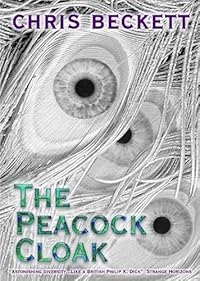
The Peacock Cloak by Chris Beckett

NewCon Press, 2013, 239p. Reviewed for Interzone 247, Jul-Aug 2013.

This is Beckett’s second collection, containing twelve short stories – with a few commonalities in background – that have been published during the past five years. Four are from the pages of Interzone. They span a wide range of perennial SF concerns – social or technological extrapolation, global warming, enigmatic aliens, their strange worlds, parallel universes, stargates, altered histories – plus a genuflection to Arthur Clarke’s The Nine Billion Names of God.

Atomic Truth contrasts the seeming connectedness of the digital world with the distancing it carries along with it. Everyone wears bugeyes, interactive goggles that form an interface between the real and virtual worlds and display emails, ads etc. Everyone, that is, except Richard, who has no need of goggles to see visions. His encounter with Jenny provides a small moment of humanity in his disorientated world.

The style of Two Thieves is reminiscent of a fairy tale – a form which has less than cosy attributes. The thieves, exiled to a remote and totally secure penal colony, start work on an archæological site, where they uncover a relic of the Old Empire. It’s a spatial gateway, which of course they jump through. There is some nice foreshadowing here that is both blatant and subtle at the same time.

Johnny’s New Job is set in an Orwellian society with a Stakhanovite labour force and a justice system to gladden a tabloid newspaper proprietor’s heart. Offenders against the public good (who all seem to work in Welfare) are demonised by the authorities. These unfortunates are named and worse than shamed, guilt by association is afflicted on their families. Johnny goes along with the general mood, then gets an unrefusable job offer.

On the planet Lutania lies The Caramel Forest, a malodorous place of grey, brown and pink vegetation contrasted by the bright green of settlers’ lawns. The Lutanian indigenes nicknamed goblins can project settlers’ thoughts back into human minds. The Agency running the planet tries to protect them but the original human settlers have their own way of dealing with them. Cassie, the child of a constantly arguing Agency couple on a tour of duty, is influenced to escape the rows by running off into the forest.

Greenland. Juan Fernandez is a refugee from Spain scraping an ever more insecure living in a slowly submerging south-east of England flooded both by global warming and the so-called beachrats, illegal immigrants lucky to escape the machine-gunners on the shores. He loses his crap job but his future is determined by a lucrative offer to copy him in a hazardous matter-replicating machine.

The Famous Cave Paintings on Isolus 9 depict a God fashioned, as all gods are, in the image of the locals. He is imprisoned and can only dream of escape. The narrator’s Uncle Clancy, a famous womaniser who has finally fallen in love, sees them, and is terrified.

Rat Island is a take on our reckless consumption of fossil fuels. A child whose civil servant father confides to him the inevitability of the consequent crash and likens us to introduced rats on an isolated island eventually eating all the seabirds’ eggs, finds his only consolation is the taking of photographs.

Day 29. Lutania again. Stephen Kohl is coming to the end of his tour of duty for the Agency and is frustrated and worried by the thought of the memories of 29 days he will lose when he undergoes Transmission back to civilisation.

England is occupied, taken over by Brythonic Celts expelled from Britain by the Romans into France, Iberia and the Americas. They have come back to the land they claim that God gave them. The scenario has implicit and explicit parallels to the Israeli/Palestinian conflict and, in common with that, isn’t resolved. Beckett’s framing device lets its story, Our Land, off that hook, though.

Jacob Stone is The Desiccated Man, transporting cargoes over the solitary spaceways, accumulating money till he can retire to a life of indulgence. But old habits die hard.

In Poppyfields, a brownfield site subject to a development delay, waif-like Tammy Pendant – who has taken slip, a drug which pierces the membranes between universes – materialises in front of bird-watching Angus Wendering. Angus is easily led.

The creator of a fabricated world called Esperine finally enters it. The copy of himself he installed there comes to confront him wearing The Peacock Cloak, a shimmering all powerful device he has used to rebel against Esperine’s tameness.

Some of these tales have an overly conversational tone, parts have a tendency to be told rather than unfold, info dumping can be intrusive and there are occasional disjunctions where story elements seem to clash but, in all of them, Beckett never loses sight of the humans he is writing about. Here we are in all our folly – and occasional glory.

Magic as Technology (Technology as Magic)

One of the famous SF writer Arthur C Clarke‘s well known sayings was, “Any sufficiently advanced technology is indistinguishable from magic.”

Demonstrate, for instance, a Star Trek communicator (or, better, a modern day mobile phone; because effectively that’s what those communicators were, minus the photo and internet functions) to a hitherto isolated tribe in the deep remote somewhere and its working principles would be impossible for them to comprehend. The same would be true of us confronted with some really advanced piece of hardware.

But it’s always seemed to me that the reverse of Clarke’s saying could equally be true and that any sufficiently effective magic would be indistinguishable from advanced technology. Certainly it could be explicable as such. “I do this with this and that happens.”

2010*

Well, we won’t make it to Jupiter this year. We haven’t even made it to Mars.

Just one more example of how the future wasn’t.

Happy New Year anyway; to one and all.

*Btw; I hope we’re all pronouncing this year as “twenty-ten.”

free hit counter script