Posted in Reading Reviewed, Science Fiction at 19:35 on 21 June 2014
Blackie and Son, 1954? 338 p.
What a strange old beast this is. It was first published in 1937 – and shows it. Its three protagonists are (in one case ex-) public schoolboys who say things like, “I say, you chaps,” “jolly well” and “Rather!” and get through more by luck than expertise. They become adrift in the stratosphere by accidentally taking off in a spaceship that someone has built (in a barn!) where they’d stopped off on a motorbike excursion. The radio on board (wireless set and radio are used interchangeably) can somehow access two week old broadcasts and their diet is provided by “super-vitamin tablets.” “One represents sufficient food for one person for one day. Dissolve in the mouth and swallow slowly.” Parse the last sentence of the quote, if you would.
Their adventures include passing through a belt of X-rays (which allow them to see through each other,) the ship being struck by particles from a passing meteor (without any structural damage,) an encounter with a cloud-like stratospheric creature, being attacked by evil Martians (complete with death rays) and meeting a somewhat more benevolent set of comet dwellers. “The speed at which we travel through space sets up an action in the ether which covers us with a gas-like vapour. Your astronomers have fallen into the mistaken belief that we are composed entirely of gas.” The adventures come thick and fast but characterisation is non-existent. Plus the return of the chaps to Earth in the final page is very perfunctorily handled.
For its time I suppose it would have been unexceptional, a Boy’s Own Adventure indeed.
A view of the nice thistle design on the hardcovers can be found here and that of the internal illustration here.
The author, one Prof A M Low, apparently designed a proto-television system he called Televista (a device of this name, which combines the “principles of television and that of the camera obscura,” appears in the book) but due to the Great War nothing much came of it.
Here Low uses the term stratosphere to describe what would now be called space. Whether that was a common usage in the 1930s I have no idea. He also employs the latter term in its modern sense. And the ship is at least once referred to as falling. In space you wouldn’t notice.
Typos corner (even in the 1950s!) – breath for breathe, noticably for noticeably.
No Comments »
Posted in Reading Reviewed, Science Fiction at 12:00 on 7 June 2014
Illustrated by George Craig. Nelson, 1960, 186p.

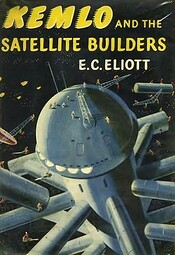 I bought this in a charity shop in Linlithgow. One time I was there they had a swatch of (overpriced) E C Eliott books with wonderfully nostalgic covers – in particular one called Tas and the Postal Rocket. On my next visit most had gone but this one had been brought down from a frankly ridiculous £19.99 to something more reasonable for a book without its dust-jacket. At the same time I bought a Prof A M Low book of similar vintage.
This is perhaps what was once called a juvenile – young adult would be pushing it a bit; it’s definitely not a grown-up kind of tale. Kemlo is a Space Scout, brought up in space on a satellite as part of a quasi-military organisation. Space infants are kept in a nursery looked after by their mothers and nurses. Scouts graduate to their own quarters between the ages of six and nine. The boys’ and girls’ quarters are separate – and this is all we hear of the girls. Despite this apparent distancing and a large degree of control over their own activities the Scouts still have reverence for and defer to their parents who can visit at any time but are mostly absent. Nevertheless Kemlo’s relationship with his father and mother seems not very different from one in a “normal” family.
The story is a farrago of nonsense about the imminent building of a huge satellite mixed in with a rudimentary plot about the extension of the restrictive social arrangements down on Earth up into the space environment. There is also a load of guff about weightlessness and gravity. The station has gravity “rays” and levers which can switch gravity on and off. For some odd reason – unexplained here – the Scouts all have names which begin with K. There are lumps of info dumping and conversations which exist only to outline or advance the plot.
Spookily there is a chief engineer who speaks in Scotticisms. Perhaps Gene Roddenberry read Kemlo books! By the way I’ve still to find the plaque in Linlithgow to Star Trek’s Scotty, the one that says he’ll be born there in 2222 or something. Apparently it’s in Annet House Museum.
Kemlo and the Satellite Builders is firmly of its time in its social and political attitudes but there is something unabashedly optimistic in it. And the illustrations are a retro delight. Not that that redeems its many failures.
Pedants’ corner:- Gravity rays! “We get our power by feeding gravity rays across the generator fins of our power units, because we’ve no natural gravity up here.” So: 1) where does the power for the “gravity rays” come from? 2) the generator fins obviously do not generate, they transform, 3) they do have natural gravity, they just won’t notice its effects because they’re in free-fall.
The Scouts are told the new satellite will, “not be in orbit with Earth. It therefore will not spin on its own axis in order for it maintain the velocity necessary to retain it in an orbit.” Satellites do not need to spin to stay in orbit. Simple velocity (linear, not rotational) balancing the attractive force of Earth is enough.
The Satellite is made of uraniametal, “the strongest and lightest substance known to man.” Really? Substitute least dense for lightest and metal for substance and you might get close. Otherwise a kilo of uraniametal will still be 1,000 times heavier than a gram of lead (or a gram of anything come to that.) Oh; and any gas is much, much “lighter” than the equivalent volume of any solid.
4 Comments »


