Posted in Altered History, Reading Reviewed, Science Fiction at 12:00 on 23 March 2015
Tor, 2012, 416 p.
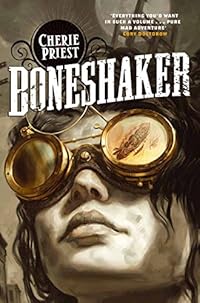
In 1863 Dr Leviticus Blue’s Incredible Bone-Shaking Drill Engine undermined Seattle and let loose an invisible gas dubbed the Blight, whose effects are (slowly) deadly. As a result Seattle’s old city centre has had a two hundred feet high wall built around it. Sixteen years later (and incidentally with the War between the States still raging back east – which makes this an altered history: then again I suppose all steampunk is) his son, Zeke, convinced his father is innocent, sets off into the forbidden area to prove it. His mother, daughter of hero Maynard Wilkes, goes after him, scrounging a ride on an airship. (Ah, the glories of steampunk.) Inside the city various adventures befall them both before they (separately) encounter the mysterious technical wizard who effectively rules the walled city, Dr Minnericht.
Despite the Blight being described as invisible Priest has the air inside Seattle’s walls as brownish-yellow in colour. Some of the people who succumb to the Blight come back to animation as zombie-like things called rotters which roam the streets of the walled city in search of live human flesh which apparently they like to feed on. (I gather this is typical of zombies more generally.) The logic of this escapes me. Granted, Priest’s rotters will need an energy source, but why would this need to be meat and how, given that their own flesh has decayed, would they digest it anyway?
The scenes inside the walled city ought to conjure up a feeling of claustrophobia but somehow, despite constant references to the discomfort of facemasks and the necessity to replace their filters, doesn’t. The chapters featuring Zeke understandably read like a YA novel as does the pace of events. At times the atmosphere is reminiscent of Phillip Pulman’s His Dark Materials but these characters are much less memorable. I’m glad I’ve sampled Priest’s work but I don’t think I’ll seek out more.
Pedant’s corner:- amuck (I prefer amok,) if you had mask (a mask,) from whence (whence already means from where,) off of, sprung for sprang, but least they weren’t bleeding (at least.) stunk for stank (x 2,) shined for shone (x 2,) who was seemed on the verge, wadded it into ball, lay of the land.
No Comments »
Posted in BSFA Awards, Fantasy, Reading Reviewed, Science Fiction at 13:00 on 15 January 2012
Angry Robot, 2010, 349 p
(Plus 4 pages of acknowledgements, 1 page “about the author” and 24 pages containing three short stories from winners of a competition to set a story in the milieu of Beukes’s previous novel Moxyland, an unnecessary addition to my mind.)
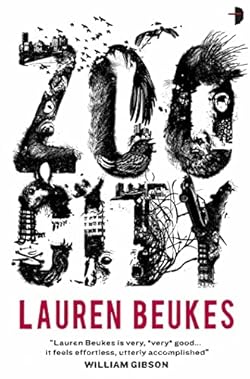
I have previously lamented the fact that the general run of fantasy novels seem to be set in a default mediævality and that no-one is trying to write fantasy in a contemporary setting. Well Zoo City is taken by some to be SF – it was on the BSFA Award shortlist for best novel last year – but to my mind fantasy would be a better description. In particular magic is an essential component of the setting and plot. Yet the novel takes place in the present day! (Albeit a present day thoroughly transmogrified.)
Zinzi December is an aposymbiont – who are derogatorily termed as animalled. Aposymbionts are individuals who, as a result of committing a serious crime, have gained an animal companion with whom they have a psychic link, in the process acquiring an attribute. This is not quite the same as in Philip Pullman’s His Dark Materials trilogy, which Beukes does refer to in the text, as in his universe the animals begin attachment at birth. Zinzi’s companion is a sloth and her attribute is sensing lost objects. She can follow psychic threads to recover things. This is her apparent job but to pay her debts she moonlights as an email scammer. She is engaged by two rather unsavoury individuals (both animalled) to find a lost pop star and is drawn into a world of intrigue, backstabbing and murder.
Narrated in an urgent present tense, apart from the interpolations of cod press articles and psychological papers fleshing out the background, the novel is of a piece with the thriller feel of much near future SF. But Beukes is good at this – very good indeed – the gritty realism makes her scenario entirely believable while you’re immersed in it. That the novel takes place in South Africa may be one factor in its appeal. African phrases and words are utilised frequently but not so as to obfuscate or confuse. The acceptance of magic is a given (as it may be in “our” South Africa.)
Where the story veers away from thriller SF into fantasy is that the transformation of the world to one where animals can become “familiars” is not given much of a rational explanation.
Zinzi and her boyfriend Benoît, whose animal is a mongoose, are well drawn, nuanced characters with full backstories which mercifully emerge from the story as it is told rather than being dumped on the reader. Others are equally believable.
This was fun, sharp and (the misuse of pre-empt aside) well written stuff.
No Comments »