Archives » Peruvian fiction

The Time of the Hero by Mario Vargas Llosa 

Grove Press, 1966, 407 p. Translated from the Spanish, La ciudad y los perros, (Editorial Seix Barral, S A, Barcelona, 1962) by Lysander Kemp

(I don’t usually remember exactly where I bought a book but with this one I do. It was in the Netherlands; in a charity shop/warehouse which had a large selection of books, one case of which were publications in English. I think it cost me one Euro, though it might have been €1.50.)


This was Llosa’s first novel and it is set in the Leoncio Prada Military Academy, among the cadets/pupils there, not all of whom are destined to join the army.

It depicts the everyday lives of the inmates, their raggings, joshings and bullying, their constant efforts to evade the rules – such as smoking, gambling, going over the wall at night, or even during the day – and to keep things secret from the officers. Some scenes are set in the surrounding city; illustrating memories of the inmates’ pasts or the intricacies of their love lives.

The plot revolves around the stealing of the text of a Chemistry exam the night before it is due to be taken. The designated cadet, Cava, makes a mistake and a window pane is broken. All passes are cancelled. In order to receive a pass to see his girlfriend a cadet nicknamed the Slave reports Cava to the officers. Later, the Slave is shot during a military exercise. The officers are at pains to insist it was an accident and ignore evidence and testimony to the contrary.

This is almost entirely a male environment; the dialogue often displays the prejudices of its time and place – especially with regard to the casual use of racist terms and to misogyny.

In their encounter the Slave’s father says to Alberto, “‘When you have a son, keep him away from his mother, There’s nothing like a woman to ruin a boy for life.’”

In the main we have here is an examination of the perennial battle of youth against authority, of the pressure to conform and of the constant tendency of institutions to cover up unfortunate happenings so as not to be shown in a bad light.


Pedant’s corner:- Translated into USian. I note La ciudad y los perros actually translates as The City and the Dogs. Otherwise; “tooth paste” (toothpaste,) “brief case” (briefcase,) “girl friend” (girlfriend,) “boy friend (boyfriend,) “on the double” (this military term is usually rendered as ‘at the double’,) “Montes’ bunk” (Montes’s.)
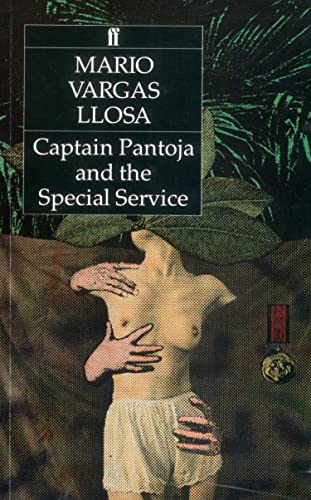
Captain Pantoja and the Special Service by Mario Vargas Llosa

faber and faber, 1987, 252 p. Translated from the Spanish Pantaléon y las visitadoras. No translator named.

Captain Pantoja and the Special Service cover

Llosa may have intended this to be a light-hearted piece of fiction. (Then again perhaps not; there are several deaths in it.) It may have been taken so in the 1970s when it was first published but I doubt the book’s premise would be viewed with much favour were it to be submitted to a publisher nowadays.

Because the soldiers posted (in effect “up the jungle”) to Iquitos, driven to distraction by the heat and conditions, are causing havoc among the local women, raping them left, right and centre – even in the street in full daylight – Army Captain Pantaleón Pantoja is given the unusual task of organising a service to prevent this. This is the SSGFRI, the Special Service for Garrisons, Frontier and Related Installations. In effect he is to procure women to provide for the sexual release of the soldiers on an organised basis. But all this is to be done in secret, he must not wear his uniform; the women, though in reality Army employees, are to be unofficial, without rank, though the service will have an identifying colour scheme, red and green, worn as a badge by the “specialists” and displayed on the trucks, boats and single aeroplane the service will have at its disposal.

Pantoja’s wife, Pochita, is at first delighted by his apparent promotion but her disappointment with their new quarters, not, of course, in the army compound but instead a very old, very ugly, very uncomfortable house in town, not at all comparable to the poorest one on the base, is profound. She is doubtful, too, of the increased sexual interest Pantoja has for her (stimulated by the heat and conditions of their new surroundings) though pleased to become preganant with their first child. Pochita’s ignorance of Pantoja’s true activities, despite his associations with shady characters, is sustained for a while but is eventually lifted when a specialist fired for misconduct writes to her.

Being an Army man, Pantoja of course treats the job with military punctiliousness, engaging surveys into the length of time each “service” will require, hence determining the number of specialists to be recruited, and itemises the amounts to be docked from the pay of the service’s users. Due to his logistical skills he makes a great success of everything; so much so that demand for his specialists increases – to the Navy and beyond.

In the meantime a heretical sect known as The Brotherhood of the Ark, led by a Brother Francisco, whose adherents’ trade-mark practice is the crucifixion of animals and birds, is gaining followers in the region. Despite all the authorities’ efforts to arrest him Brother Francisco remains elusive. The intersection between Francisco’s cult and the activities of the SSGFRI provides th enovel’s turning point.

The story is told through conversations, the texts of military dispatches, letters from and to Pochita, transcripts of local radio broadcasts and extracts from newspaper reports. The “normal” text has an unusual flavour, as different conversations are interleaved with each other on the page, with only a paragraph break to signal any change to and from each discussion. This initially has the efect of obstructing the story’s flow but is soon accustomed to.

Sensitivity warning. One of the characters, an inhabitant of the demi-monde whom Pantoja employs to help him with his mission, is called Porfirio Wong, but is also given the soubriquet the ‘Chink.’

Pedant’s corner:- supervisers (supervisors,) a capital letter on the next word following a colon – but not in every instance of a colon, a line repeated on the next line (x 2,) smoothes (smooths,) “the lay of the land” (the lie of the land,) Collazos’ (Collazos’s,) Manaos (this Brazilian city is usually spelled Manaus,) Iquitos’ (Iquitos’s,) “consults with his adjunct” (that military functionary in English is called an adjutant,) “‘he’d of died of sorrow’” (does this illiterate solecism exist in Spanish? The correct English form is ‘he’d’ve’.)

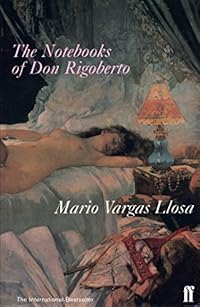
The Notebooks of Don Rigoberto by Mario Vargas Llosa

faber and faber, 1999, 308 p. Translated from the Spanish Los Cuadernos de Don Rigoberto by Edith Grossman

 The Notebooks of Don Rigoberto cover

A very odd piece, this. I’m tempted to add very South American; but it does focus on love and sex (especially the sex) – two of the triumvirate of big novelistic concerns.

Don Rigoberto is a legal director of an insurance company with an interest in collecting books and works of art but he never has more nor less than the same amount of either. Each new purchase must be balanced by the disposal of a previous one. Rigoberto has an extensive set of notebooks where he has inscribed his reflections on all he has seen or read. At the book’s start Rigoberto is estranged from his second wife Doña Lucrecia due to an indiscretion involving Alfonso, Rigoberto’s son from his first marriage, still a schoolboy but one who has an unhealthy fascination with the life and work of the artist Egon Schiele – to the extent he believes he may be a reincarnation.

The novel depicts sessions where Alfonso is visiting Lucrecia with a view to effecting a reconciliation between his father and stepmother, mixed in with Rigoberto’s memories and fantasies of life with Lucrecia and his notebooks’ polemics against aspects of modern life and the timid aspirations and attitudes of the general mass. One of these is a railing against pornographers, who pervert the higher aspects of love and sex, commodify the impulse and therefore desacralize the act of love and make it banal. In the same piece he absolutely nails Margaret Thatcher “not one of whose hairs moved for the entire time she was Prime Minister” (though it has to be said describing her as a delectable source of erotic desire is a perversion far too far.) Another of the Don’s reflections is an aside on the difference between a eunuch and a castrato.He also thinks, “The obligation of a film or book is to entertain me. If … I begin to nod or fall asleep when I watch or read them, they have failed in their duty and they are bad books, bad films.” By this criterion The Notebooks of Don Rigoberto could be a bad book, as I began to nod or fall asleep several times while reading it. Mind you I had been dotting about the country like a blue-arsed fly during the week when I read it and consequently was prone to tiredness. But that’s my fault, the book is still worth reading.

The Notebooks of Don Rigoberto is a consciously literary work, scenes are described from different viewpoints simultaneously, the shifting taking place from sentence to sentence, signalling a certain unreliability in narrative viewpoint (or a touch of magic realism.) Those with a prudish sensibility might want to give it a miss, though.

Pedant’s corner:- maître d’s (surely the plural of maître d’ is maîtres d’?) ambiance (x2, ambience,) a missing full stop before the quote mark at the end of a piece of direct speech x2, depilitated (x3, depilated,) corolla (x2, used in the sense of areola, but corolla is a botanical term,) Saint Vitus’s dance (x2, Vitus’s,) motorcross (motocross.) “They had know each other” ~(known,) “the American Harley-Davidson and Triumph” (implies Triumph is an American marque,) checked flag (the usual term in motor racing is chequered flag,) CD’s (there is no need for that apostrophe, there is no letter missing; CDs,) “the only anthem that can move me to tears are the sounds” (“anthem” is singular; so, is. On the other hand “sounds” is plural and the verb to be implies equivalence; so, are. Better to have something like “expresses the sounds of”,) “a sort of cowl, even, even, the head” (one of those “even”s is extraneous,) a missing end quote mark, “pubises trimmed and dyed” (the pubis is the bone, not the hair of the pubic region. Pubes is the noun to depict the region or its hair, though in English it’s liable to mispronunciation. I assume its plural is “pubes” still, compare the plural of sheep,) offpring (offspring,) a supposed newspaper report has, “A twenty-four year old teacher in New Zealand was sentenced to four years in prison for carnal relations with a ten-year old boy, a friend and classmate of her son’s” (that implies she would have given birth when she was fourteen; possible I suppose, but unlikely,) will-o’-the-wisps (wills-o’-the-wisp.)

free hit counter script