Posted in Art Deco, Empire Exhibition, Scotland, 1938 at 12:00 on 24 February 2022
Another Brian Gerald Art-drawn postcard from the Empire Exhibition Scotland 1938. Pavilions for South Africa, New Zealand, Australia and Canada on left with Palace of Engineering at far end:-

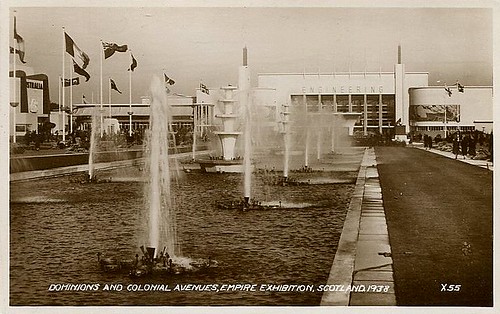
Valentine’s sepia postcard of the Dominions and Colonial Avenues at the Empire Exhibition Scotland 1938 featuring fountains, Australian Pavilion and Palace of Engineering:-
Reverse view. Another Valentine’s postcard. Australia and Canada Pavilions to near right, Palace of Industries at far end:-

Valentine’s sepia postcard of Canada Pavilion plus Palace of Engineering at far end. Tower of Empire in background left:-

No Comments »
Posted in Art Deco, Empire Exhibition, Scotland, 1938 at 20:30 on 21 February 2022
I haven’t posted one of these for a long while now.
A Brian Gerald art-drawn postcard of buildings and floral displays at the Empire Exhibition Scotland, held in Bellahouston Park, Glasgow. Palace of Engineering to right, Garden Club in centre, below Tait’s Tower:-

No Comments »
Posted in Art Deco, Empire Exhibition, Scotland, 1938, Exhibitions at 13:00 on 3 March 2014
For some reason postcards with a blue tint were produced in the 1920 and 1930s.
This one shows off some of the elaborate fountainry at the Empire Exhibition, Scotland, 1938.

This is a slightly different angle of the same fountain as in the previous picture but in a black and white (sepia) postcard.

No Comments »
Posted in Art Deco, Empire Exhibition, Scotland, 1938 at 20:25 on 4 November 2013
Another sepia postcard from the Empire Exhibition, Scotland 1938; this time of the Palace of Engineering. Lovely rounded walls with murals.
In the foreground you can see a railodok car, a means of getting around the Exhibition more quickly than on foot.

No Comments »
Posted in Architecture, Art Deco, Empire Exhibition, Scotland, 1938, Exhibitions, Glasgow at 09:01 on 3 May 2013
The zenith of Art Deco (or of Moderne if you must) in Scotland came in 1938 with the Empire Exhibition, Scotland, held in Bellahouston Park, Glasgow, and which opened 75 years ago today on 3/5/1938.

Its signature building was the Tower of Empire (seen in the above photograph taken from the link) designed by Thomas Tait whose houses at Silver End I featured eighteen months ago. The tower was erected on the hill in Bellahouston Park and dominated the Exhibition.
Tait was in overall charge of the architecture for the Exhibition – some of whose buildings made extensive use of the new construction material, asbestos cement! – and designed many of the buildings himself.
My favourite is the Atlantic Restaurant, a ship-shaped building cresting the wave of the hill on which it was set, two postcards of which I reproduce below.


Sadly almost none of the buildings remain. (It was a condition of such events that their locations were restored to their original condition soon afterwards. Moreover shortly afterwards the country was involved in the Second World War and conserving architecture became a minor consideration. The Exhibition itself came to an end in the midst of the Munich Crisis.)
Only the Palace of Arts is still standing in Bellahouston Park itself. It was transformed into a sports pavilion. The Palace of Engineering was taken down and re-erected at Prestwick Airport and can still be found there. The South Africa building was in Dutch Barn style rather than deco or moderne and later became a staff canteen at ICI Ardeer. All the rest were demolished.
Think of what a tourist attraction Tait’s Tower, as it was known, could have been! Glasgow’s answer to Eiffel.
As it is, the main tourist draw in the Park today is the House for an Art Lover built to designs of Charles Rennie Mackintosh whose buildings are a sort of bridge between the freer, flowing style of Art Nouveau and the more rigid Art Deco.
You may have noticed that I have added a new category to my list especially for this Exhibition. There is so much more I could, and will, post.
No Comments »
