Archives » myth

The Voyage Home by Pat Barker

Hamish Hamilton, 2024, 292 p.

This is the third in Barker’s Troy series. Unlike the first two, which were narrated by Briseis (the former princess of Lyrnessus, a town sacked by the Greeks before they ventured on to its ally Troy, with Briseis being given to Achilles as a prize of war,) this novel’s main narrator is Ritsa, a friend of Briseis, but now a possession of Machaon, physician to Mycenean King Agamemnon, and body-slave (or, as she puts it, catch-fart) to Troy’s Princess, Cassandra, herself Agamemnon’s bed-slave, though they had gone through a form of marriage.

Cassandra is famed for her gift of prophecy; a gift bestowed on her by the God Apollo, whose priestess she was, but also cursed by him never to be believed since she refused his advances.

Ritsa’s tale is narrated in first person past tense but some chapters of the book are in the third person present tense from the viewpoints either of Cassandra or of Agamemnon’s wife Clytemnestra. This is useful authorially as of course Ritsa cannot have access to scenes where she is not present.

The book’s title is, of course, ironic. The home they journey to was never that of the Trojan women; only of the Greeks who took them captive. It is also slightly inappropriate in that the sea voyage to Mycenae is over before the book is even halfway through – though less so in the sense that by the novel’s end Cassandra’s journey home is utterly complete.

Some of the prose and dialogue is in a modern register which might jar with the ambience of myth which Barker is dealing with. But in looking at these events/stories with a modern eye (Barker’s controlled indignation, even rage, at the treatment of women in these tales, while not getting in the way of the story she tells, is never far away) an up-to-date treatment is absolutely appropriate. There is also some inter-sexual politics at play when Ritsa notes that, “She” (Cassandra) “was speaking in a Daddy’s-little-girl voice, the kind that some men find mysteriously attractive and makes every woman within earshot want to slap you.”

Ritsa bitterly contemplates Cassandra’s question about a description of the ship’s figurehead Medusa (another misrepresented woman?) as a monster, “Who decides who the monster is?” and Machaon’s reply, “The winner.”

Medusa did not win, and neither has Ritsa, whose monsters lie in front of her: the Greeks who have the temerity to call Trojans barbarian, while themselves being the purveyors of savagery. Only the Medusa’s captain, Andreas, treats her as worthy of respect. (Or is that only because he has always fancied her?)

Agamemnon is prime monster, even if he is haunted by visions of his daughter Iphigenia, sacrificed to the gods to secure fair winds for the voyage to Troy. (His palace in Mycenae is also haunted: by the hand and foot prints of his cousins, killed by his father, Atreus, and their bodies fed by him to theirs, Thyestes, with their feet and hands shown to Thyestes to prove he had eaten them. Greek myth is a horrifically bloody edifice.)

But the heart of this story doesn’t lie with either Cassandra or Ritsa; nor Agamemnon. This is Clytemnestra’s time of reckoning. Ten years ruling in Agamemnon’s stead – and ruling well – only to be ignored the moment he returns; ten years worshipping her dead daughter, erecting a temple in her honour which no-one arriving by sea could avoid seeing; ten years devising a calculated, elaborate revenge for Iphigenia’s death. A dish served cold, with relish.

But every action has its conseqences. Revenge begets revenge. Clytemnestra’s remaining children, Electra and Orestes, will be sure to avenge their father.

Not that Ritsa will be around to see that. Barker instead contrives a more hopeful fate for her.

Pedant’s corner:- Three sentences of Ritsa’s narration are for some reason given in the present tense. “Achilles’ child” (Achilles’s; most names ending in s were given only s’ rather than s’s when possessives, Aegisthus’, Andreas’, Orestes’, Iras’, Briseis’, etc,) “more like, a bowl of barley porridge” (doesn’t need that comma,) “that some men find mysteriously attractive” (ought to be ‘that some men mysteriously find attractive’,) had never showed” (had never shown.) “The guard come toward us” (The guard came towards us.)
Another for ParSec

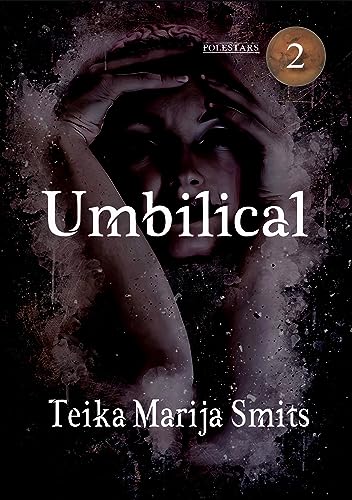
It’s not appeared on my sidebar yet but I am at the moment working my way through the first collection of stories by Teika Marija Smits for a review to be published in ParSec.
 

The book is titled Umbilical and contains twenty-one stories, covering various speculative fiction genres, plus one poem.

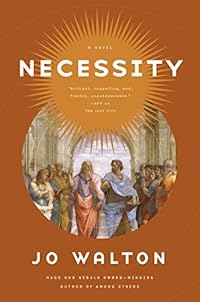
Necessity by Jo Walton

Tor, 2016, 332 p, including ii p Thanks.

This is the last of Walton’s “Thessaly” trilogy in which the author examines the ramifications of implementing Plato’s philosophy in a restricted setting. This is also a scenario in which the ancient Greek Gods are real and can interfere in human affairs. I reviewed the first volume, The Just City, here and the second The Philosopher Kings here.

Necessity takes place in the 26th century on the planet Plato to where Zeus removed the people of the Just City at the end of The Philosopher Kings. As in that second book there are twelve cities in all to cater for people’s various preferences. The climate on Plato is colder than the Greece from which most of the humans now living there were derived. Nevertheless their habitual attire is the kiton. As well as humans, the planet is home to some aliens known as Saeli who have immigrated there and are accepted as full members of society. Contact has also occurred with another set of aliens known as Amarathi. Many tasks on Plato, as in the Just City, are carried out by Workers, sentient robots accorded human rights. One of these, Crocus, has narration duties, as do the humans Jason and Marsilia and the god Apollo. Jason is a fisherman whose crew includes the Saeli, Hilfa, and the present consul Marsilia. He has an unrequited yen for Marsilia’s sister Thetis.

The book starts on the day when Pytheas, the human incarnation of Apollo and grandfather of one of our narrators, Marsilia, dies and a spaceship containing humans (from the planet Marhaba) arrives in orbit round Plato. This last, the reader might have thought, would provide the main thrust of the intrigue/plot but in fact not much is made of it. Instead the thread that is followed is a search for Apollo’s sister Athene who has ventured outside time, to study Necessity, and what Chaos is, and how time began. Necessity is later referred to as a great force that binds all thinking beings. Zeus, the father of both Apollo and Athene, would apparently be displeased if he knew Athene had done this – at least once his attention had been drawn to it – but despite him knowing everything no consequences will ensue if she can be brought back before it comes to his attention.

The human interactions are something of a sub-plot. Marsilia has an eight-year-old child, Alkippe, whom she had conceived with someone calling himself Panodorus. He appears at a gathering but does not recognise her and everyone else sees he is Apollo’s brother Hermes. (Yet even this is another disguise as he is in fact the Saeli god, Jathery.) His failure to recognise Marsilia is because in his time he has not yet met her. This is a potentially disastrous situation since if he does not step outside time then Alkippe may not ever have existed. Again, not as much is made of this situation as might be expected.

Walton it seems is more interested in philosophical speculation than interpersonal (or god to human) conflict. Her writing is fine, though – she can pull you along – and she brings out her characters’ attributes well, but in the end Necessity is a touch disappointing.

Pedant’s corner:- kiton (the spelling chiton displays its Greek origin more clearly,) “we were back on in the peaceful glade” (no need for the ‘on’,) “on a women’s body” (a woman’s.)

The Silence of the Girls by Pat Barker

Hamish Hamilton, 2018, 331 p.

The epigraph quotes a character from Philip Roth’s The Human Stain about the urtext of Western literature. “All of European literature springs from a fight.” And what is the quarrel about? “A woman. A girl really.”

That woman, that girl, is not Helen, proximate cause of the Trojan War as she was. Instead, the object of the fight and so that well-spring of Western letters is Briseis, narrator of this novel (most of it anyway,) torn from the life and comfort she knew as wife to Mynes, king of Lyrnessus, to a reduced existence as slave to Achilles and the unwitting pivot on which the outcome of the Trojan War hinged. This novel is an attempt by Barker to retrieve the memory and experience not just of Briseis, who, after all, like Achilles, Hector, Ajax et al, may be no more than a myth, but of all the women whom myth and history have traditionally made incidental.

The novel is made up of Briseis’s recollections and thoughts with occasional interpolations as if from a reader asking her questions. There are some sections which initially seem like missteps on the author’s part when we shift to a third person focus on Achilles at times when Briseis is not present to observe him but they are there to nudge us in the direction of whose story this really is.

The book starts with Briseis and the women of Lyrnessus waiting for their city to fall to the Greeks, the great war cry of Achilles ringing in their ears. They know what is to come, their men and boys killed, visibly pregnant women speared in the belly on the off-chance they are carrying a son, their futures cut off, any semblance of autonomy erased, taken over as chattels at best and in any case degraded to sexual playthings.

Possibly to bring myth down to Earth Barker occasionally deploys anachronisms. The Greek soldiers sing rugby songs around their tables. When the captured women are paraded before them Briseis hears one of them say, “‘Look at the knockers on that.’” Achilles greets his award of Briseis with the words, “‘Cheers, lads. She’ll do.’” From then her life becomes one of service, and she a thing, not a person; a drudge and object of sexual release. Her only solace is to immerse herself in the sea every evening but she finds the smell of seaweed on her skin and hair arouses Achilles. (His mother was a sea-goddess after all.) There and back, she wanders through the Greek camp in all its rat-infested squalor.

Though Briseis doubts the efficacy of prayers she nevertheless implores Apollo to bring down pestilence on the camp. Whether this is an attempt by Barker to give Briseis some agency is left open but one day a priest of Apollo arrives to plead for the release of his daughter, Chryseis, now Agamemnon’s slave. He refuses. A subsequent outbreak of plague in the camp leads the superstitious sodiers to believe it is Apollo’s revenge for his refusal and Achilles is forced to demand Agamemnon give Chryseis up. He will do so only if Achilles yields Briseis to him. This is the source of their quarrel. An enraged Achilles says to his closest friend Patroclus, “He hasn’t earnt it.” Briseis focuses on that one word: “it. It doesn’t belong to him, he hasn’t earnt it.” Achilles is talking about the honour he’d gained by fighting but she experiences the phrase as being about her. And of course it was. She was the embodiment of that ‘honour’, its symbol, a prize – however unwilling – won for being able to kill people. Achilles cries as she is taken away – but it isn’t for her.

Briseis frequently reflects on the lot of women. “There was a legend – it tells you everything really – that whenever Helen cut a thread in her weaving, a man died on the battlefield. She was responsible for every death.” A slave called Tecmessa relays to Briseis what Ajax said to her when he won’t speak about what’s causing his recurring nightmare, “Silence becomes a woman,” and Briseis tells us, “Every woman I’d ever known was brought up on that saying.” A few days after Achilles kills Hector on the battlefield, the Trojan King, Priam, secretly makes his way into the Greek camp to plead for his son’s body for burial. Kneeling before Achilles he says, “I do what no man before me has ever done, I kiss the hands of the man who killed my son.” Briseis can only think, “I do what countless women before me have been forced to do. I spread my legs for the man who killed my husband and my brothers.” She realises though that Trojan songs and stories would survive since their Greek sons would remember what their Trojan mothers had sung to them. (Curiously daughters are not mentioned here, yet they would surely also pass on those tales and songs.)

For this story, however, the pull of myth is too powerful, the legend of Achilles too strong, “make no mistake, this was his story, his anger, his grief, his story…. I was still trapped, still stuck inside his story, and yet with no real part to play in it.”

As for posterity, “They won’t want the brutal reality of conquest and slavery. They won’t want to be told about the massacres of men and boys, the enslavement of women and girls. They won’t want to know we were living in a rape camp. No. They’ll go for something altogether softer.”

This is not a book I’m likely to forget.

Aside: I suppose this is all moot if we’re dealing with myth but I have mentioned before the problems I have with the concept of a ten year long siege of a Bronze Age city. Here they are compounded by the fact that the men go off to fight during the day – seemingly with mayhem occurring, certainly lots of bloodshed (so where do the reinforcements come from?) – leaving a few behind to guard the ships. But the soldiers return to their huts in the evening to eat, to drink, to argue and to do the other things soldiers do. The text does imply the use of sentries but no consideration seems to be given to the possibility of a concerted night attack.

Pedant’s corner:- Time interval/within minutes count: at least ten. Otherwise; Mynes’ (Mynes’s; all names ending in ‘s’ – Patroclus, Achilles, Odysseus, Chryseus, Alcimus, Peleus etc, have their possessives rendered as s’ rather than s’s,) “around out feet” (our feet,) ceasefire (x2. It’s an odd word to describe an agreed temporary interruption to a war in the Bronze Age, carried out in the main by hand-to-hand combat, ‘truce’ would have jarred less.) “The sound rose to a crescendo” (no it didn’t; it rose – crescendoed – to a climax.)

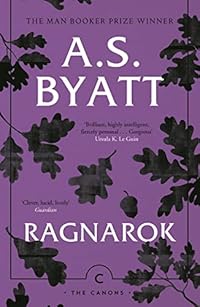
Ragnarok: the end of the Gods by A S Byatt

Canongate, 2012, 179 p – including bibliography and 15 p on Thoughts on Myths.

 Ragnarok cover

This is Byatt’s retelling of the myths of the Norse/Germanic Gods, an interest in which she had indulged during her childhood and rekindled often in the time since. As an author so many years later her entry into the tale is via “the thin child in wartime,” a child who may be a barely disguised version of the young Byatt, a child who reflects on the copies of Asgard and the Gods and Pilgrim’s Progress she had available to read.

That these myths should have resonated with the young Byatt is not too surprising. A child growing up during the Second World War (and who was convinced her father would never return from it) may well have thought the end times were upon her. Adults may have thought so. The contrast with Christian mythology – so milk and water in comparison – perhaps presented the greatest interest. As the child reflects, “It was a good story, a story with meaning, fear and danger were in it, and things out of control.”

It is in the nature of the beast that a myth has to be told. Hence we are not shown anything here except, perhaps, in the sentences relating to the thin child. As Byatt says in her “Thoughts on Myths” afterword, Gods do not have psychology, they have – at most – attributes. Hence in the main body of the book incident is piled on incident. Things happen; but they have a driving force. “Stories are ineluctable. At this stage of every story, something must go wrong, be awry, whatever the ending to come. It is not given, even to gods, to take foolproof, perfect precautions.”

Ragnarök (the word is always spelled this way in the text but in the title has no umlaut) means judgement of the gods; judgement as in trial, not sagacity. For her notional thin child and for Byatt herself the bleak end to the Norse tales is more satisfactory than a return to, or a resurrection of, what had gone before (with which some cleaned up versions end.) “This is how myths work. They are things, creatures, stories, inhabiting the mind. They cannot be explained and do not explain.” In this they may be the opposite of novels, which by and large do.

Some new words to me were eft, gage – as in a gage of honesty – and chaunting as a (not very opaque) variant of chanting but for Pedant’s Corner we had a shrunk count of 1, plus iceflo without its terminal e, stove in (staved in,) and beseeched (besought.)

free hit counter script