Memoirs of a Spacewoman by Naomi Mitchison
Posted in Reading Reviewed, Science Fiction, Scottish Fiction, Scottish Literature at 20:00 on 18 December 2019
Women’s Press, 1985, 149 p. © 1962, First published in the UK, 1976.
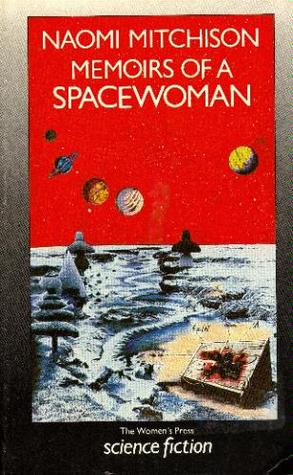
I read this when I first bought it many moons ago but couldn’t actually remember much about it other than it was a bit dry. Re-reading partially reinforces that impression. Much of it is told not shown and the overall effect tends towards the intellectual. That said, it is never less than interesting.
Our narrator Mary is a communications expert who has gained employment on the intergalactic expeditions sent from Earth to contact and understand the aliens on the target planets. Non-interference with the alien life-forms is the guiding principle of the expeditions. On her travels Mary encounters radiates, a bit like starfish, who therefore have no binary view of the universe, and creatures who form grafts on others’ surfaces as a means of reproduction. Mary accepts such a graft and finds herself mentally dissociating somewhat and mysteriously attracted to water. All creatures who agree to such a graft (dogs for example) tend to be unwilling to repeat the experience.
Reference is made to Mary’s relationships with the various fathers of her children but there is more or less no exploration of these and not much more of the hermaphrodite Martian, Vly who somehow manages to engender her haploid child, Viola. (Martians communicate via sex organs.) Keeping contact – or even contemporaneity – with partners is admittedly made difficult by the time blackout caused by space voyaging.
The bulk of the text, though, is devoted to the life-forms on a planet which bears pattern-making “caterpillars” whose patterns are painfully disrupted by “butterflies” they refer to as “masters”. Teasing out the relationships between these creatures takes Mary and her companions a while. Some tension is caused by this as one of the expedition members becomes too close to the “caterpillars”.
In its depiction of a society in which women are on an equal footing with men as scientists and explorers – and in more general senses – as well as in its exploration of the details of alien reproduction Memoirs of a Spacewoman was something of a trail-blazer. That makes it an important (I hesitate to say seminal) pioneering work of SF.
Pedant’s corner:- Extra points for hyaena (now defunct, as hyena has become the accepted spelling.) Otherwise; “I liked in that he had tried” (‘I liked it that he had tried’ makes more sense,) “assemblement of data” (assemblement? Assembly, or assemblage, of data, surely?) “Peder was much interested” (‘very interested’ is the more natural expression,) a missing comma before a piece of direct speech, aureolus (that means golden. I suspect aureola was intended,) in, “We might unwittingly destroy some life which was not induced to move out by any of these stimuli, and of course we destroyed vegetation,” life is contrasted with vegetation (but vegetation is, of course, alive,) Silis’ (Silis’s,) furtheir (further,) Miss Hayes’ (Hayes’s.) Miss Hayes sent off on long expeditions” (Miss Hayes set off on…,) the text describes alien creatures in Earthly terms as eg ‘reptiles,’ ‘caterpillars,’ ‘butterflies’ (I know this usage is for purposes of familiarity for the reader but animals on other worlds would/will not come under the same biological classifications as on Earth,) “as regard” (usually as regards,) follicules (follicles.)
