Archives » Margaret Oliphant

Hester by Mrs Oliphant

A Story of Contemporary Life, Virago, 1974, 497 p, plus xiii p Introduction by Jenny Uglow. First published 1883.

Vernon’s bank is an institution in the town of Redborough. Its stability threatened once by the injudicious conduct – and subsequent flight – of the founder’s grandson, John Vernon, it was saved by the injection of cousin Catherine Vernon’s cash, as a result of which she is held in reverence. The never married Catherine dispenses largesse in the form of grace and favour houses to her relatives but has turned over the bank into the care of her nephews, Harry and Edward Vernon, the first of whom she considers almost as a son. He in turn sees her interest in him as unwarranted surveillance.

After the death of her husband, Mrs John Vernon has returned from abroad with their fourteen-year-old daughter Hester, who knows nothing of her father’s reprehensible conduct, to take up residence in what is referred to as the Vernonry. On their first meeting Hester and Catherine do not hit it off and the two remain more or less antipathetic for the rest of the book.

As the years go by Hester slowly integrates into the life of the town and strikes up a friendship with near neighbours Captain and Mrs Morgan, relatives of Catherine on the non-Vernon side. Their grandson Roland comes to visit and it looks as if he may be a romantic interest for Hester but the plot is to be a little more complicated. Harry and Edward Vernon’s married sister, Ellen Merridew, starts up a series of thé dansants, which are set to be the hub of Redborough’s social life. On Hester’s first attendance, her mother’s pearls (which her mother insisted she wear,) incite some comment. On a later visit to the Morgans, Roland’s sister, Emma, procures an invitation to these events and throws herself into the fray in her search for a husband.

Harry falls for Hester but she isn’t charmed, finding Edward more interesting, if also more annoying. The sustaining of her continuing ignorance of her father’s conduct throughout the book begins to seem unlikely the more things progress but it is tied up with the book’s main thrust as inevitably the bank is threatened once more, Edward succumbing to the excitement of speculative investments. The resolution, though, has at least one aspect not foreshadowed.

The above is only a brief summary – the whole thing is as wordy as to be expected of a Victorian novel – but there is at times a subtle feminism to Oliphant’s prose – there are strong women here and the men can be weak – though the subtlety is at one point betrayed by Catherine’s remark to Captain Morgan, “‘You are only a man, which is a great drawback, but it is not to be helped.’”

Oliphant’s novels are solid pieces of fiction though her prolificity means that perhaps they don’t reach the heights other Victorian authors did.

Pedant’s corner:- a few old usages – inuendo (innuendo,) dulness (dullness,) grumphy (grumpy,) vulgarer (more vulgar,) sha’n’t, secresy. Otherwise; missing commas before pieces of direct speech, “the Miss Vernon Ridgways” (the Misses Vernon Ridgway,) ditto the Miss Ridgways (Misses Ridgway) and “the Miss Bradleys” (Misses Bradley,) “‘a step further that I saw him’” (than I saw him,) wont (won’t,) “‘and she, was far more disposed” (no need for that comma,) “thé dansante” (dansant,) “getting under weigh” (it wasn’t a ship, ‘under way’.)

Chronicles of Carlingford: The Perpetual Curate by Mrs Oliphant

Virago, 1987, 544 p with viii p Introduction by Penelope Fitzgerald. First published 1864.

Frank Wentworth (who appeared as a minor character in The Doctor’s Family) is the permanent curate of the title, in charge of St Roque’s church. As well as his ecclesiastical duties he is engaged in good works, evangelising the bargees of Wharfside in which endeavour he is aided by Miss Lucy Wodehouse. Their appearances together are the subject of warnings to her by an older woman as being liable to gossip. As a perpetual curate Wentworth’s prospects are dependent on either a living turning up elsewhere or the good will of the parish’s Rector.

Unfortunately the new Rector of Carlingford, Mr Morgan, has taken a dislike to Wentworth precisely because of those good works, since he had not sanctioned them. That the previous Rector, Mr Proctor, had done so is neither here nor there. Morgan’s wife has no such objections; her strictures are directed at the hideous carpet installed in the Rectory by the previous incumbent. Of her, Oliphant tells us in an odd unsisterly phrase, “Though she held that elevated position” (wife of the Rector of Carlingford) “she was only a woman, subject to outbreaks of sudden passion, and liable to tears like the rest.” But this is a Victorian novel after all.

Frank’s high church tendencies are somewhat looked down on by his aunts who have the living at Skelmersdale in their gift. Their extended visit to Carlingford coincides with the of the plot.

Frank lodges at Mrs Hadwin’s where he has vouched for a mysterious man going by the name of Tom Smith, who comes and goes by night. Also lurking round Mrs Hadwin’s is Rosa Elsworthy, an orphan taken in by her shopkeeper uncle. She is referred to as a child but later revealed to be seventeen. Finding her at the garden gate as he comes home one evening Frank makes the mistake of escorting her straight home, instructing her uncle to take more care where she is concerned, but is of course seen by those who are out and about. Carlingford is a rumour mill at the best of times and this is a juicy morsel.

A message from his brother’s wife calls him home to Wentworth where Gerald Wentworth, the vicar there, has decided to turn to Rome. Their father is the local squire and greets Frank by “holding out his hand to him as became a British parent.” (Wentworth senior has had various families with successive wives.) With Gerald’s situation not resolved Frank is recalled to Carlingford by a mysterious missive from their elder brother Jack, the black sheep of the family. In the meantime Rosa Elsworthy has disappeared and Frank is given the blame.

The attentive reader notices several thematic and plot similarities to the author’s other Carlingford novels – especially Salem Chapel – and her continuing interest in ecclesiastical doings.

The unravelling of the above plot strands, the identity of the mysterious lodger and his connection with other characters, the resolution, all take some time. The book’s wordiness is of a piece with the Victorian novel and is exacerbated by Frank throughout the book being referred to not only as Mr Frank Wentworth, but at times as the Perpetual Curate, or the Curate of St Roque’s, and even the Evangelist of Wharfside. This is one of Oliphant’s stylistic tics. She far too frequently refers to characters with phrases such as these or attributions like “said the disturbed monitor” instead of using a character’s name. Was this to add to the word count or perhaps to avoid close repetition? In any case, less here is more. In addition Oliphant has Aunt Leonora Wentworth objecting to things “‘ending off neatly like a novel in this sort of ridiculous way,’” thereby bringing attention to the fact that it does.

This is not great literature, but it is serviceable. Oliphant had an audience and catered to it. Presumably they liked what they read.

Pedant’s corner:- “the Miss Wentworths” (many times; the Misses Wentworth,) “the Miss Wodehouses” (also many times; the Misses Wodehouse,) “the Miss Hemmings” (a few times. The surname here is Hemmings, its plural would be Hemmingses; the formulation ‘the Miss Hemmings’ does not make either part plural. Utilising ‘the Misses Hemmings’ would have got round that,) “‘did not use to be so’” (did not used to be,) villanous (villainous,) “upon whom a curious committee of aunts were now to sit” (a … committee … was to sit,) “a group of ladies were visible” (a group of ladies was visible,) “which almost drive that troubled citizen to his knees” (the narrative is in past tense; drove,) “neither here not there” (nor there,) “Virginian creeper” (x 2, Virginia creeper,) “the trouble which has overtaken his brother” (had overtaken,) several instances of a comma missing before a piece of direct speech,) “wiled the night away” (whiled,) receipt (recipe,) unbiassed (unbiased,) “the entire family were startled into anxiety” (the entire family was,) “he put up his handkerchief to this eyes as he spoke” (to his eyes,) “was quite stanch and honest” (an unusual case of ‘stanch’ for staunch’; it’s normally the other way round,) cruelest (cruellest,) dulness (dullness,) fulness (fullness,) mantlepiece (mantelpiece,) “could in this pleasant condition of mind he went down-stairs” (that ‘could’ sticks out oddly,) trode (trod.)

The Rector and The Doctor’s Family by Mrs Oliphant

Chronicles of Carlingford. Virago, 1993, 196 p, plus xii p Introduction by Penelope Fitzgerald.

 The Rector and The Doctor’s Family  cover

Being two shorter works The Rector, not even novella length, and the more substantial The Doctor’s Family.

In The Rector, the old Rector (profoundly Low Church, “lost in the deepest abysses of Evangelicalism”) has died. Mr Proctor – Fellow of All-Souls Oxford – has come to replace him but finds the practice of ministry very different from the academic life he has left. When his aged mother joins him she divines instantly that at least one of the churchwarden’s two daughters will be “intended” for him. He is terrified and reflects, “But have not women been incomprehensible since ever there was in this world a pen with sufficient command of words to call them so? …. And is it not certain that …. every soul of them is plotting to marry somebody? …. Who could fathom the motives of a woman?” Meanwhile his mother, “watched him as women do often watch men, waiting till the creature should come to itself again and might be spoken to.” That fear, combined with Mr Proctor’s total inability to cope with the needs of a dying parishioner and the demands of sociability lead him to reconsider his position.

The Doctor’s Family.
Dr Edward Rider, not the pre-eminent physician in Carlingford – that would be Dr Marjoribanks – has the medical care of the less well-off of Carlingford society. His only burden is that of his waster of a brother Fred, back from the colonies under a cloud, indolent to a fault and an almost permanent resident in an easy-chair. Two ladies arrive at the door one day and Edward is astonished to find that Fred has a wife, Susan – and three more or less uncontrolled children – come over from Australia with Susan’s sister Nettie, who in turn has just about the means to support them. Nettie is the practical one, arranging lodgings for the ensemble in St Roques’s cottage, and undertaking all the work of the household. Edward becomes enamoured of Nettie, but her sense of duty to her sister’s family is so strong that she will not contemplate leaving them for anything.

It is reasonably clear from Edward’s first encounter with Nettie where all this will be going. There are of course minor complications to the narrative, a potential rival for Nettie’s affections in the person of the permanent curate of St Roques’s church, a tentative leaning towards Miss Marjoribanks while Edward works through his irritation at Nettie’s refusal of his own, but even when Fred dies, drowned in a canal after a night in the pub, Nettie will not abandon her duty. Only the entrance of Richard Chatham, another Australian, (un)distinguished by a luxuriant beard – not common in Carlingford in those days, only Mr Lake has such an affectation and his is very much subdued by comparison – changes the dynamic.

Oliphant’s style is wordy, she was a nineteenth century novelist after all, but her eye for the human heart, for its predicaments, is sure.

Pedant’s corner:- In the Introduction, a missing comma before a quote of direct speech, and one missing at the end of such a quote, Freddie (x 2; the text has Freddy,) “between man and women” (men and women.) Otherwise; “the two Miss Woodhouses” (several times; the two Misses Woodhouse,) “‘It did not use to be’” (used to be,) St Roques’ (St Roques’s.)

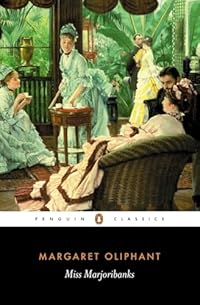
Miss Marjoribanks by Margaret Oliphant

Penguin Classics, 1998, 499 p, plus 21p Notes, 28 p Appendices, i p Contents, iv p Chronology of the author’s life, xxii p Introduction, iii p Notes on the Introduction, ii p Further Reading, ii p A Note on the Text. First published, serially, in Blackwood’s Edinburgh Magazine 1865-6 and in three volume book form, 1866. One of the 100 best Scottish Books.

 Miss Marjoribanks cover

Four years after her mother’s death, Miss Marjoribanks (that designation is used much more frequently than the character’s given name, Lucilla) returns to Carlingford from her education (plus a year’s finishing in Switzerland and Italy) and sets out to redesign not only her father’s domestic arrangements but also the polite society of the town. Constantly declaiming it is her sole purpose to be “a comfort to Papa” she feels duty bound not to marry for at least ten years and none of the eligible bachelors who enter her orbit manages to “engage her affections”. Not Mr Cavendish whose sister is the town mimic, forever taking people off, and whose origins are somewhat obscure but is said to be “one of the Cavendishes”; not the Archdeacon, Mr Beverley, who is favourite to become bishop should Carlingford ascend to the status of a see; not even Mr Ashburton, despite Miss Marjoribanks immediately divining that he is the man for Carlingford when the old MP dies and nudging him onto the path to candidacy.

The first two volumes are given over to the workings out of the relationships between Lucilla and the former two men and the interest shown – especially by the ladies – in any possible match. The third is set after those ten years have elapsed. Much of the intrigue is centred round Lucilla’s institution of “evenings” every Thursday. The narrative is not quite so wordy as a Walter Scott novel but is still fairly prolix, possibly due to its initial serialisation in Blackwood’s Magazine.

Prominent are Oliphant’s thoughts on men as mediated through Miss Marjoribanks’s views and comments. In this discourse pronouns for men as a group are frequently capitalised and italicised as They, Their and Them. One of Lucilla’s observations leaves no doubt as to which she thinks is the more capable sex. “‘I am so sorry I don’t understand about politics. If we” [women] “were going in for that sort of thing, I don’t know what there would be left for gentlemen to do.’” Lucilla’s condescension to the lower orders (such as Barbara Lake and her sister Rose, the latter of whom considers herself eminently respectable, but who are the daughters of the town’s drawing master and so forever below the salt) strikes the modern reader forcibly and seems to reflect Oliphant’s own opinions. However, very little of Oliphant’s Scottish background is evident, really only this, “Dr Marjoribanks was Scotch, and had a respect for ‘talent’ in every development, as is natural to his nation,” but a certain English attitude permeates the sentence, “she had been brought up in the old-fashioned orthodox way of having respect for religion, and as little to do with it as possible.”

It struck me on reading this that Oliphant’s Carlingford novels might make a suitable project for adaptation for TV instead of the usual suspects which are trotted out on a regular basis.

PS: Those of a sensitive nature might note that the text also contains a word which might offend the modern sensibility but which was used thoughtlessly in Victorian times in the line, “the committee, which ordered him about like a nigger.”

Pedant’s corner:- “‘Oh, nonsense, Lucilla.’” (Though she was present, the previous speaker had not been Lucilla,) “‘and me who have such a respect for religion’” (me who has,) “the Miss Browns” (the Misses Brown,) “a succession of dreadful thumps were heard” (a succession was heard,) “the Miss Blounts” (the Misses Blount,) “A series of the most enthusiastic compliments were paid” (strictly, a series was,) “neither of the two were very poetical” (neither of the two was…,) Westeria (wisteria,) goloshes (galoshes,) canvass (canvas, it was for a painting.) “Lucilla caught , as it were, and met, and forced to face her, her informant’s … look” (looks to have a “her” too many and also seems syntactically out of sorts,) two Miss Ravenswoods (Misses Ravenswood,) the Miss Penrhyns (the Misses Penrhyn,) Affghanistan blanket (nowadays Afghanistan.)
In the Notes: “the, shorter, Nicene creed” (the shorter, Nicene, creed,) “the pro-Dissenting wing … were campaigning” (the pro-Dissenting wing was campaigning.)

free hit counter script