Archives » Liz Williams

Worldsoul by Liz Williams

Prime, 2012, 310 p.

 Worldsoul cover

This starts promisingly enough in the prologue when the ancient library of Alexandria lifts off into the sky like a rocket with parts of it still burning. What follows after though is a bit of a disappointment by comparison as its settles down into a tale of fantasy and magic which arguably does not need that preamble at all. When we start chapter one the library has for a long while been in Worldsoul, a place in connection with Earth but also on the border of the Liminality – woven by the Skein out of the legends of the ancestors of man – and a kind of limbo known as the nevergone.

A power vacuum has been created by the sudden unexplained disappearance of the Skein, who used to run Worldsoul, and now various entities are trying to muscle in. It falls to librarian Mercy Fane and an alchemist called Shadow to resist.

Since the origins of the Liminality are not revealed till near the end the mythologies the book draws on appear a bit of a mish-mash with djinns and ifrits, not to mention a Shah, mixed in with demons and Norse gods, Loki in particular. Another off note is the short chapters, which do become more appropriate towards the end when the action hots up but at the start prevent the reader getting to know the characters well enough before being flung off into another viewpoint. Then, too, the action sequences are curiously perfunctory and there is too much info dumping, with a lot of telling rather than showing. The ending screams “sequel coming.” I might give that a long time before ever reading it.

Still, fantasies like this are not really my thing and I have found Williams’s work more palatable in the past.

Pedant’s corner:- Plus points for Abbots General as the plural of Abbot General. Otherwise; the Has’ (the Has’s,) descendent (descendant, which was used later but then reverted to descendent,) Sulis’ (Sulis’s,) “is in the cards” (I’ve always known this as on the cards,) “she would say only that it had been a ploy” (she would say that it had only been a ploy,) dreadnaught (dreadnought, which appeared later,) “the bisecting road ran in either direction” (yes, roads do that; but shouldn’t it be each direction?) stood (standing,) “the no-colour of clear glass” (‘clear glass’ does not mean what this implies; clear itself means transparent. It does not mean colourless.) “But she could not more have resisted it than it any more than she could have flown” (has one ‘more’ too many.) That mean a deeper investigation” (meant,) fit (fitted,) “had made a homunculus of her” (a humuncula, then? Maybe not,) humunculus’ (humunculus’s.) “When it was sure it had got its full attention” (her full attention makes more sense,) “‘I wanted to see what you’d so’” (what you’d do,) “‘Something’s happening?’” (It wasn’t a question,) auroch’s (as far as I’m aware the singular of aurochs is aurochs, so aurochs’s) “all was not as predicted” (that not all was as predicted.)

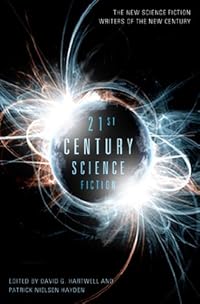
Twenty-First Century Science Fiction edited by David G Hartwell and Patrick Nielsen Hayden

Robinson, 2013, 572 p. Borrowed from a threatened library.

 Twenty-First Century Science Fiction cover

The book cover and spine has 21st Century but the title page Twenty-First Century. The editors choices were made from those writers whose rise to prominence came after 1999 – in a world where they say SF is no longer marginal but a part of the cultural landscape. So to the stories.

In Vandana Singh’s Infinities Abdul Karim is fascinated by mathematics. Visions of beings he calls farishte and sees out of the corners of his eyes lead him to ponder the variety of mathematical infinities and the intersection between transcendental numbers and primes. But life wears him down and his glimpse of the connections does not mesh with the troubles of a divided India. Rogue Farm by Charles Stross is set in a depopulated future and features trees which can store nitrate (effectively making them rockets/bombs) and collective farms composed of several people melded into some sort of tank-like vehicle. I know it was originally published in a US magazine but it’s located in Cumbria yet not only the prose but also the dialogue – with a few exceptions – was written in USian. The exceptions were some unconvincing “ayup”s and a sudden splattering of “Northern” speech in the second last paragraph.

Paolo Bacigalupi’s The Gambler sees an exiled Laotian struggle to get enough click-bait on his news stories, Neal Asher’s Strood features more or less beneficent invading aliens and their pets, which have unusual eating habits. In Eros, Philia, Agape by Rachel Swirsky, Adriana seeks love from and marries a robot called Lucian. Things go wrong when she lets Lucian have free will and their adopted daughter begins to believe she’s a robot. “The Tale of the Wicked” by John Scalzi is an updated version of Asimov’s Three Laws of Robotics stories when the brains of two spaceships in a hot pursuit start to communicate. Bread and Bombs by M Rickert is a post-apocalypse, post twin towers, tale where no-one travels by air, indeed any sighting of an aeroplane is accompanied by fear, and outsiders are treated with suspicion.

Taking its inspiration from a Biblical text and the Uncertainty Principle, Tony Ballantyne’s The Waters of Meribah is set in a universe shrunk to only tens of miles across where a group of scientists is engaged in a bizarre experiment to create an alien in order to break out again. Tk’Tk’Tk by David D Levine features the experiences of a hereditary salesman on a planet inhabited by excessively polite aliens. He comes to an epiphany, as you do. Genevieve Valentine’s The Nearest Thing is the closest to a human an artificial entity can get but the process is neither morally nor emotionally simple for its software designer. In Ian Creasey’s Erosion the comparison evoked by its title is perhaps a touch over-egged in his tale of an augmented human about to leave for the stars out for a last hike along the North Yorkshire coast. Marissa Lingen’s The Calculus Plague tells of the beginnings of transfer of memories by viral infection. One of our Bastards is Missing by Paul Cornell is set in a future where early eighteenth century Great Powers have lasted into the space age, the balance of power is kept steady but they still plot against each other.

A damaged war machine, the last of its platoon, roams the seashore in Elizabeth Bear’s Tideline, collecting material to make memorial necklaces for the fallen. Finistera by David Moles is set on a giant planet with a nitrogen-oxygen atmosphere where floating creatures as large as mountains form homes for people and exploitable resources for the less scrupulous. In Mary Robinette Kowal’s Evil Robot Monkey an augmented chimpanzee wants only to make pottery; but humans – especially schoolchildren – remain humans. The junior of The Education of Junior Number Twelve by Madeline Ashby is the twelfth offspring of a kind of self-replicating android, designed so as not to allow harm to humans. They make perfect lovers though. Even if humans themselves remain as messed up as ever. Toy Planes by Tobias S Buckell sees a Caribbean island join the space-faring nations. Ken Liu’s The Algorithms of Love is curiously reminiscent of Flowers for Algernon in its tale of a designer of truly interactive dolls coming to believe she herself, and all humans, are merely reacting to inbuilt instructions. The Albian Message by Oliver Morton speculates on just exactly what is contained in a pyramid left by aliens in the Trojan Asteroids hundreds of millions of years ago while Karl Schroeder’s To Hie From Far Cilenia supposes layers of “cities” – or at least organised groupings of people – only existing in a kind of online virtual reality parallel to the real world. Brenda Cooper’s Savant Songs is about the search by a brilliant (but socially awkward) female physicist for her counterparts in the multiverse of worlds. Ikiryoh by Liz Williams is reminiscent of Le Guin’s The Ones Who Walk Away from Omelas in that the eponymous child is the repository of all the darkness that would otherwise be present in the goddess who rules. The Prophet of Flores by Ted Kosmatka is set in a world where Darwinism was disproved in the 1950s by dating techniques. Yet on the Indonesian island of Flores unusual bones have been discovered in a cave. The protagonist’s conclusion sticks neatly to the logic of his world.

According to Catherynne M Valente’s How to Become a Mars Overlord each solar system has its own Red Planet and the author provides a stepwise guide to its overlordship but the piece overall is less of a story than a disquisition. In Daryl Gregory’s Second Person, Present Tense Therese has taken an overdose of a drug called Zen, which alters her persona. Her parents don’t accept this. Third Day Lights by Alaya Dawn Johnson features a shape-shifting demon and a human looking for the afterlife of the afterlife. James L Cambias’s Balancing Accounts has a robotic/AI protagonist plying a living for its owners by trading in the Saturn system. An unusual cargo brings problems. A Vector Alphabet of Interstellar Travel by Yoon Ha Lee is another disquisitive story about various different cultures’ star drives. Hannu Rajaniemi’s His Master’s Voice stars a dog (and, yes, it’s called Nipper) seeking the return of its master who has been “condemned to the slow zone for three hundred and fourteen years” for illegally producing copies of himself and, since Rajaniemi sojourned for a while in Edinburgh, could just perhaps have been inspired (a bit) by the tale of Greyfriars Bobby. Plotters and Shooters by Kage Baker is set on a space station dedicated to spotting and destroying Earth threatening asteroids. The station’s hierarchies are disrupted by a new arrival. In The Island by Peter Watts a never-ending mission to seed the universe with jump gates threatens the existence of a millimetre thin organism surrounding its sun like a gossamer Dyson sphere. Escape to Other Worlds With Science Fiction by Jo Walton is set in a world where not only did the New Deal fail but the Second World War did not occur as we know it. By 1960 the US is becoming fascistic. Cory Doctorow’s Chicken Little posits a future where the rich are utterly cut-off from even the wealthy but a drug called Clarity can enable true assessment of risk to take place.

On the whole, strong stuff. There is enough here to suggest that SF is a vigorous culture still.

Pedant’s corner:- “the cluster of competing stories are growing” (the cluster is growing,) metastized (metastasised – I have also substituted s for the USian z,) remittance (remission,) minutia (minutiae,) her sisters’ ability to overcome her fear of their father (their fear?) rung (rang,) “I hate to come out of that jump (I’d hate to,) none of the …. have (none has,) a they as an antecedent to an it, and the killed (and killed,) the architecture of the brains are different (the architecture is different,) a yearning gap (the context suggests yawning gap,) “where his regiment were dining” (his regiment was dining,) a Queen Mother is addressed as “Your Royal Highness,” (I suspect that would still be, “Your Majesty,”) “the Queen Mother’s Office are asking” (is asking,) “the unit are still in the fold” (is still in the fold,) the start quote mark is omitted at a story’s beginning, stripped off (stripped of,) Becqurel Reindeer (they are radioactive, so I presume Becquerel,) borne (born,) Hitchens’ (Hitchens’s – which is used later,) jewelery (the USian is jewelry, in British English it’s jewellery,) the total affect (the noun is effect,) goddess’ (goddess’s, which is used 12 lines later!) equilibriums (equilibria,) Deluvian Flood Theory (Diluvian? – which means flood, so is this Flood Flood Theory?) “Hands were shook” (shaken,) a phenomena (phenomena is plural; one of them is a phenomenon,) “It’s the circulating domain of their receptors that are different” (is different,) sunk (sank,) rarified (rarefied,) talk to the them (no “the”,) none of us get (gets,) aureoles (context suggests areolae,) “that whole series were built” (that series was built,) “a great deal of time to attempting” (no need for the “to”,) “The chained aurora borealis flicker and vanish,” (if its one aurora borealis that should be “flickers and vanishes”; otherwise it’s aurorae boreales.) “We sweeped over the dark waves,” (I think that really ought to be “swept”,) hemi sphere (hemisphere,) the Van Oort belt (a confusion of Oort Cloud with Van Allen Belt?) infered (even USian surely has inferred?) borne of parents (born of; definitely born of.)

Winterstrike by Liz Williams

Tor, 2008. 358p.

For some reason I just could not get into this book and found it a bit of a slog. As it is the first part of a mooted trilogy this was dispiriting. There were thematic and stylistic similarities between this and the Darkland/ Bloodmind duo of books by Williams which I have read in the recent past but Winterstrike seemed to lack something in comparison.
On a far future Mars inhabited by women – any men are of the changed and to be shunned, contact with them is ostracisable – a woman called Alleghetta has her sights set on becoming a member of the ruling Matriarchy. The daughters of her union with her partner Thea are the main focus of the book as they play out the ramifications of the choices Alleghetta has made about their genetic inheritance.

The changed come in at least two types, strangely altered humans known as demotheas and vulpen who seem to be exclusively male. Curiously – and against the normal English usage (ox/oxen, child/children, brother/brethren) – Williams renders the singular also as vulpen.

Not much is made of the all-female scenario. The characters have all the venalities, jealousies and weaknesses that you might find in any society. Beyond the absence of sex scenes there isn’t much to set this novel apart from others. Maybe, however, this was the point.

The Mars in the book is as you might expect, terraformed and with canals on which someone of course takes a trip. This last is the one bit of using such a setting that is almost obligatory: “the best bit” as Colin Greenland once remarked to me. (No criticism here; I’ve done the same myself in my unpublished novel Who Changes Not. )

The two main protagonists are Essegui and Hestia whose paths soon diverge and never recombine, which is something of a fault in a multi-stranded narrative. (The book does end with a message between the two but this serves only to set up the succeeding volume.) Their other sisters Letetui, also known as Shorn, and Canteley are not viewpoint characters but Letetui is the hinge of the narrative. She has associated with a vulpen, been shut away, but escaped.

At times the treatment tips over from SF into Fantasy – or at least there is no convincing explanation of how certain things occur. Williams has shown such sensibilities in the past and this may be one of the reasons why Winterstrike did not appeal. Her descriptive writing, the convincing dropping in of essential detail, can be excellent though.

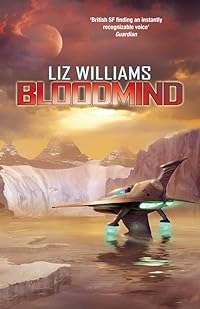
However, when a book fails to grip, infelicities begin to stand out, make the reading more difficult than it might be and, crucially, undermine trust in the author. Examples weren’t hard to find. There is a military aircraft – probably the one depicted on the cover – which Williams dubs a dreadnought and which, to indicate age, is described as having rust on it. Now, I would think that, even on Mars, a flying machine made of iron would have too high a density to get off the ground successfully. Some later chapters are set on Earth and feature a post-warming flooded Ropa (Europe) where there nevertheless is a city with an iron tower still surviving to poke up through the waves. The tower plays an important part in one of the scenes but it seems this iron structure is not susceptible to rust, despite enjoying the optimum conditions for it. Also at one point we have the phrase, “The woman brightened imperceptibly.” Really? If the brightening was imperceptible how, then, did the viewpoint character know it had occurred? There is also some confusion between born and borne.

Maybe it is this lack of the necessary consideration which is at the root of my dissatisfaction. A proper editing could have picked this sort of thing up but, increasingly, books do not receive the sort of close attention during the publication process they once did.

Unlike in either Darkland or Bloodmind this book does not bring all the strands together and as a result ends inconclusively. This is perhaps not surprising from the first part of a trilogy but I did feel somewhat short-changed.

Bloodmind by Liz Williams

Tor, 2007. 293p.

Having now read both it is apparent that Bloodmind and Williams’s previous book, Darkland, are indeed a thematic unity. While both are capable of being read as stand-alone novels they are essentially one book split into two.

Bloodmind is a lessening of sentience, a reversion to animal status, which occurs naturally from time to time to the inhabitants of the planet Mondhile, and in reverse to the creatures known as Selk on Vari Halsdottir’s world, Muspell. It is also induced artificially in the women of Nhem by their male rulers. This last barbarism is strictly necessary to neither plot nor resolution and, apart from being a piece of gender politics, it is difficult to see why else it has been included beyond giving one of the viewpoint characters a reason for being more or less on her own. (I did, however, note that Nhem is men spelled backwards with the interpolation of an h, which may or may not be significant.)

The narrative flits between the three planets and the women whose fates, along with that of the Selk, become intertwined but is mainly carried by Vari, the protagonist whose story links the two books.

As in Darkland the SF and Fantasy elements of Bloodmind do not sit well with each other. The tale is at base a fantasy with SF trappings bolted on and as a result fails on both counts.

Not one of Williams’s best I would say.

There is a span count of 1, sadly.

Darkland by Liz Williams

Tor , 2007. 424p

We first meet Vali Hallsdottir on the planet Nhem, on an assassination mission. Due to an unfortunate love affair with a man who she feels betrayed her (it is a moot point, or insufficiently delineated, whether he actually did) she has come under the influence of the Skald and has vowed not to have sex except as an aid and precursor to killing someone. Vali’s Skald training means she can utilise the seith, a set of enhanced intuitions which is inbred but nevertheless has to be honed.

Asides. 1. The prelude to the assassination is described as a rape but, while to the man concerned it is – as by implication are all the sexual encounters on Nhem, where women have been reduced to the state of animals and are treated as possessions – Vali is complicit in the act (and moreover has to be to fulfil her mission) so the word is not entirely appropriate. Admittedly the true mot juste does not spring readily to mind.
2. Williams describes Vali’s usual sexual abstinence as celibacy. It is, rather, chastity; there is a difference.

Vali’s disguised ex-lover, Frey, accompanied her to Nhem where he seemed to betray her again. He is from the part of the planet Muspell known as Darkland which severed ties with the set of islands known as the Reach a long time before the action of this book since some men disagreed with women’s rights. As the depiction of life on Nhem illustrates, the book is riddled with sexual politics such as these.

Darkland is home to the vitki, people with even more enhanced powers than Vali’s. When Vali subsequently travels there to seek out Frey and gain her revenge she encounters a vitki called Thorn who has plans for her.

Williams has her characters on Muspell descended from islanders – specifically from Orkney, Iceland, Greenland and Eire. As it is set 2000 years after these people left Earth I’d have thought old names might have been forgotten. Yet places are called Stronsay, Tiree and Coll, and a stretch of water is known as the Minch. (This is a curious echo of Mike Cobley’s Humanity’s Fire trilogy where Scots, Russians and Scandinavians settled a planet they named Darien.)

Darkland often veers over from SF into fantasy territory; no more so than in the other strand of the narrative set on the planet Mondhile, where a young man called Ruan is strongly attracted to a mysterious tower embodying a dark energy of some sort and to the strange girl called Gemaley who lives there. The off-worlder who is also entangled with Gemaley is of course Frey. Alerted to Frey’s whereabouts by Thorn, Vali soon arrives on Mondhile, where the bulk of the book is set.

The novel is actually two different stories; a first person narration SF one centred on Muspell, the Reach and Darkland and a third person crypto-fantasy on Mondhile. Williams does attempt to give the dark powers on Mondhile an SF gloss but it is never convincing. So too with the presence of Frey on Mondhile which seems merely to be a device to bring Vali there. The SF-ness of the Muspell sections and the fantasy slant of the Mondhile segments did not sit well, I thought.

The problem may be that the overall story was probably conceived as being longer and had to be split for publication. (SPOILER ALERT – Darkland ends with a cliffhanger.)

The “sequel” – I wait to read it before being certain – is called Bloodmind. The idea of bloodmind is mentioned several times in this volume and is a temporary switching off of humanity in Mondhile’s inhabitants: again given a somewhat unconvincing, not to say sketchy, technological rationale.

I’ll reserve full judgement till I’ve read that book.

free hit counter script