Archives » Kenneth Branagh

Dunkirk

Syncopy Inc. Directed by Christopher Nolan.

Since our move to Son of the Rock Acres we’re now close to a “proper” cinema, the Kino. It’s not a separate building though but part of Glenrothes town centre, though accesssed from outside. We still don’t go often but the good lady took a fancy to the new film about Dunkirk so off we toddled.

The film dispenses with any preamble or scene setting about the situation leading up to the retreat to Dunkirk and starts with a group of British soldiers moving through the streets of Dunkirk with paper leaflets falling down around them. One looks at a leaflet to see the phrase “We Surround You” and arrows pushing in towards the English Channel – presumably a facsimile of a real German propaganda leaf drop at the time and probably where Dad’s Army took the idea for its opening credits from. Suddenly the men are fired on and they start running – and dropping like flies. Eventually one reaches the beach and the hordes of men waiting there.

We then move to the situation at the Mole (Dunkirk harbour’s long pier) which features Kenneth Branagh as Commander Bolton, in charge of naval affairs there.

The action then switches to the “small boats” being requisitioned by the navy with particular emphasis on one boat. (Mark Rylance puts in a fine performance as the boat’s master but all of the acting was convincing.)

Then we are transported to an RAF patrol of three Spitfires flying to the Dunkirk area with the leader warning his team to keep an eye on fuel levels.

The film intercuts between these four scenarios at (ir)regular intervals and repeatedly shows the same incident but from the several differing viewpoints.

Most of it, though, displays a distinct lack of heroism, men fetching for themselves, queue-jumping, arguing, though others (Royal Engineers contstructing makeshift jetties out of whatever is lying about on the beaches for example) are trying their best to muddle through.

But that is how it would have been. For a soldier Dunkirk must have been anything but heroic. A frantic mixture of hope and fear and endurance with even rescue from the beaches no guarantee of a safe journey home what with the gauntlet of bombers and U-boats still to run.

If anything it is the efforts of the RAF pilots that the film emphasises – despite the complaint after a Stuka attack on the beach of “Where’s the ruddy Air Force?”

I could have done without the swelling strings (a very slowed down tempo for Elgar’s Nimrod) when the small boats started to make their appearance off the beaches, though.

It also seemed odd to me that Rylance’s small boat took its cargo back to Dorset – that’s a long way from Dunkirk and far from the nearest point in Britain. And I had the impression from my reading that the small boats were mainly used to ferry men from the beach to destroyers etc lying off-shore.

The film touches on the point of the soldiers feeling that they had let the country down and dreading the reception they would get on arrival only to find they were being greeted with cheers. It is still strange that the “Dunkirk spirit” is invoked by those who wish to big Britain up. As Churchill said at the time, “Wars are not won by evacuations.”

The second last image – of a burning Spitfire on the beach – seemed emblematic of a Britain that has lost its way and won’t easily find it again. At least in 1940 it only took four years for Britain to get back into Europe.

I saw in the credits at the end the name of one Harry Styles. I knew of the name of course but could not have put a face to it.
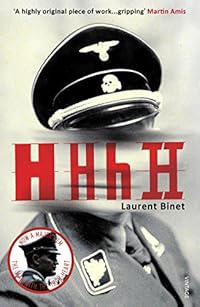
HHhH by Laurent Binet

Vintage, 2013, unpaginated. Translated from the French HHhH (© Éditions Grasset et Fasquelle 2009) by Sam Taylor.

 HHhH cover

HHhH is a strange book, claiming to be a novel, but which is also a historical account of Operation Anthropoid, the British-backed mission to assassinate the head of both the Gestapo and the SD and architect of the Nazis “Final Solution” to what they called “the Jewish Problem,” Reinhard(t) Heydrich, (he removed the final “t” of his forename to make it sound harder) in Prague in 1942. The narrator makes much of his attempts to be true to his characters’ actual lives, saying he will eschew invention of dialogue where possible, commenting on occasions where he does so. He asserts his heroes are the assassins, Jozef Gabčík and Jan Kubiš (one Czech, one Slovak at the insistence of President-in-exile Beneš) and other members of the resistance, yet they and the assassination itself take up only a small portion of the novel which is really the story of Heydrich’s life and an examination of the insanities of the Nazi belief system and organisation. Along the way we delve deep into the roots of the Czech-German dispute – in mediæval times a Bohemian king invited miners from Germany to exploit the silver deposits found in his kingdom – we digress into the origins of the Reformation in the Hussite heresy and, solely because Heydrich visited Ukraine, the heroism of the Ukrainian footballers who took on the previously undefeated Luftwaffe team with ten men and despite being warned to lose at half-time, triumphed 5-1. A few days later they also won the return against a team bolstered by “professional” players from Berlin. [I put that “professional” in quotes because I’m sure I read somewhere else – probably in Inverting the Pyramid – that the pre-war German game was amateur and the Nazis believed only amateur sport was true sport. Professional football only developed in Germany after the war.] The Ukrainians also won the hastily arranged return match and all but three players, who escaped in the confusion of a pitch invasion at the end, were executed.

The narrator mentions the many books and films featuring Heydrich and/or the assassination which he has sought out or encountered – mainly to emphasise their historical inaccuracies – and puts in a good word for Conspiracy where Kenneth Branagh portrayed Heydrich at the Wannsee Conference but scorns most other representations. Despite his apparently encyclopædic knowledge of Heydrich’s afterlife in book and film he makes no mention of the only other I have seen bar Conspiracy, a film called Operation: Daybreak starring Anthony Andrews as Gabčík, but he does dwell on the novel on which the film was based, Seven Men at Daybreak by Alan Burgess.

The first person narration is a piece of authorial trickery. We are invited to believe it is by Binet himself but the narrator does his military service teaching French at an academy in Slovakia, Prague is the city he loves most in the world, yet the author is French – HHhH won the first-novel Prix Goncourt in 2010 – and the constant references to his attempts to establish facts (for example he dithers over whether Heydrich’s Mercedes was black or green; his memory has it as black but the museum exhibit he saw may have been a substitute, an otherwise reliable book has it as green) subtly undermine reliability. In a sly aside he mentions that – contrary to the perennial defence trotted out by ex-Nazis to defray blame for their actions – Heydrich was not averse to disobeying orders when the opportunity to be lenient was available. Heydrich was never lenient.

It seems Heydrich was also supremely arrogant, usually travelling round Prague with no escort, a fact which troubled Albert Speer on his visit to the city and to whom Heydrich says in the novel, “Why should my Czechs shoot me?” Heydrich had previously been shot down on the Eastern Front after a reckless chase of a Soviet plane in an attempt to make himself a war hero, causing great apprehension in Berlin till he got himself back to German lines. Hitler banned any further such adventures. Yet Heydrich didn’t learn. His only companion on the day of the assassination was his driver. After his death the book has Hitler berating his carelessness, saying, “Men as important as Heydrich should always know that they are like targets at a fairground.”

Except for those parts dealing with the narrator’s research and primary readers’ comments the book is for the most part written in the historic present. (John Humphrys would not like it, then.) Its unusual title is from the German Himmlers Hirn heisst Heydrich (Himmler’s brain is called Heydrich.) The original title Operation Anthropoid was apparently “too SF” – !!!! – “too Robert Ludlum.”

The climax of the German hunt for the assassins and their comrades, fruitless until they were betrayed by a fellow parachutist for the reward of twenty thousand crowns, is dealt with in a few pages. Of course, there are no eye witness accounts of the final moments in the crypt at the church of Saints Cyril and Methodius, as the group held out till their ammunition was about to be exhausted and killed themselves with their last bullets.

The narrator quotes George Sand – “Struggle against those who tell you: ‘Work hard to live badly’” – which he says is “not an invitation to digress – it’s a demand.” One of the Nazis is stated as thinking, “Scapegoats at all costs – that could be the Reich’s motto.”

Notwithstanding the lack of tension – surely any interested reader will already know the outcome – and the digressive nature of the treatment the book is immensely readable. It’s easy to see why it won the praise it has received.

The translation was excellent (except for its unfortunate forays into USian – ass for arse, jerked off.)

free hit counter script