Archives » Joan Slonczewski

The Highest Frontier by Joan Slonczewski

Tor, 2011, 489 p.

There is not much Science Fiction that deals directly with politics. It’s possibly too contentious a subject. In The Highest Frontier, though, Slonczewski extrapolates from the US situation of the 2000s to present a scenario where a fundamentalist group known as Centrists states baldly that the Sun (and the Firmament) go round the Earth and whose adherents form the core of one of the two main political parties. There has been a sort of balance between those two parties lasting many elections – a statistical tie the last five times – but the results have been accepted, albeit with riots following the count. (Riots apart that is not arguably as grim as things have turned out in the real world where US election results are questioned simply because one side believes that no-one could possibly have voted for the other or else that their opponents’ votes have been inflated nefariously and therefore the elections were fraudulent. No one in Slonczewski’s scenario is claiming election fraud.) A man known as the Creep, due to a medical intervention after an accident leaving only his head and hands as original to him: those hands have a tendency to move away from his body, has been Vice-President for the last several terms. Candidates chose someone else as running-mate but they always got dropped as liabilities just before the vote. Direct taxation seems to have been relinquished – what a USian notion – instead people known as taxplayers have levies placed on their gaming activities.

This is not to say that politics is all that the book concerns itself with, even if Cuba is the fifty-second state of the Union. Global warming has led to Dead zones and migration northwards in the US, a type of plant known as ultraphyte (it ‘feeds’ on uv light) threatens to engulf Earth’s habitat niches and is a further source of political contention.

Jenny Ramos Kennedy is a child from a political family with ancestors and living relatives on both sides of the political fence who have been Presidents. She has been sent to a college on a space habitat known as Frontera to complete her education. Her twin Jordi with whom she was supposed to attend Frontera recently died in an accident and she has been assigned a companĕra roommate called Mary, who is strange. Access to off-world is via a space elevator built from anthrax. Biological engineering is advanced enough to render the material both strong and unharmful. On Frontera, amyloid and carboxyplast are the main structural materials. Resources seem not to be much of a problem at least for the rich. Jenny prints her clothes everyday. Mini versions of Earth creatures provide a simulation of everyday fauna. A political course for some reason leans heavily on Theodore Roosevelt and presumably in his memory the bears on Frontera resemble the toy ones named after him. A version of the internet called Toynet exists. It connects to someone’s personal toybox, is accessed by brainstreaming and usually manifests as an intrusive news service fronted by a reporter called Clive. Frontera’s power source can occasionally be cut off by orbiting debris but does engender the rather pleasing portmanteau word solarray.

There is a ton of such explanation at the beginning of the novel, more often than not clunkily introduced. It slackens off somewhat later on but never entirely disappears.

Jenny’s life is complicated by her family’s political connections. She also is an adept at a game called slanball, a sort of cross between hockey and quidditch only with no magic. The act of slanning instead involves brainstreaming. Her coach is of the strict nothing-must-interfere-with-training type with whom Jenny’s volunteering as a medical first responder and her occasional lack of sleep do not go down well. The game seems to be forgotten about in the latter half of the book, though. Jenny also involves herself with local politics. Voting in these elections includes a ridiculous stipulation that people vote in person, handwriting their choice into the ballot book using a uranium based ink.

Early on in her studies Jenny is told that ultraphyte genes have been found in pileworms. Her tutor leads her into research on plants which can “laugh” due to the introduction of neurons. These are developed into Arabidopsis sapiens and Mary instigates experiments with negative and then reverse controls, which become wisdom plants. Here someone mentions a Greek tag Sophia philai paromen, wisdom is the highest frontier, from which Slonczewski presumably took her title. The plants’ placement onto the stage of a Presidential debate leads to an unusual exchange between the candidates.

Jenny’s attraction to fellow student Tom is par for the course for a tale of an older adolescent – they have the usual misunderstandings and some awkwardness as regards their relative social status – but Slonzcewski’s treatment of such young love and sex is rather coy, in the latter case to the point of blink and you might miss it.

In this future more or less everyone is in effect their own political commentator/extrapolator – a nod to an SF forerunner is provided by a poster of the fictional political predictor Hari Seldon on a classroom wall.

However, the conclusion by some of Slonczewski’s characters that voting is no longer of any utility is a dangerous concept.

Pedant’s corner:- descendents (descendants.) “The faculty were full of expertise” (the faculty was.) “The college ran their own taxplayers rehab” (the college ran its own,) “the amyloid liquified (liquefied.) “The medibot shined a light on his face” (shone.) “A crude pixilated window opened” (pixilated means ‘drunk’, a computer screen window cannot be drunk; ‘pixellated’,) “said Tom said” (either ‘said Tom’ or ‘Tom said’,) sunk (sank.)

Brain Plague by Joan Slonczewski

Tor, 2000, 382 p.

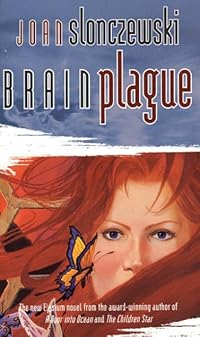
 Brain Plague  cover

Since the events of The Children Star – the third in Slonczewski’s tales of The Fold – the people of Valedon have come to terms with the microzoöids found on the planet Prokaryon spreading through their population. With some hosts the tiny creatures are under control (usually by means of restricting access to the arsenic necessary for their survival but also via rewards of the chemical azetidine,) in others their proliferation runs rampant resulting in a disease (the Brain Plague of the title,) whose victims become zombie-like. A rogue human element known as slavers promotes fear in the population by abducting citizens to their concealed planet.

The book’s protagonist is Chrys (Chrysoberyl,) an artist who can see infrared. Initially she is struggling to pay her rent and keep painting and when she is introduced to her colony of microbes, which reveal themselves and communicate with their host by flashing colours in the host’s eyes, some of her former friends and associates withdraw from her. Since the hosts have power of life and death over them the microscopic creatures refer to their hosts as gods. They also have only a limited understanding of their hosts’ lifestyles.

Chrys’s colony, known as Eleutheria and to whose leaders she gives names corresponding to the colours with which they “speak” to her, inspires her work and her paintings become collectable. Her microbes are also mathematicians and allow her to gain a contract to refurbish a failing piece of architecture known as the Comb, whose ever expanding structure has become unstable. The colony members’ lifespans are short and they have their internal politics for Chrys to contend with.

There is plenty of Valedon politicking to occupy Chrys outside all this and some intrigue involving the slavers whose secret planet she is the first to be abducted to and return to tell the tale.

Brain Plague is 392 pages of fairly small font size print and continues Slonczewski’s trait of incorporating biological and chemical ideas into her SF. It is rewarding enough reading and deals with a common SF concern (alien invasion of the body) with an unusual slant.

Pedant’s corner:- shrunk (shrank,) “the stress must have wreaked its program” (wrecked, I think, [and I spell it ‘programme’,]) “the shear newness” (sheer,) “laying low” (lying low,) a missing quote mark at the end pof a piece of direct speech. “The sphere cut in, it’s the plane of section…” (The sphere cut in, it’s plane of section.) “She shined her light inside” (shone.) “‘Such an distinctive cut’” (Such a distinctive cut,’) “Chrys grasp his back” (grasped.)

The Children Star by Joan Slonczewski

Tor, 1999, 347 p.

The Children Star cover

This is another of the author’s tales of the Fold, an interstellar polity which we have met before in A Door Into Ocean and Daughter of Elysium.

Here, a prion plague known as the creeping is devastating the human population of the planet L’li. A L’liite child called ’jum G’hana is rescued by Brother Rhodonite and taken to Prokaryon, a planet where the living things all contain ring-shaped structures in their body plans and chromosomes. Zoöids are animal-like, phycoöids resemble plants, phycozoöids display plant and animal traits, while the microzoöids are microbes. The planet is also rich in arsenic. Humans need to be life-shaped to survive there, a process which works better the younger you are. Adults have almost insuperable difficulties in being adapted. ’jum G’hana is on the cusp. She does, however, have a facility for numbers, especially primes which she calls ‘orphans.’ Sarai, a Sharer lifeshaper working on Prokaryon, connects the tale more directly to Slonzcewski’s previous novels of the fold, which were both set on the Sharer’s home planet of Elysium. Sarai’s adoption of ’jum G’hana as a co-worker has ramifications later in the book in whose initial stages the narrative flow is cramped somewhat by the intrusiveness of the author’s information dumping.

While there is a diversion into interstellar politics Slonzcewski’s interest in The Children Star is on the biology of Prokaryon. Tumblerounds have a triplex DNA and reproduce by splitting three ways down the middle. Microzoöids contain a brain’s worth of data in a single cell and are capable of ‘infecting’ humans. This is the main engine of the plot and an explicit threat to Prokaryon. The Fold’s authority debates whether or not to destroy Prokaryon’s indigenous life-forms (by a process known as boiling.) That at least some of these turn out to be intelligent would be their saving.

It’s all readable enough – and more so than Daughter of Elysium. To have such a focus on biology at the microscopic level is an unusual trope in SF, but Slonzcewski is herself a biologist so that isn’t too surprising. The characters tend a bit to the stereotypical, however.

Pedant’s corner:- Sari (elsewhere Sarai,) clear (used as equivalent to colourless. Clear does not mean this, it means transparent. Objects can be both clear and coloured.) “Rod would never has asked” (never have asked.) “Patella came because is a Spirit Caller,” (because he’s a.) “Khral’s voices was softened” (Khral’s voice was softened,) ’jum Ghana (elsewhere always ’jum G’hana,) “or she would not have designed to come” (deigned to come makes more sense,) “he picked her up and folded her in her arms” (in his arms,) kidnaped (kidnapped,) “ten thousand-odd items priorities by her nanoservos” (prioritised makes more sense,) “only a few last long enough to secret toxins” (to secrete toxins,) odiferous (usually spelled odoriferous,) “others such correlations” (other such correlations.) “There … were a group of tumblerounds” (there … was a group.) “And what would the Fold do when they found out?” (And what would the Fold do when it found out?,) “all-to-familiar” (all-too-familiar,) “knew them better, perhaps, even then they knew themselves” (even than they knew themselves,) descendent (descendant.) In the Appendix (a description of the life-forms of Prokaryon): “Rotate as they swims through the water.” (Rotate as they swim through.)

Daughter of Elysium by Joan Slonczewski

Avonova, 1994, 525 p.

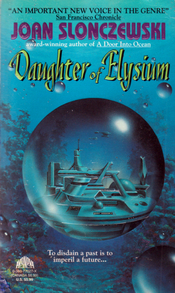
 Daughter of Elysium cover

Raincloud Windclan is from the planet of Bronze Sky where women are called goddesses, and have the dominant role in society. She has come to Elysium with her family to avert a confrontation between its inhabitants and the apparently aggressive planet of Urulan. Elysium is a city established on the water-world of Shora but separate from the raft dwellers of that world familiar from Slonczewski’s previous novel A Door into Ocean. Raincloud’s husband Blackbear is a scientist set to investigate the possibilities of restoring fertility to Elysians, whose “children” – known as shonlings from the crèche-like shons where they are brought up – are artificially generated since Elysians’ longevity treatment has modified their chromosomal DNA and conferred sterility. By treaty with the Shorans, though, the numbers of Elysians are meant to be kept steady.

Elysian society is attended to by genetically modified creatures known as sims, and artificially intelligent servants much given to intoning, “Please refer any fault to…”

There are, then, several conflicts built into this scenario as well as, in the persons of the Blue Skyans, a contrast with the gender norms of the time when Slonczewski was writing. Raincloud is an adept practitioner of martial arts, which gives her honorary male status in the eyes of the Urulite Ambassador to Elysium. Later, on Urulan itself, subjected to an attempt to murder her companions she muses, “Men were supposed to be wholesome nurturing creatures, not predators.”

While it is gratifying to a Chemistry graduate like myself to read of acetyl and methyl groups and glucosamine in an SF novel and there is a concentration on domestic life usually absent in such genre works this one is marred by excessive information dumping. Another flaw is that we don’t meet the indigenous inhabitants of Shora till well through the book. The enmeshing of all the elements of the set-up into the plot and its resolution is well-done though.

Pedant’s corner:- dumfounded (dumbfounded.) “Did not ‘death’ equate ‘shame’ in the Urulite tongue?” (equate with,) unsubstantially (insubstantially.) “Her breasts peeped out cheerfully beyond her bare back and shoulders,” (is some anatomical feat,) nanomanipulaters (nanomanipulators.) “What would Public Safety think, he wondered” (needs a question mark,) “either she was growing up – or just saving her spit” (??? Is this a USian phrase?) syllabi (I prefer syllabuses, it’s not originally from Latin.) “His chest was crossed with ropes of milky gems set in good Blackbear stared” (???? ‘… set in gold’ and a missing full stop?) “A number of long-necked reporter servos were on hand” (a number … was on hand,) “until the Gathering sent their messengers” (until the Gathering sent its messengers.) “Raincloud though it very likely” (thought it,) “took things in stride” (in her stride, please,) “‘except prone’” (the context demanded ‘supine’, not ‘prone’,) “who had woken at last and began to wail” (the ‘had’ carries over, so ‘who had woken at last and begun to wail’,) “‘none of the worlds we deal with are as safe as Elysium’” (none is as safe.) “None of the Guardians were allowed to leave” (none of the Guardians was allowed to leave.) “None significant were found.” (None significant was found.)

A Door Into Ocean by Joan Slonczewski

Women’s Press, 1987, 410 p.

The novel starts off on the planet Valedon but is mostly set on its aquatic satellite, Shora, inhabited for centuries solely by women. They wear no clothes since they spend a lot of time in the moon-spanning ocean and have a bluish tinge due to microbes which, in the aquatic environment, help them to maintain breath. In contrast to Valedon – a world where the usual vices of political power are prevalent and which seems to be a militarily directed society – life on Shora is peaceable, its values based on sharing learning, and where the highest form of punishment is Unspeaking (that is, sending someone to Coventry.) They are also capable of a state known as whitetrance, a type of withdrawal where their hearts slow almost to death. The Shorans live on rafts of plant material floating on the water’s surface and have an appreciation of the interactions between all the life-forms – beneficial or seemingly inimical – that make up Shora’s web of life. They also have a deep knowledge of biology and genetics and a plant-based means of expressing new organisms quickly.

Traders from Valedon – sometimes known pejoratively as malefreaks – have been present on Shora for years and Berenice Hyalite – known on Shora as Nisi – has come to a deep understanding of its way of life. Her father set up the trading post but she reports back to the rulers of Valedon. There is some interplay between Valans and Shorans on whether the others are really human with respect to each other but all the characters present as recognisably so to the reader. Berenice’s fiancé Realgar is a military man, and he is given the command of the Valedon forces sent to Shora to bring it fully under control.

The novel is thus set up to explore the mutual incomprehension of the military mindset and the habitual, instinctive, non-violence of the Shorans. It can therefore be read as a feminist work but is equally parsable as a Science Fictional exploration of a different approach to life’s challenges. In A Door Into Ocean Slonczewski is exploring an alternative way of being human. This is partly territory pioneered by the late lamented Ursula Le Guin. Slonczewski is no Le Guin but is good enough to be going on with.

Pedant’s corner:- laniard (lanyard,) “Berenice like to absorb” (the rest of the paragraph was in past tense, so, Berenice liked,) maw (mouth was implied, a maw is a stomach,) sunk (sank,) shined (shone,) octopi (octopuses, or, octopodes, but since we’re on an alien planet, octopods,) sprung (sprang,) “I could take take pills” (only one take needed,) “‘You could to that?’” (do that,) brusk (brusque,) langauge (language,) “more that she let on” (than she let on,) “was kept with in raftwood” (within,) strategem (stratagem,) collander (colander,) waked up (woken up,) automatons (strictly, automata.)

The Wall Around Eden by Joan Slonczewski

Women’s Press, 1991, 288 p

The Wall Around Eden cover

It’s the little things that niggle. One of the families in this book is Quaker, of the strict variety. And they address others as “thee” (except in the possessive when they use “thy”.) This is fine, but…. Bar once, they never use the form “thou” – and in the nominative case they ought to. I found this omission intensely irritating (though I’ll admit that “thou” would require, for example, the verb form “seest” as in “thou seest” rather than the author’s “thee sees.”) Do strict Quakers in the US actually use “thee” in this way? In any case Slonczewski and her characters are clearly aware that the “thou” form exists as in that one instance Daniel Scattergood uses it in the punning phrase “an I for a thou” when he and Isabel Garcia-Chase are exchanging images with an alien artefact. It also occurs in, “She had watched it for too long not to think of it as thou” when Isabel has an apparently wounded keeper at her mercy. Very annoying.

Then too, Slonczewski has her characters reference various works of Science Fiction which, although it provides a means of explaining the topographical relationship of the alien Pylons which link various human settlements together with a central core, comes over more as her demonstrating an awareness of the genre rather than something organic to her creations.

But to the tale. It’s set in the aftermath of an atomic war in which aliens called Keepers may or may not have had some part but where most of humanity and other life failed to survive the ensuing nuclear winter. Those who did now live in domed cities created by the aliens. These have an impenetrable barrier (the wall around Eden of the title) to the outside and also a walled off Pylon at their centre, plus flying aliens (or alien artifacts) called angelbees – who see infra-red – roaming the air inside the domes. There are very few of these environments – none in Europe – the main one is in Sydney, Australia, but ours is in Gwynwood, USA. Courtesy of the aliens the domed cities are kept in touch with each other by a teleportation technology.

Sunlight can penetrate the wall around Gwynwood but snow cannot; nor can animals – the outside is littered with the bones of the dying, humans among them, attracted there by its warmth and light in the days of nuclear winter – but there is weather inside (not to mention bluejays, mice and squirrels.) Despite references to the growing of crops and fruit – and their contamination with radiation via the groundwater – Gwynwood seems rather too small to create that internal weather, and to be self-sufficient. Yes, imports come in from Sydney but these seem to be mostly technological or medical. I did wonder how even the small number who live there managed to survive. Their existence is summed up by one of them remembering Chief Seattle, on being taken to the reservation, “It is the end of living and the beginning of survival.”

No matter; the main story is of Isabel’s quest to escape Gwynwood, join the Underground and eject the aliens from Earth. Somewhere along the way it turns into a voyage of discovery about the nature of the Keepers and their purposes. Slonczewski does the discovery stuff very well and the central message – unusually for a post disaster novel – is of hope but I was left wanting more.

Pedant’s corner:- there was a “sprung” count of one (but sprang was used elsewhere,) the now very unPC, “We’ll watch the poofs at Les Girls.” “But King George (III) was a tyrant” is a very USian sentiment. We had crèche (for nativity scene,) rhinoceri (the word ending is plain wrong; its root isn’t from Latin, the English plural is rhinoceroses anyway,) calling an in unimaginable variety (in an,) polyhedrons (it’s from Greek so the plural is polyhedra,) shined (shone,) could have mowed us down (mown.)

free hit counter script