Archives » Jeff Noon

The Body Library by Jeff Noon

Angry Robot, 2018, 380 p.

The first sentence of this novel sets the action in 1959. But it’s not the 1959 of our world. Though the tale proper starts off in a noirish way a prologue chapter has already revealed to us an apparently dead man on a library floor whose skin is covered in words; not tattoos, since they’re moving. A man covered in stories.

For we are in Storyville. A city run by a Narrative Council. A city whose suburbs and streets are named after writers – Lower Shakespeare, Rabelais Walk, Calvino Road, Plath Lane etc. There’s even a Bradbury Avenue, plus an Asimov reference. A pivotal location is the Melville Estate, particularly Melville Tower Five.

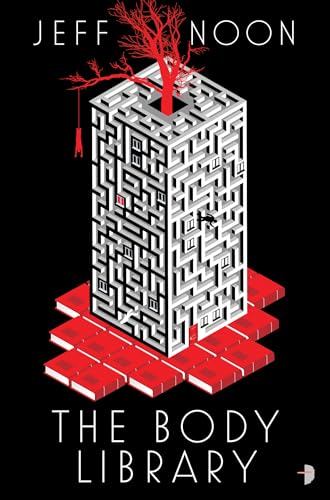
Our protagonist is Nyquist, a private investigator whose current case involves following a man called Patrick Wellborn. Inside Melville Tower Five Wellborn attacks him with a knife and Nyquist kills him in self-defence. Ramifications ripple out from this act. A woman named Zelda Courtland was to meet Welborn in the Tower and becomes embroiled with Nyquist. This brings them both into conflict with a heavy called Dreylock whose body is criss-crossed with scars, liable to open at any moment and pour blood everywhere. Bee-like creatures known as alphabugs, each marked with a glowing letter, – though never an ‘x’ – occasionally flit about. Partway through the novel we discover Melville Tower Five has a tree growing up through its floors – all the way to the roof and beyond. Whether this is meant to refer to the Yggdrasil legend is not entirely clear (though seems likely) but it nevertheless comes over as a bit gratuitous.

Referentiality or self-referentiality is a recurring emblem. Nyquist is a character in a book who comes to think of himself as a character in a book – or is at least reading about “himself.” He encounters pages from The book – called The Body Library, fragments written in midnight’s ink. The pages of the book can be burned and the smoke inhaled. Later we read, “The night had been cut up into pieces, sliced by a blade into strips, and then glued back together in the wrong order.”

In his search for the lost Zelda Nyquist comes across the place where she is said to have been executed. A boy witness says to him, “‘All the stories, mister …. all the lousy, unwanted, lonely, disgusting, forgotten stories, all the tales that no-one wants in the city, they flow through the pipes, they get flushed clean away and they get pumped out, right here, in the mud and the dirt and the shit.’”

Dreylock tells Nyquist, “‘The Body Library is a novel, a book, and a rather special one at that.’” Made of extracts of cut-ups and splinters. “‘Everything that happens in this tower’” says Dreylock ,…“‘happens because of The Body Library.’” The book contained the city, it was the city. For the people whose skins are covered in words midnight’s ink makes them believe they’re inside a story. “‘Words make us, and keep us. Words embrace us. Words save us from our true selves, covering us in story. Words deliver us from everyday life.’” A woman called Daisy says, “‘Zelda was scared to death of words.’” Storyville’s Grand Hall of Narrative Content, where the city’s inhabitants’ stories are being written down, is an instrument of control.

The whole thing of course is a metaphor for reading – even a pleading for the necessity for story. But it’s slightly misplaced. However much an author may try to steer the reader to a certain point or conclusion he or she is not in sole charge. The reader brings his or her own experiences to the enterprise, makes his or her own judgement while they are reading. Sometimes that means concluding the author has gone too far. In literature, less can be more.

Pedant’s corner:- Written in USian. Otherwise; “femme fatales” (fatale is an adjective here – even in English. The noun is ‘femme’, its plural is ‘femmes’ hence we should have ‘femmes fatales’.) “‘So why don’t you sit down and tell me.’” (Is a question and so requires a question mark at its end.) “He hardly noticed when one of the screws worked itself free” (a page earlier he had been panicking as this started to happen.) “‘Who it is?’” (‘Who is it?’)


BSFA Awards 2015 Booklet

BSFA Awards 2015 cover

First, congratulations to the BSFA for getting this out in time in time for it to be read before the presentation of the awards at Eastercon. Easter is remarkably early this year. About as early as it can possibly be. (See previous post.)
And not only does the booklet contain the listed short stories but also the non-fiction nominees (or extracts therefrom) and as usual the nominated artworks.

As to the short fiction:-

Three Cups of Grief, by Starlight by Aliette de Bodard.1
An interstellar Empire has crop-growing space stations and long-lived mindships. Parents’ memories are usually downloaded to their children but those of crop researcher Professor Duy Uyen are allocated to her research group’s next leader. Her daughter, who became a mindship, will nevertheless remember her forever.

Witches of Lychford by Paul Cornell.2
A supermarket chain wants to build an outlet in a town where the borders with the other worlds are weak. This would result in the borders being breached. The witches of the title (not all of whom are witches) are three women who band together to preserve the status quo (in all its aspects.)

No Rez by Jeff Noon.3
Unlike in its original publication (in Interzone 260) the text here is not laid out transversely (perhaps robbing the story of some of its visual impact.) The tale is nevertheless rendered in a variety of typefaces. In its world, pixels are the be-all and end-all. Our narrator stumbles across a dead body with a box that renders everything in high rez. Heavies then come after him to get the box back.

Binti by Nnedi Okorafor.4
Binti is the first of her Himba kind to be invited to Oomza Uni, the first to leave Earth. Her tribal habit was to cover themselves in otjize, a mixture of plant extract and red clay. On the trip the space ship is invaded by Meduse with whom the otherwise dominant humans, the Khoush, are at war. Only Binti’s edna – a general name for a piece of old tech whose use no-one remembers – protects her. Otijze turns out to be useful to the Meduse, as does Binti herself.

Ride the Blue Horse by Gareth L Powell.5
In a post-apocalypse US two men scavenging amongst a huge collection of shipping containers for sellable goodies from the old days uncover a 1960s Ford Mustang. The freedom of the road beckons.

In the non-fiction6 Nina Allan called for the possibility of a woman Doctor (Who) not to be dismissed and for that programme to be less self-referential, the book of Letters to Tiptree acknowledges the legacy of Alice Sheldon (aka James Tiptree Jr,) James McCalmont worries about the future of impartial reviewing, Adam Roberts surveys the SF and Fantasy of 2014 (and skewers Puppygate for its baleful effect on the Hugo Awards,) while Jeff VanderMeer tells of his trials while writing his three novels that were published in one year.

Pedant’s corner:-
1 “had fallen out before, on more trivial things” (over more trivial things,) “treason to much as think this” (to as much as think this,) “the only thing in existence were the laboratory and the living quarters” (“and” – therefore the only things in existence were,) designed to accept an unbalance (imbalance,) it’s mother’s hands that lie her down into the cradle” (lay her down [in?] the cradle,) ‘“When I hear you were back into service”’ (in service.)
2 This is set in Gloucestershire so the need to use the USianism “gotten” totally escapes me. Also “I could have used” for “I could have done with”. I know it was originally published on a US website but that’s no excuse. After all Cornell does have one character say “summat” as in summat terrible. Sprung (sprang,) focussed (focused,) “instead that she setting up the shop” (was setting up the shop,) “someone she vaguely new” (knew.)
3 “She always get the best streams” (gets,) “too many people, to many viewpoints, all on me” (context suggests “too many viewpoints”.)
4 “too old for anyone to know it functions” (its functions,) CO2 (CO2,) sunk (sank, x 3,) conducter (conductor,) ‘“The only thing I have killed are small animals”’ (things, then,) “all I could see were a tangle of undulating tentacles and undulating domes” (all I could see was…,) “Or the cool gasses” (gases) “Okwu promised would not harm my flesh even though I could not breathe it” (breathe them,) miniscule (minuscule,) museum specimen of such prestige are highly prized” (specimens,) ojtize (otjize,) clear is used to mean colourless rather than transparent.
5 Written in USian. “I caught a whiff of carbon monoxide.” (Carbon monoxide is odourless I’m afraid. A whiff of partially burnt petrol, maybe.) Plus: if the narrator and his companion don’t know how to drive a car (and nor has anybody for decades) how does he know which is first (gear) and what a clutch is?
6 There were typos etc (noun/verb disagreements in particular) in most of the non-fiction but I haven’t bothered enumerating them.

free hit counter script