The Copper Promise by Jen Williams
Posted in Fantasy, My Interzone Reviews, Reading Reviewed, Reviews published in Interzone at 22:18 on 17 November 2014
Headline, 2014, 538p. Reviewed for Interzone 251, Mar-Apr 2014.
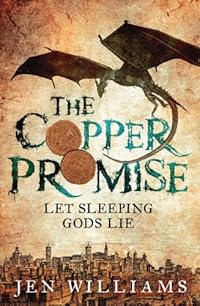
The Citadel contains within its labyrinthine caverns not only the trapped remains of the old gods (bar one) but a supposed treasure trove. By reputation no-one escapes from it alive yet it still attracts adventurers and has guards who must be bribed to allow entry. Sell-swords Wydrin of Crosshaven (the Copper Cat) and Sebastian Carverson, disgraced former Knight of Ynnsmouth, are engaged by the mutilated Lord Aaron Frith of Blackwood to penetrate its secrets. They agree somewhat off-handedly considering the apparent dangers. Amid adventures which in part are curiously reminiscent of the 1980s children’s adventure game TV show Knightmare and Indiana Jones films they succeed up to a point. Sebastian suffers a mortal wound but Frith is restored to fitness – and beyond – by immersing himself in the lake underneath the Citadel. In the process Frith acquires magical powers by which he involuntarily transports our three heroes to Blackwood in an instant when they are threatened by the old god Y’ruen, a dragon, which their foray into the Citadel has raised from its confinement. Frith’s new powers allow him to heal the wounds of both Sebastian and Wydrin.
In the Blackwood village of Pinehold, they encounter the source of Frith’s misfortunes, Fane, who is torturing the inhabitants to find the secret of the Frith family vault. While wearing a peculiar glowing helmet – which channels the influence of the demon Bezcavar, the Prince of Wounds, an enthusiastic harvester of pain – Fane is immune from harm. His equally cruel henchmen, the Children of the Fog, Enri and Roki, wear enchanted gauntlets to manifest copies of themselves which confuse and confound any opponents. With help from an old woman, Holley, and her magical glass spheres our heroes escape, cross an invisible bridge to the vault, find in it little but maps and return to free Pinehold from its oppressors. Meantime Y’ruen and her indistinguishable brood army – whose members have numbers but no names (though some of them have developed an interest in words and their own individuality) – is devastating the land of Relios.
The three then split up to pursue their own projects before being reunited for the final scenes. Wydrin returns to Crosshaven, Sebastian goes to fight the brood army. On the Hollow Isle of Whittenfarne, Frith meets Jolnir, who turns out to be O’rin, the untrapped god, and, without much protest or questioning, bestows on Frith the power to control his magic. As a by-product Frith realises that the maps describe a weapon.
This is Williams’s first novel and I’m afraid that shows. We start with a torture scene – never auspicious – from the viewpoint of a character who is not even mentioned again for about a hundred pages and is encountered in the narrative just once more – and that after she has already been killed. Chapter two introduces the Citadel and some of its menaces. Sebastian’s erstwhile friend Gallo is killed. Only in Chapter three do we meet our heroes, the two sell-swords, in a tavern, awaiting their client, the tortured party from Chapter one, Aaron Frith, whose escape from torture is dealt with exceedingly sketchily. (Not quite “with one bound he was free” – but near enough.) Descriptions of fights are leaden, we have changes of viewpoint within scenes, suggestions by a character of what to do next are followed by the sentence, “And so they did.” At various points a touch of economy with the prose would not have gone amiss. For example, who else would a cluster of people be in proximity to but each other?
There is also a curious prudishness to the proceedings. None of the characters really swears. (Williams tells us they do but no expletives save two “bloody”s appear in direct speech.) They might as well be neuter for all the sexuality we are shown. The one time even the faintest possibility of sex arises the subject is treated with absurd coyness and the opportunity is snuffed out abruptly. We infer early on, and later are told – but without description – that Sebastian is gay. He doesn’t manifest it in the text. (But he does carry a large broadsword.) Wydrin, I suspect, is intended to be a spiky young woman but instead appears rather foolhardy and unreasonably cocky. All are hauled hither and yon by the necessities of the plot. Gallo’s reappearance as one of the walking dead is a case in point. None of them come across as having agency of their own.
For all these reasons The Copper Promise fails to breathe. There is no sense in it of a life beyond the page, and little but death on it.
The following comments did not appear in Interzone.
I read an uncorrected proof copy so some of these may have been amended for final publication but (among others) there was a “sunk” count of 5, 1 span, 1 sprung, a “scrapped” for scraped, an “octopi,” one instance of vocal “chords,” “every bone felt as though they had shattered,” – one of innumerable failures of verbs to agree in number with their subject nouns; in especial an army is singular – “over take” for overtake, “very almost completely normal,” “it’s” for “its,” the “lay” of things (which wasn’t a song,) “lengths they would go to deceive each other,” “fit” for fitted etc, etc.

