Posted in Poetry at 20:00 on 27 April 2020
The Rime of course is that of the Ancient Mariner (a nickname bestowed on a 1980s full-time team’s part-time goalkeeper of my acquaintance – he taught in the same school as me – on the grounds that, “he stoppeth one of three”) by Samuel Taylor Coleridge.
In another piece in Saturday’s Guardian Review, Philip Hoare, remarks on the poem’s continuing relevance, from Mary Shelley’s Frankenstein and Herman Melville’s Moby Dick through to Fleetwood Mac’s Albatross and beyond.
(Aside; when I hear the word, “Albatross!” I nearly always think “Gannet on a stick.”)
The instant recognition of the lines, “Water, water, everywhere” and “all creatures great and small,” he says, have become part of the lexicon.
At which point my senses pricked up. All Creatures Great and Small is nowadays best known as a television adaptation of a James Herriot set of novels.
But surely, rather than from the Rime, that quote comes from the hymn All Things Bright and Beautiful of which it is the second line? To my mind that is a much more likely source for a collective awareness of the phrase than the poem.
The hymn’s writers may well themselves have been inspired by the poem and its almost identical line “All things great and small” (which is followed by “For the dear God who loveth us; He made and loveth all,”) itself very close to “The Lord God made them all.” However that is not quite what Philip Hoare claimed.
No Comments »
Posted in Football, Politics, Reporting Scotland, Trips at 12:00 on 28 October 2019
I couldn’t help recognising the scene in this photo from Saturday’s Guardian Review:-
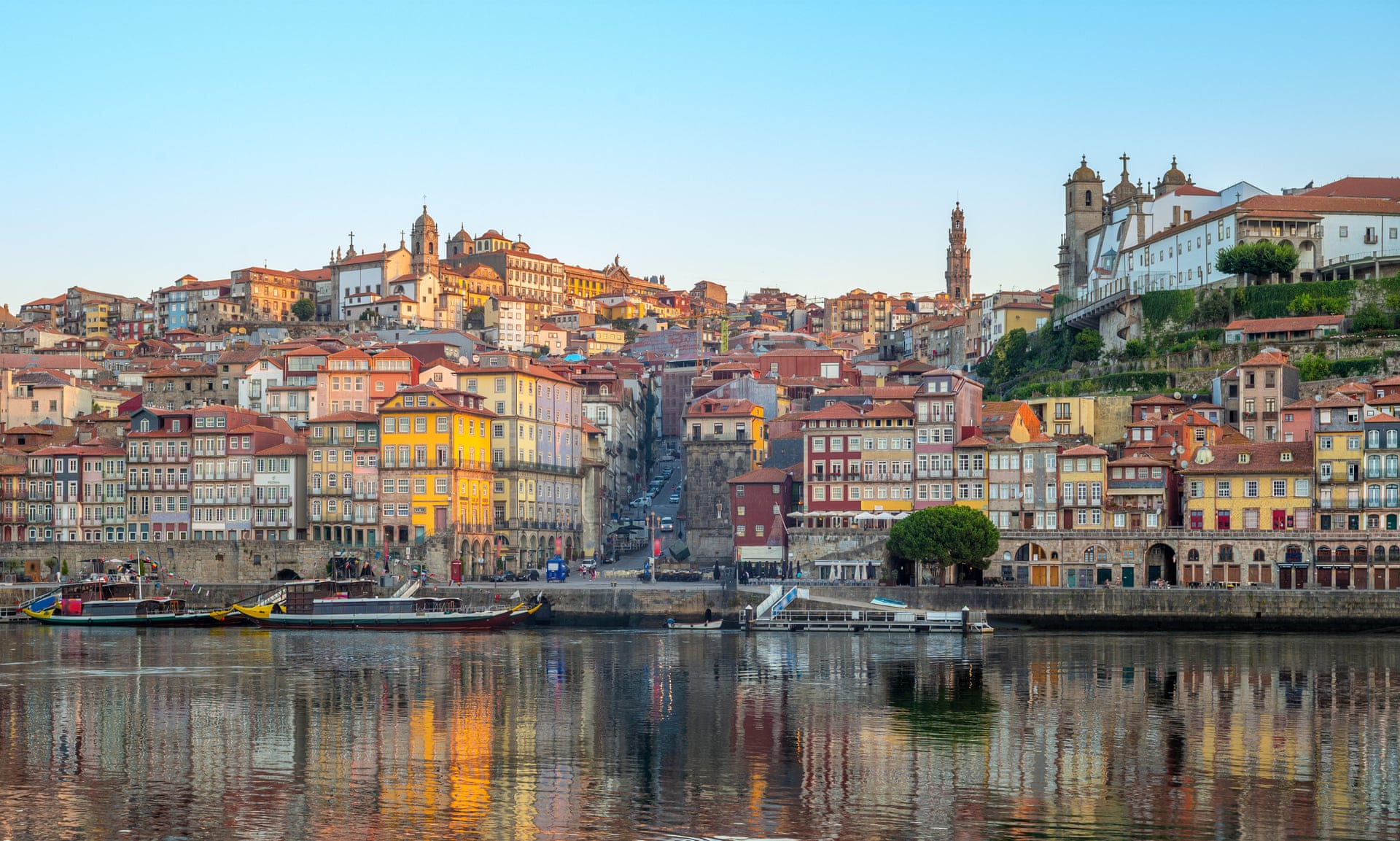
It was illustrating an ensemble piece about various writers’ relationship with Europe.
The photo brought back memories of that wonderful trip we took down (and up) the River Douro from just that jetty in the picture and which I featured in this post:-

And this one:-
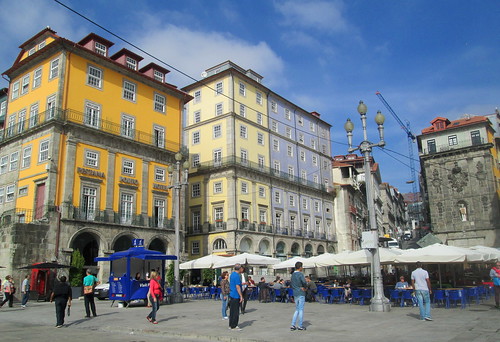
Curiously an item on Reporting Scotland on Thursday? night about the trip of Rangers to Porto for a Europa League* game also showed scenes of the same jetty. Synchronicity.
*So-called.
No Comments »
Posted in Science Fiction at 12:00 on 6 July 2015
In Saturday’s Guardian Review Hari Kunzru had an article – the lead article – reflecting on Frank Herbert’s Dune fifty years on, describing its genesis and continuing relevance.
I’ll slip over the contention in the above the piece strapline that Dune is perhaps the greatest novel in the Science-Fiction canon (on second thoughts I won’t slip over that, it simply isn’t) but it certainly spawned a series of gradually diminishing in return sequels.
Of course I reached it in the wrong way. My first contact with it was via Dumbarton Library when I had graduated to the adult shelves and devoured the yellow jacketed Gollancz hardbacks, the Dobson Science Fiction and Hale SF publications but it was Dune Messiah – the first (and best) sequel I read first as I didn’t realise it was a sequel since Dune wasn’t on the shelves – that day at least. This is perhaps why to this day I prefer Dune Messiah to Dune. I simply think it works better as a novel and indicator of what Herbert was getting at.
That, as Kunzru says, Star Wars was ripping off Dune I suppose I noticed subliminally. But then I never thought the film could be original in any way. I still think that SF works best on the page and not on a screen (of whatever size.) Film and TV images could only ever be a poor imitator of the pictures created inside the brain.
One thing that did occur to me on reading Kunzru’s piece though, was that with its championing of the Arabic/Muslim æsthetic in the culture and religion of the Fremen of Arrakis Dune would not – could not – be published today. (At least not by a traditional publisher. And even if it was, say, self-published, it would not meet with the same appreciation.)
No Comments »
Posted in My fiction, Politics, Science Fiction at 18:18 on 7 April 2013
There was an interesting article by Adam Roberts in yesterday’s Guardian Review about the two contrasting political strands in SF.
Unfortunately I couldn’t find it on the Guardian website – neither by searching for Adam Roberts nor for, “Who owns the political soul of SF” (Yes, the article’s title did have a missing question mark.) It is probably there somewhere, though.
By and large the article focused on the differing attitudes to the “other,” taking as its exemplars of either breed, Iain M Banks and Robert A Heinlein. (Ever since I worked out his political allegiances – see below – I always perversely liked to think of him as Roberta Heinlein as I’m sure that would have annoyed him.)
The gist of Roberts’s piece was that lefty SF tends to be inclusive and heterogeneous on encountering the alien, whereas right wingers reach for the ammunition. (I paraphrase, but not much.)
Aside:-
I remember well reading Heinlein’s short story The Roads Must Roll, wherein as the principal mode of travel people are conveyed by moving walkways. Those who work on the system throw a spanner in the works. Heinlein overstates the case by making this sabotage rather than something more peaceful and, as the story’s title suggests, comes down firmly on the side of the owners and users. Despite Heinlein’s intentions, while I was reading it my sympathies were fully on the side of the workers who to my mind were being exploited. I realised then that as far as Heinlein would be concerned there was something wrong with me, I was less than human. My dignity (and those of honest toilers) did not compare with his dignity.
In my own novel A Son of the Rock the narrator, Alan, shockingly encounters the “other” in the shape of an old man. At first frightened, he eventually embraces the strangeness and makes it his own.
Clearly, in Roberts’s dichotomy, Alan was (will be? – it is SF after all) – and I am – a leftist.
Sorry about that.
No Comments »
