Posted in Trips, War Memorials at 20:30 on 29 April 2022
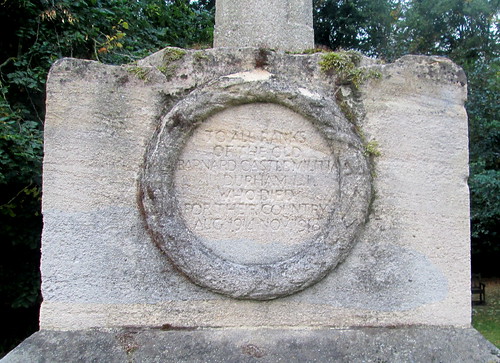
Three photographs of the memorial to the men of the Durham Light Infantry (DLI) which lies in the grounds of Bowes Museum, Barnard Castle.
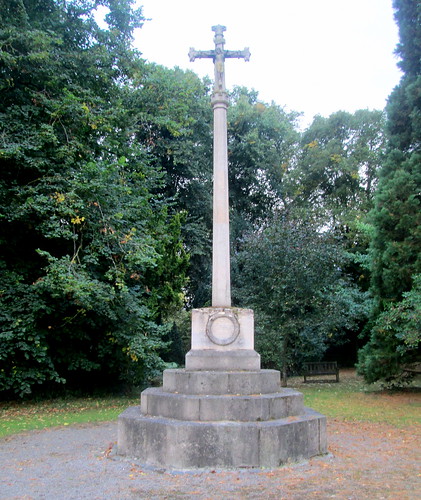
Dedication: “To all ranks of the old Barnard Castle Militia, Durham LI, who died for their country Aug 1914 – Nov 1918.”
The reverse carries the symbol of the DLI:-

No Comments »
Posted in Trips, War Memorials at 11:00 on 10 November 2019

Close-up. The Dedication reads, “to the enduring memory of all ranks of the 50th Northumbrian Division who fell in the Great War 1914 – 1918 and in memory of their comrades of the same division who gave their lives in the war of 1939 – 1945 for the liberation of France, Belgium and Holland.” On the lowest plinth, “Pro Patria.”

Side inscription, “The Ayrshire Yeomanry; the Yorkshire Hussars; 1st, 2nd, 3rd, 4th, Northumbrian Brigade, RFA; Northumbrian Amminition Column; Northumbrian Divisional Engineers, RE; 50th Divisional Train, RASC; 1st, 2nd, 3rd, Northumbrian Field Ambulance, RAMC; Northumbrian Division CCS; Northumbrian Vet Section, RAVC; RAOC.”

Other side inscription, “149th Infantry Brigade: 4th, 5th, 6th, 7th Northumberland Fusiliers; 5th Border Regiment.
150th Infantry Brigade; 4th East Yorks; 4th, 5th Yorkshire Regiment Green Howards; 5th Durham Light Infantry.
151st Infantry Brigade: 6th, 7th, 8th, 9th Durham Light Infantry; 5th Loyal North Lancs Regiment.”

Memorial Information Board:-

The view from the 50th Northumbrian Division Memorial is now so peaceful:-

So much so alpacas were ruminating by the memorial:-

No Comments »
Posted in Architecture, Trips, War Memorials at 14:00 on 11 August 2010
After Newcastle we scooted down to Durham (passing Antony Gormley‘s Angel of the North on the way.) The main attraction there is, of course, the Cathedral. I’d seen it before from the train, dominating Durham’s skyline.
This is a side view I took from the south.

This one is from the north: a stitch of two photos as I couldn’t get back far enough to get the whole thing in.

Just to the right of the cathedral entrance in a grassy area there was a large stone cross.
We crossed the grass to investigate and it was another memorial to the South African War, if not quite as ornate as the one in Newcastle (see two posts ago.)

The cathedral itself is impressive while more intimate than York or Canterbury. It apparently costs over £60,000 a week to maintain it.
The stone columns supporting the structure are carved with different patterns. The chevrons were the most attractive. The shrine to St Cuthbert is a bit over the top though. Its canopy has iconography you would more expect to see in an Orthodox context rather than C of E. (But it would have been constructed in the RC era I suppose.)
On one wall there were lists of previous abbots, deans and bishops. I noticed one Thomas Wolsey, Cardinal, in the latter. He seems to have been the only Bishop of Durham who was also a Cardinal. The early names were all single. When did the practice of adopting surnames come into being?
The part of the cathedral I found most moving was the side chapel devoted to the Durham Light Infantry (DLI.) There were lists of battle honours dating back to beyond the Napoleonic wars. Books of remembrance of both World Wars were open at the relevant week’s dates showing the names of those DLI who died on the corresponding days in the war years, and where they fell. I saw no blank days for either war. So it goes. Several small crosses with poppies were laid in a niche. There was one for a former DLI soldier with the dates 1910-2010 and annotated “Veteran of Kohima.” Kohima was a particularly vicious battle on India’s border in World War 2. He did well to survive it, and to reach such an age.
There was also a memorial to miners who had died in pit disasters and such, not the sort of thing usually found in cathedrals I think. And a modern piece of stained glass showing the cathedral’s and Durham area’s history.
There’s a lot to see.
2 Comments »
