Archives » Darkland

Winterstrike by Liz Williams

Tor, 2008. 358p.

For some reason I just could not get into this book and found it a bit of a slog. As it is the first part of a mooted trilogy this was dispiriting. There were thematic and stylistic similarities between this and the Darkland/ Bloodmind duo of books by Williams which I have read in the recent past but Winterstrike seemed to lack something in comparison.

On a far future Mars inhabited by women – any men are of the changed and to be shunned, contact with them is ostracisable – a woman called Alleghetta has her sights set on becoming a member of the ruling Matriarchy. The daughters of her union with her partner Thea are the main focus of the book as they play out the ramifications of the choices Alleghetta has made about their genetic inheritance.

The changed come in at least two types, strangely altered humans known as demotheas and vulpen who seem to be exclusively male. Curiously – and against the normal English usage (ox/oxen, child/children, brother/brethren) – Williams renders the singular also as vulpen.

Not much is made of the all-female scenario. The characters have all the venalities, jealousies and weaknesses that you might find in any society. Beyond the absence of sex scenes there isn’t much to set this novel apart from others. Maybe, however, this was the point.

The Mars in the book is as you might expect, terraformed and with canals on which someone of course takes a trip. This last is the one bit of using such a setting that is almost obligatory: “the best bit” as Colin Greenland once remarked to me. (No criticism here; I’ve done the same myself in my unpublished novel Who Changes Not. )

The two main protagonists are Essegui and Hestia whose paths soon diverge and never recombine, which is something of a fault in a multi-stranded narrative. (The book does end with a message between the two but this serves only to set up the succeeding volume.) Their other sisters Letetui, also known as Shorn, and Canteley are not viewpoint characters but Letetui is the hinge of the narrative. She has associated with a vulpen, been shut away, but escaped.

At times the treatment tips over from SF into Fantasy – or at least there is no convincing explanation of how certain things occur. Williams has shown such sensibilities in the past and this may be one of the reasons why Winterstrike did not appeal. Her descriptive writing, the convincing dropping in of essential detail, can be excellent though.

However, when a book fails to grip, infelicities begin to stand out, make the reading more difficult than it might be and, crucially, undermine trust in the author. Examples weren’t hard to find. There is a military aircraft – probably the one depicted on the cover – which Williams dubs a dreadnought and which, to indicate age, is described as having rust on it. Now, I would think that, even on Mars, a flying machine made of iron would have too high a density to get off the ground successfully. Some later chapters are set on Earth and feature a post-warming flooded Ropa (Europe) where there nevertheless is a city with an iron tower still surviving to poke up through the waves. The tower plays an important part in one of the scenes but it seems this iron structure is not susceptible to rust, despite enjoying the optimum conditions for it. Also at one point we have the phrase, “The woman brightened imperceptibly.” Really? If the brightening was imperceptible how, then, did the viewpoint character know it had occurred? There is also some confusion between born and borne.

Maybe it is this lack of the necessary consideration which is at the root of my dissatisfaction. A proper editing could have picked this sort of thing up but, increasingly, books do not receive the sort of close attention during the publication process they once did.

Unlike in either Darkland or Bloodmind this book does not bring all the strands together and as a result ends inconclusively. This is perhaps not surprising from the first part of a trilogy but I did feel somewhat short-changed.
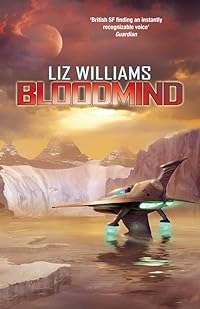
Bloodmind by Liz Williams

Tor, 2007. 293p.

Having now read both it is apparent that Bloodmind and Williams’s previous book, Darkland, are indeed a thematic unity. While both are capable of being read as stand-alone novels they are essentially one book split into two.

Bloodmind is a lessening of sentience, a reversion to animal status, which occurs naturally from time to time to the inhabitants of the planet Mondhile, and in reverse to the creatures known as Selk on Vari Halsdottir’s world, Muspell. It is also induced artificially in the women of Nhem by their male rulers. This last barbarism is strictly necessary to neither plot nor resolution and, apart from being a piece of gender politics, it is difficult to see why else it has been included beyond giving one of the viewpoint characters a reason for being more or less on her own. (I did, however, note that Nhem is men spelled backwards with the interpolation of an h, which may or may not be significant.)

The narrative flits between the three planets and the women whose fates, along with that of the Selk, become intertwined but is mainly carried by Vari, the protagonist whose story links the two books.

As in Darkland the SF and Fantasy elements of Bloodmind do not sit well with each other. The tale is at base a fantasy with SF trappings bolted on and as a result fails on both counts.

Not one of Williams’s best I would say.

There is a span count of 1, sadly.

Darkland by Liz Williams

Tor , 2007. 424p

We first meet Vali Hallsdottir on the planet Nhem, on an assassination mission. Due to an unfortunate love affair with a man who she feels betrayed her (it is a moot point, or insufficiently delineated, whether he actually did) she has come under the influence of the Skald and has vowed not to have sex except as an aid and precursor to killing someone. Vali’s Skald training means she can utilise the seith, a set of enhanced intuitions which is inbred but nevertheless has to be honed.

Asides. 1. The prelude to the assassination is described as a rape but, while to the man concerned it is – as by implication are all the sexual encounters on Nhem, where women have been reduced to the state of animals and are treated as possessions – Vali is complicit in the act (and moreover has to be to fulfil her mission) so the word is not entirely appropriate. Admittedly the true mot juste does not spring readily to mind.
2. Williams describes Vali’s usual sexual abstinence as celibacy. It is, rather, chastity; there is a difference.

Vali’s disguised ex-lover, Frey, accompanied her to Nhem where he seemed to betray her again. He is from the part of the planet Muspell known as Darkland which severed ties with the set of islands known as the Reach a long time before the action of this book since some men disagreed with women’s rights. As the depiction of life on Nhem illustrates, the book is riddled with sexual politics such as these.

Darkland is home to the vitki, people with even more enhanced powers than Vali’s. When Vali subsequently travels there to seek out Frey and gain her revenge she encounters a vitki called Thorn who has plans for her.

Williams has her characters on Muspell descended from islanders – specifically from Orkney, Iceland, Greenland and Eire. As it is set 2000 years after these people left Earth I’d have thought old names might have been forgotten. Yet places are called Stronsay, Tiree and Coll, and a stretch of water is known as the Minch. (This is a curious echo of Mike Cobley’s Humanity’s Fire trilogy where Scots, Russians and Scandinavians settled a planet they named Darien.)

Darkland often veers over from SF into fantasy territory; no more so than in the other strand of the narrative set on the planet Mondhile, where a young man called Ruan is strongly attracted to a mysterious tower embodying a dark energy of some sort and to the strange girl called Gemaley who lives there. The off-worlder who is also entangled with Gemaley is of course Frey. Alerted to Frey’s whereabouts by Thorn, Vali soon arrives on Mondhile, where the bulk of the book is set.

The novel is actually two different stories; a first person narration SF one centred on Muspell, the Reach and Darkland and a third person crypto-fantasy on Mondhile. Williams does attempt to give the dark powers on Mondhile an SF gloss but it is never convincing. So too with the presence of Frey on Mondhile which seems merely to be a device to bring Vali there. The SF-ness of the Muspell sections and the fantasy slant of the Mondhile segments did not sit well, I thought.

The problem may be that the overall story was probably conceived as being longer and had to be split for publication. (SPOILER ALERT – Darkland ends with a cliffhanger.)

The “sequel” – I wait to read it before being certain – is called Bloodmind. The idea of bloodmind is mentioned several times in this volume and is a temporary switching off of humanity in Mondhile’s inhabitants: again given a somewhat unconvincing, not to say sketchy, technological rationale.

I’ll reserve full judgement till I’ve read that book.

free hit counter script