Archives » Charlotte Brontë

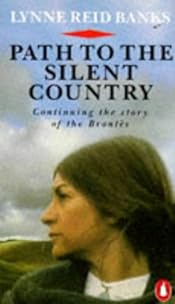
Path to the Silent Country by Lynne Reid Banks

Charlotte Brontë’s Years of Fame, Penguin, 1988, 238 p, plus i p Foreword and vi p Preface.

In this continuation of Charlotte Brontë’s story from Dark Quartet, she is in deep mourning for her late sisters and brother but left in effect to see to her father’s welfare on her own (except for the two servants.)

Her true identity has finally been unmasked though and on a visit to London she finds herself a celebrity but the unkinder reviews of Jane Eyre received distress her. In particular being brought up as the daughter of a cleric and steeped in that religion she is upset by the criticism that her book was unchristian. In Reid Banks’s account it was fellow writer and social theorist Harriet Martineau who explained to her people’s objections. Other literary luminaries of the time who pop up here include William Makepeace Thackeray, Harriet Martineau and Mrs Gaskell, the latter of whom she formed such a friendship with that she was entrusted to write Charlotte’s biography.

The main tension in the book, though, is her relationship with her father Patrick who acted very autocratically towards her and resented any time she spent away from him. (His main fear was that she would marry and thus fall prey to a then common fate, the rigours and dangers of child-bearing. How much of this is Reid Banks’s imagination or whether he was just being extremely selfish is moot.)

As told here a few men took Charlotte’s attention but none cast the same sort of spell on her as had her employer in Brussels, Constantin Héger. When Mr Nicholls, Patrick’s curate, expressed a romantic interest in her Patrick reacted violently and more or less banished him.

A commission to construct a book from her sister’s the papers brings her grief to the fore again but leads her to destroy the best of their remaining literary pieces, as being poems too personal to publish.

After the publication of Villette her writing ground to a halt, she had too much else on her mind and too much to do looking after her father.

It was her eventual marriage to Nicholls, after a promise never to leave her father reconciled him to the match, that would indeed prove disastrous as, despite perhaps thinking herself too old, she became pregnant and her body could not cope with the concomitant demands on it.

Attempting to fictionalise the lives of real people, especially ones about whom such a lot is known, can not be an easy endeavour. Reid Banks does it as well as can be expected.

Pedant’s corner:- has USian spellings throughout (color, honor, modelling, somber etc.) Otherwise; villain (villain – used later,) unperceivingness (unperceptiveness?)

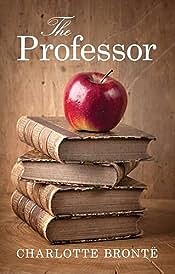
The Professor by Charlotte Brontë

Hesperus Press, 2014, 280 p, including ii p Preface by A B Nicholls, iii p Notes and ii p Biographical Notes. First published 1857.

This was Brontë’s last published novel, indeed it was posthumous, but its writing predated her other novels. There are signs of that lack of experience here. Its early chapters are pretty standard fare, (at times reminiscent of those passages of Mrs Oliphant which lean to the humdrum,) not really anything to do with what comes after but not quite as tedious as the beginning to Shirley.  Later incidents, though, reflect events in Brontë’s last novel, Villette.

William Crimsworth is distanced from his wider family whom his late mother had offended by marrying into trade. He rejected their offer of a living as a parson and instead took a position in his haughty brother Edward’s business but only as a lowly clerk, a job he performed more than adequately. There he was noticed by one of Edward’s customers, Mr Hunsden, and through him obtained a post as a teacher at a boys’ school in Belgium. Through its proprietor, M Pelet’s, acquaintance with the directress of the neighbouring girls’ school, Mlle Zoraïde Reuter, he also began to teach there. Mlle Reuter affects to find him attractive but he is soon disabused of that notion by discovering her engagement to M Pelet.

A teacher of sewing to the girls, Mlle Frances Evans Henri, a Swiss national of English descent, is brought to attend his classes and he soon begins to find her, and her English intonations, interesting. Mlle Reuter is less than pleased and tries to obstruct any further developments by dismissing Frances but the final course of the book is now set.

The setting of the pensionnat in Brussels and its next-door establishment were to recur in Villette, and of course were inspired by Brontë’s own experiences teaching in the city. As in that book but much more prominently here, the author’s upbringing in an English parsonage lead to comparisons of the rightness of Anglicanism as opposed to Roman Catholicism, its supposed superiority in inculcating character and upright moral behaviour.

That the viewpoint character is a man sets The Professor apart from Brontë’s other books and that may be a flaw since William as a person seems a bit distant, not quite fully realised. Brontë was on surer ground with her female protagonists.

The Professor is by no means without merit but without her later books and the reputation of her family would, I doubt, still be read widely today.

Pedant’s corner:- the occasional Victorian spelling such as recompence (recompense) and ecstacy (ecstasy.) Otherwise; sprung (sprang,) encomiums (I prefer the Latin plural, encomia,) Moses’ (Moses’s,) Frances’ (x 2, Frances’s,) “‘cannot be considered as a concurrent’” (as concurrent?) “closing behind end around us” (behind and around,) Evans’ (Evans’s,) “having eaten …. and drank several bottles” (having eaten … and drunk several,) “I had not been brought up at Eton and boated and bathed and swam there” (and swum there,) “it would be vain to seek the Rue Notre Dame” (would be in vain,) “my bark hung on the topmost curl of a wave of fate,” (my barque,) “her hand shrunk away” (shrank,) “Rosalie the portress’ area” (the portress’s.)


Dark Quartet by Lynne Reid Banks

The Story of the Brontës, Penguin, 1986, 409 p including ii p Foreword and ii p Postscript First published 1976.

In her foreword Banks mentioned that when she was approached with the commission to write this book she was daunted – as who would not be given its subject is three of the best-known writers of the nineteenth century, plus their unfortunately less gifted brother? Much of course is known about the Brontë family (and even more written about them) but gaps remain. The fascination they hold for many is such that any exploration of their lives will attract readers eager to glean how such a hotbed of literary invention should arise within one family from a small village in the back of beyond.

So does Dark Quartet illuminate much? A novel is likely to be more accessible than a drier academic piece but has a different purpose and as a novel Dark Quartet suffers from a lack of focus. Here, four main characters are too many, attention to each too diffused.

A lot, especially in the book’s initial stages, is told rather than shown, making any differences between Emily and Charlotte (not so much Anne, as she was younger) haze over. It is only in the latter stages where Emily’s fierce – and thwarted – desire to remain incognito distinguish them. Branwell, praised as he was within the family and over-indulged by his father, did not have the self-possession to rise above that estimation – though surely he secretly must have known, or at least suspected, that his talents were minimal, something which no doubt contributed to his descent into dissolution. It is his learning by accident (for the others had taken pains to keep it from him) that his sisters had attained the validation of publication that precipitates his final crisis. Emily and Anne succumb to consumption, the former by apparently willing it, the latter with forbearance. The unhealthiness at the time of Haworth as a village, the one with the worst death rate in England, the Brontës’ home sited just above the packed cemetery whose decaying contents seeped into its surroundings during any rainfall, running under the church and into the village, goes unremarked here.

Mention is made of the young Brontë siblings’ inventions of imaginary worlds, their notebooks filled with tiny writing, but only on the odd occasion does anyone take to the fabled moors – for inspiration or otherwise. Anne’s (actually not well evidenced) falling in love with her father’s curate Mr Weightman, who was soon to die of cholera, is stated rather than shown but Anne is depicted as being undemonstrative. Similarly Charlotte’s formative sojourn in Brussels at the Pensionnat Heger is treated somewhat cursorily.

As an introduction to the family’s history Dark Quartet is an admirable endeavour but perhaps inevitably it fails to conjure up the inner nature of these remarkable people, fails to render them whole. Maybe the novel as a form needs its authors to have free reign, its characters not to be too slaved to historical individuals, to convince completely. Or is it that in this case the task is simply too great?

Pedant’s corner:- Miss Evans’ (Miss Evans’s,) “one of the Miss Woolers” (one of the Misses Wooler,) whiskey (several times; whisky,) Mr Williams’ (Mr Williams’s,) Mr Nicholls’ (Mr Nicholls’s.)


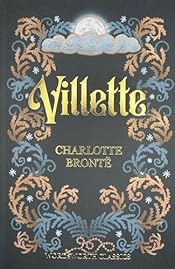
Villette by Charlotte Brontë

Wordsworth Editions, 1999, 476 p, including 10 p Notes, plus ii p Contents, xiii p Introduction by Sally Minogue and iii p Bibliography. First Published 1857.

I think I have remarked before how difficult it is to read a nineteenth century novel with a historical eye, without any knowledge of the development of the form and of readerly expectations in the decades since. Villette might be a case in point. Wordy, discursive, thoroughly preoccupied with religion, it is also something of a tease in the way it sets up a potentially supernatural theme before deflating it in a cursory fashion.

It is the memoir of Lucy Snowe, who spent time every year of her childhood at the home of her godmother Mrs Bretton and her son Graham, where she met a girl called Paulina, whose mother had died and Mrs Bretton had taken the child in. In young adulthood, contact with the Brettons long lost, she finds herself alone and takes up a position as companion to Mrs Marchmont, on whose death with her fifteen pounds wages in her pocket she decides to set out for the continent. By a series of chances she ends up in a teacher in a pensionnat run by Madame Beck, in the Rue Fossette in the city of Villette, modelled on Brussels, but in a country referred to as Labassecour,

Madame Beck is at first distrustful, Lucy spies her ruffling through her belongings, but slowly allows her some latitude in behaviour. Most of Lucy’s pupils go unnamed but the profoundly unserious Ginevra Fanshawe has a plot function, diverting the eye of the pensionnat’s English physician, Dr John. The pensionnat is also said to be haunted by a nun, dressed in black with a white head covering. Another of its teachers is a M Paul Emanuel, an overbearing sort who, on finding Lucy one day in an Art Gallery surveying a somewhat revealing painting of Cleopatra, chides her for her attention to it. Lucy notes that he himself has no qualms about viewing it, nor does he object to the men in the room doing so. A quiet understated feminism is in evidence in the text here, but Lucy herself does not seem to perceive M Emmanuel is perhaps not someone to take up with.

Intrigue involving messages passed into the pensionnat’s grounds leads Lucy to encounter the nun twice, speechless on both occasions. The gothic implications of this are at odds with the decidedly realistic portrayal of other scenes. The resolution of the nun’s identity when it comes is as mundane as it is disappointing.

It may have been a Victorian novelistic practice but many times here a character known to Lucy is described at the start of a scene (or indeed through many chapters) before his or her identity is revealed to the reader. This tendency gets more irritating the more often it occurs. A case in point is that of Dr John, who is eventually disclosed as John Graham Bretton, the son of Lucy’s godmother. He in turn is a subject of Ginevra Fanshawe’s amatory machinations, played off by her against the Comte de Hamal.

A fairly large part of the narrative is taken up with Lucy’s holding firmly to Protestantism, many conversations with M Paul revolve around it as does her strange recourse to a Catholic confessional when she is particularly down one day and roaming Villette’s streets.

Villette is to modern eyes too long and too wordy. Dr Sally Minogue’s introduction says it is in fact two novels, the one we first encounter and the other when we reread it with knowledge of its content, but surely that could be said of all novels? She also cautions against interpreting it as entirely autobiographical and praises Brontë’s transformation of her personal love and pain into something more, but she refers to the author’s other novel which drew on the same experiences, The Professor, as being ‘leaden.’ (Oh dear. I’ve still to read that one.)

In the end though it illustrates the tendency towards gleaning romance of someone who has few choices open to her.

Pedant’s corner:- In the Introduction; Williams’ (Williams’s.) The usual Brontë spellings such as apostacy for apostasy, irid for iris (of the eye,) doat for dote (though I note doted) up-stairs; also strung, rung, swum for sprang, rang, swam etc. Otherwise; bannister (banister – used later,) whiskey (whisky,) “a stuff apron” (stiff?) “old acquaintance were all about me” (was all about me,) retractation (the sense is of retraction,) the indication of note 157 appears three lines above what it refers to, that of note 162 twelve lines above its referent, camelias (camellias.)

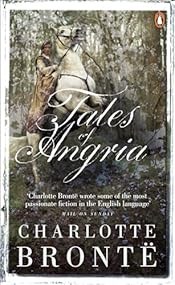
Tales of Angria by Charlotte Brontë

Penguin, 2013, 521 p

Angria was the imaginary country where Charlotte Brontë and her brother Branwell set stories they wrote in a tiny script into notebooks. The ones in this book were presumably all penned by Charlotte as she is the named author. Somewhat frustratingly Angria itself is indeterminately fixed, at times seeming to be carved out of the north west of England – people from Ireland are described as western – at others somewhere else entirely. I got no sense as others have that Angria was supposed to be in Africa. There is also an odd mixture of real sounding names (the Sydenham hills, Alnwick, Arundel) and the invented (Verdopolis, Northangerland, Adrianopolis, Zamorna.)

On the evidence here these five tales and an associated set of literary fragments were probably too risqué to be published in Charlotte’s lifetime, containing as they do accounts of mistresses, natural children and illicit passions. They are obviously tyro pieces, most likely never intended for publication, with a tendency to melodrama, and to the modern eye overwritten and prolix, with a propensity to start scenes with a description of the doings of an unnamed man or woman, as if inviting us to guess who it is meant to be, and overall an overdone tendency to address the reader directly. They mainly focus on a small set of aristocratic figures and their interactions and relationships.

Mina Laury is the mistress of the ruler of Angria, the Duke of Zamorna, kept by him in a house run by herself. Her existence is disturbed one day by the Duchess unexpectedly making an appearance. In addition a marriage proposal to her by Lord Hartford angers the Duke.

Stancliffe’s Hotel is the location opposite Angria’s capital’s city hall in front of which occurs an angry gathering of the lower classes, annoyed at Angria’s neighbour Northangerland. The Duke of Zamorna turns up and angrily harangues them to leave.

The Duke of Zamorna is mainly told via letters written by one Henry Townshend and some other characters but reads as being very disconnected.

Henry Hastings is an outlaw and traitor, tracked down to the house where his sister Elizabeth is housekeeper. At his subsequent trial he is offered what in the US is called a plea bargain if he spills the beans about his accomplices. The story is really more about Elizabeth though.

Caroline Vernon is the natural daughter of Lord Northangerland, brought up by her mother and as a ward of the Duke of Zamorna. At the age of sixteen she feels all grown up, but of course isn’t. Sent into seclusion by her father she runs away – to the Duke of Zamorna.

The Roe Head Journal Fragments are notes, aides memoires and drafts for scenes from stories.

These are of historical interest in showing the genesis of the writer Charlotte Brontë would become but cannot be set beside the likes of Jane Eyre or even Shirley. It is noticeable though that as in Shirley Brontë deploys words which nowadays are almost exclusively Scots (eg scunner) but which must have been prevalent further south in her lifetime.

Sensitivity warning: the book contains the word ‘nigger,’ and a character saying, “I’m as rich as a Jew.”

Pedant’s corner:- ancle (several times, ankle,) “it laid in ashes” (lay in ashes,) pourtrayed/pourtray (portrayed/portray,) syren (siren,) “the broad, far-stretching’s” (far-stretchings,) oppositie (opposite,) Londsdale (elsewhere Lonsdale,) “the party were exceedingly merry” (the party was,) “which that corps have so rightly earned” (that corps has so rightly earned,) viznomy (yet elsewhere we have physiognomy spelled correctly,) broach/es (brooch/es,) furor (furore,) Miss Hastings’ (Hastings’s,) “any known principal of government” (principle,) “neither of them were” (neither of them was,) bannisters (banisters,) extacy (ecstasy,) laid (lay,) trowsers (trousers,) bason (basin,) “no bark had ever before cast anchor” (barque,) coulour (colour.)

Shirley by Charlotte Brontë

Oxford World Classics, 2008, 571 p including vi p Introduction by Janet Gezari, vi p Note on the Text, iii Select bibliography, vi p Chronology of Charlotte Brontë and xxx p Explanatory Notes. First published in 1849.

Nineteenth century novels are now to some extent a historical curiosity. Life has changed since then, and so too have expectations of the novel. Books like Shirley were written for a slower paced time, for leisurely afternoon or evening reading, for diversion as well as entertainment and enlightenment. Digression and length were to be welcomed. This is evident in the novels of Sir Walter Scott but in whose work for some reason the longueurs cease to be noticeable after a while. To me though, it seemed Shirley took the tendency to extremes and the longueurs the more irritating. I took longer to read this than I did War and Peace. (Admittedly I was younger then, but arguably I had less time for reading.)

Shirley’s first chapter is an entirely unnecessary depiction of the conversations between three local curates, which has nothing at all to do with the subsequent plot. The second has a bit more purpose, laying out the background of the times (to which Brontë is looking back from forty years later) as a local Mill owner Mr Robert Moore, Caroline’s cousin, is bringing in machines to speed up his factory’s processes. In this he is opposed by the working men whose jobs will be replaced. For many passages nothing much of note seems to happen. A more singular drawback is that the titular Shirley (heiress of the estate of Fieldhead) is not encountered until a full third of the way through the book. Here too is a common trope of the nineteenth century novel, the revelation of the hidden identity of one of the characters. The book understandably also has the attitudes of the middle class of its time. Volume II, Chapter VII has the heading, “WHICH THE GENTEEL READER IS RECOMMENDED TO SKIP, LOW PERSONS BEING HERE INTRODUCED.” I suspect none of these would get past a modern-day writers’ group, agent or editor.

Main viewpoint character Caroline Helstone is living in the house of the local vicar, her uncle Mr Helstone, since her father, not a good man by the accounts she has heard, is dead and her mother had in any case long since left her marriage, whereabouts unknown. Mr Helstone has views on marriage: he takes a very dim view of having to officiate when people are committing what he considers an act of folly, yet he had done so himself. At an early point in the book Caroline asks her uncle, “Why were you so inconsistent as to marry?” and he replies, “Every man is mad once or twice in his life,” chiding Caroline not to confuse the general with the particular.

There are other aperçus. Caroline tells us, “In English country ladies there is this point to be remarked…. All have a certain expression stamped on their features, which seems to say, ‘I know I am the standard of what is proper; let every one therefore whom I approach, or who approaches me, keep a sharp look-out, for wherein they differ from me – be the same in dress, manner, opinion, principle, or practice – therein they are wrong.'” Workman William Farren says, “‘Them that reckons to be friends to a lower class than their own fro’ political motives is never to be trusted: they always try to make their inferiors tools.’”

Shirley has some good lines. Of a suitor, Samuel Fawthrop Wynne, (one of several who ask for her hand) Shirley’s uncle, Mr Stymson. who presumes to be her guide, says, ‘In all respects he is more than worthy of you.” She replies, “‘And I ask in what sense is that man worthy of me?’” and goes on to say that she would refuse a peer of the realm if she could not value him for himself. She says to Caroline, “‘Men, I believe, fancy women’s minds something like those of children. Now, that is a mistake.’” When Caroline demurs and says, “‘authors’ heroines are almost as good as authoresses’ heroes,’” Shirley says, “‘Not at all; women read men more truly than men read women,’” but that a magazine paper asserting that would never be accepted by any publication. This is a subtle feminism, certainly, but it is there to be read.

In both the novel’s time and Brontë’s a single woman was always thought to be conniving to trap a husband and when denied a particular quarry was described as disappointed. As Mrs Yorke says to Caroline, “‘Every sister with an eligible single brother is considered most kind by her spinster friends.’” Caroline denies any such predatory intentions for herself but the overall plot is entirely taken up with the prospects of marriage, both for Caroline and for Shirley, and the obstacles to that end.

Brontë mentions Yorkshire Doric, which some of the characters speak. Most of these words – described as dialect in the Notes on the Text – are still in use in Scots.

While obviously the Brontë sisters’ works are important in the history and development of the novel in English, for the reasons I mentioned above I could not seriously recommend Shirley to the modern reader except in so far as they are interested in that history.

Pedant’s corner:- nineteenth century usages of the chid (chided,) sunk (sank) and rung (rang) kind. An inconsistency in spelling – exstasies but later, ecstacy, – etc, etc. I add plus points for “the three Misses Sykes,” “the Misses Pearson,” “the Misses Wynne.” Otherwise; a missing comma before a piece of direct speech, “the trot of a little nag’s hoofs were, five minutes after, heard in the yard” (the trot … was heard,) Moses’ (Moses’s,) “‘I am tried of it'” (‘tired of it’ makes more sense,) milleniums (millenia, but it was in dialogue,) “knows nought about” (naught,) hoofs (in my youth the plural was always ‘hooves’,) “blue orbs” (up till page 340 Caroline’s eyes are described as brown; from then on they are always blue.) In the explanatory Notes; “the intervention if Minerva” (of Minerva,) Ulysses’ (Ulysses’s.)

Wide Sargasso Sea by Jean Rhys

World Books, 1967, 186 p, including 9 p Introduction by Francis Wyndham.

This is the fruit of the author’s fixation with “the mad woman in the attic,” the first Mrs Rochester from Charlotte Brontë’s Jane Eyre. The novel is told in three Parts, the first and third from the viewpoint of the unfortunate Antoinette (or Bertha as her husband calls her,) the second, and much the longest, from his and hers.

The first two Parts are set in the West Indies, where Antoinette, the offspring of a Creole family, was brought up. In Part One she describes her early life. Part Two is the story of her (unnamed in the text) husband’s sojourn in the West Indies, where he and Antoinette married quickly after the illness which followed his arrival, and honeymooned in Dominica. There he receives a letter from a man who claims to be Antoinette’s half-brother, telling him he has been duped into the match as Antoinette is unstable and has a past. This is backed up by the attitude of those in Jamaica who knew her. The marriage is thereby doomed, its failure and her husband’s adultery contribute to Antoinette’s mental decline. Part Three sees our heroine locked up in an attic in England (though she is not entirely sure she is in that country) attended only by a nurse called Grace Poole. Hers and Antoinette’s names along with those of her stepfather and stepbrother are the only overt clues to the connection between this story and Jane Eyre. There are of course other correspondences, however; Antoinette/Bertha’s fascination with fire, her taking advantage of Poole’s falling asleep to roam the wider house, her attack on a man who comes to visit her, but this book is complete in and of itself and could be read with no knowledge of the previous book without any detraction from it.

Wide Sargasso Sea is both a commentary on Jane Eyre and on the ramifications of slavery and its abolition. Its illustration of the inequality of power between men and women also reflects the ending of Brontë’s novel where Jane brings herself to marry Rochester only after he has been blinded, when she has the advantage. There is, however, a kind of opacity to Rhys’s writing which makes it something of a chore to read.

Note to the sensitive; there are many uses of the n-word, but that is true to the times depicted.

Pedant’s corner:- In the Introduction; diststrous (disastrous.) Otherwise – a missing comma before a speech quote (x 3,) a comma missing at the end of a piece of direct speech, cocoanut (nowadays spelled coconut,) “the row of small trees outside my window were covered” (the row …. was covered,) 14 completed thoughts, italicised and in parentheses, mostly of one sentence but some with two, giving us the husband’s thoughts while someone else is speaking to him but only 12 of them had full stops at the end, hynotized (hypnotised,) frangipanni (frangipani; as used earlier.)

The Tenant of Wildfell Hall by Anne Brontë

Penguin Classics, 1996, 536 p (including 3 p Preface to the Second Edition, 34p Notes on the Text and 2 p Select Bibliography) plus xix p Introduction by Stevie Davis. Originally published in 1848.

This novel is effectively two different stories in one. The enveloping narrative is a series of letters addressed to J Halford Esq by one Gilbert Markham of Linden-Car. Enclosed within it, but much the most substantial part, is a personal testament via diary entries of the woman he comes to love, telling her life story up till she met him. She is, of course, the tenant of Wildfell Hall of the title, Mrs Helen Graham.

The arrival of this widow at the dilapidated Hall, only part of which is now inhabitable, causes much comment in the village, as do her secretive ways. Gilbert first espies her in the local church where he is more interested in her than the sermon. He eventually sets out to the Hall and meets her via an incident involving her young son Arthur, of whom she seems overly protective but whom Markham soon befriends.

Their relationship builds slowly, mediated through Markham’s friendship with Arthur. Mrs Graham has very few dealings with the locals – she will not go anywhere without Arthur and as he cannot walk far extended trips are impractical – but does visit the Markhams’ house where in one conversation he says to her, “When a lady does consent to listen to an argument against her own opinions, she is always predetermined to withstand it – to listen only with her bodily ears, keeping the mental organs resolutely closed against the strong reasoning.”

Slowly rumour and innuendo grow in the village around Helen’s past until Markham confronts her about the tittle-tattle whereupon she gives him her diary to read so that he can learn the truth about her. She is not a widow, but still married, to an Arthur Huntingdon, to whose attractions she had succumbed against her aunt’s better judgement. Her husband is of course a very bad lot indeed and his behaviour was such that she felt forced to flee taking their son with her to avoid his father contaminating his upbringing, her only recourse since divorce was impossible for a woman and as a wife she was in effect a non-person, with no legal rights.

The novel is implicitly feminist therefore not only in that Helen is portrayed as wronged but that she is a stronger, more moral and upright human being than her husband or any of his cronies. Indeed, she is more morally upstanding than Markham since his treatment of Mr Lawrence – who unbeknown to him till later in the book, is Helen’s brother – is thoroughly reprehensible (as well as criminal.) In fact Helen is almost saintly in her forbearance and her actions towards her husband when she discovers he has fallen ill.

It would not be hard to deduce from this book that the author was a daughter of the parsonage. It is saturated with Biblical allusions and quotations. Helen derives most of her consolations from her religious beliefs.

In human affairs things don’t really change that much. Despite complaints from reviewers at the original time of publication that the upper classes no longer behaved in the debauched manner of Huntingdon’s friends as Brontë portrayed them, their activities reminded me of nothing so much as the Bullingdon Club. The book’s feminism most likely also formed the grounds for the unappreciative nature of the original reviews, though Anne’s sister Charlotte also thought the work reprehensible.

To modern eyes the novel is perhaps overwritten and overwrought but Brontë was exposing an ongoing injustice. A degree of fire and venom is understandable.

Pedant’s corner:- window’s weeds (widow’s weeds,) a missing end quote mark, “‘that he is a sensible sober respectable?’” (needs no ‘a’,) ““till the gentleman come. ‘What gentlemen?’” (it was to be a group of men therefore ‘gentlemen’, for ‘gentleman’,) “‘might seem contradict that opinion’” (might seem to contradict that opinion,) plaguy (plaguey?) “in behalf of” (is this an early nineteenth century usage? – on behalf of,) an extra open quote mark in the middle of a piece of direct speech. In the Notes; Jesus’ (x2, Jesus’s,) paeon (paean,) Dives’ (Dives’s,) Mephistophilis (said to be in Marlowe. He spelled it Mephastophilis.)

Jane Eyre by Charlotte Brontë

Everyman’s Library, 1991, 606 p, plus xxiii p Introduction by Lucy Hughes-Hallett, ii p Select Bibliography, iv p Chronology and iii p Prefaces to the Second and Third Editions (as by Currer Bell.) First published in 1847.

Jane Eyre cover

I suppose this book hardly needs an introduction what with it being an acknowledged classic of nineteenth century literature. It could be described as Gothic – there is a madwoman in an attic, but it is also an instance of the ‘gaining of wisdom’ narrative, plus a case of virtue fulfilled, and there is even a dollop of Cinderella in its protagonist’s childhood. The later appearance of long-lost cousins, not to mention a handy inheritance, though, lend an air of authorial contrivance to the proceedings. And it has that besetting characteristic of the Victorian novel, an unrelenting wordiness. It’s easy to carp of course (and it should not be forgotten stepmothers were a prominent feature of life in the days the novel describes) but Lucy Hughes-Hallett’s Introduction reminds us Jane Eyre was innovatory, Brontë’s voice something new. The book certainly has had an enduring influence, with a wide afterlife, inspiring other hands to write prequels (Jean Rhys’s Wide Sargasso Sea) and homages (Daphne du Maurier’s Rebecca.)

Jane Eyre is an orphan, entrusted to the care of her uncle, Mr Reed, who has unfortunately also deceased. Mrs Reed takes the wicked stepmother role, preferring her own children and treating Jane with lack of kindness and understanding, not seeing the calumnies with which her son John in particular attributes to Jane. Being packed off to boarding school (Lowood,) would have been a relief were that institution not (at least initially) so spartan. Here Jane meets the almost too saintly Helen Burns whose fate it is to die of consumption but not before Jane can reveal her philosophy to her. “‘If people were always kind and obedient to those who are cruel and unjust, the wicked people would have it all their own way.’”

Feminism avant la lettre reveals itself in the passage, “Women are supposed to be very calm generally: but women feel just as men feel; they need exercise for their faculties, and a field for their efforts as much as their brothers do.” This of course shows that women have been telling men things for donkey’s ages without the message ever managing to get through.

With her schooling finished Jane spends a few years teaching at Lowood herself before the departure of her mentor Miss Temple – to get married – prompts her to advertise for a position as governess. Thus finally, after over one hundred pages of preamble, we get to the main seat of the story, Thornfield Hall, and the brooding presence of its lord and master, Edward Fairfax Rochester.

How anyone could be attracted to Mr Rochester is a mystery to me. Jane knows almost from the outset of her dealings with him that he has a past. He himself tells her of a dalliance with the French actress Céline Varens, through whose machinations he has the charge of a ward in the shape of Adéle, for whose benefit Jane has been engaged as governess. He plays games with Jane – and, to be fair, with his aristocratic confrères – dressing up as a gypsy fortune teller to beguile them all and further his own designs, but also verbally. Moreover, he crucially conspires to keep the identity of the secret occupant of the attic unknown to Jane, allowing her to believe it is an attendant, Grace Poole. And is it a form of cruelty that sees Jane lodged in a room directly below that occupant? OK, he’s been dealt a stacked hand and trying to make the best of it but he is still trying to take advantage of a relative innocent. Even when his perfidy is revealed to her at the altar just before he’s about to contract a bigamous marriage with her she continues to think well of him. It is a fact of history, though, that such men are usually able to get away with it.

Still, Jane’s virtue will not see her become Rochester’s mistress. She flees Thornfield, and, penniless, stumbles into a village where no-one extends a helping hand. She is about to expire on his doorstep when St John Rivers hears her invoking God and brings her indoors to be looked after by his sisters and maidservant. Rivers is a strict religious man intent on becoming a missionary and creates a teaching post for her in the village. Religion may have been prominent in Victorian life but even so its presence here is an indicator that Brontë was brought up in a parsonage. Despite protestations on its first publication of its lack of piety, even of anti-religious content, religious discourse and allusion perfuse the novel, its resolution depends on Rivers’s vocation, and Jane’s different understanding of it.

It is in these closing stages of the book, though, that events begin to stretch credulity – even beyond a bigamous marriage being thwarted at the altar by the revelation of a previous wife who is still alive. Not many of us in extremis would expect to end up by chance in the household of a long-lost set of cousins nor to be the beneficiary of a bountiful bequest. Then off-stage events at Thornfield Hall enable what we are presumably to infer is a happy ending, though that Jane now has the advantage of Rochester does not speak entirely well of her. And it wasn’t at all happy for the incarcerated wife that had to die to allow it.

There are, too, other irritating aspects of the writing. Brontë has that unfortunate habit of designating places and periodicals with part names, _______shire, The ________ Herald. Why this coyness? Either spell them out properly or invent fictitious names for them. It’s a novelist’s job to make things up.

Love and death are perennial in the novel (any sex here, however, is strictly not to be mentioned.) However, time, and changing habits, have partially obscured the merits of a book like Jane Eyre. Novels nowadays tend to be less discursive. To modern eyes Jane Eyre is overwritten, even at places overwrought. It will always have an audience though.

Pedant’s corner:- In the Introduction; Helen Burns’ (Burns’s,) Dickens’ (Dickens’s,) Jean Rhys’ (Rhys’s.) Otherwise; there are various Victorian spellings – pannels (but, later, panels,) doat, blent, canvass, trode (trod,) secresy, dulness, etc, the correct ‘by-the-by’ swaps with ‘by-the bye’ at times. Then we have, “the Miss Reeds” (the Misses Reed,) also Miss Wilsons (Misses Wilson; I note that later on we have the two Misses Eshton,) Madame Jouberts (Mesdames Joubert,) bounp (bound, the p is actually an upside-down d so definitely a typesetting error.) “‘His elaer brother?’” (elder A transcription error in the typesetting?) “TheApollo Belvidree” (The Apollo Belvedere,) inammorata (inamorata,) stupefied (stupefied,) “the rest of the party were occupied” (the rest of the party was occupied,) “for the company were gathered” (the company was gathered,) “his gripe was painful” (his grip,) “had belonged to the Rivers’” (to the Riverses,) “Mr Rivers’ pointer” (Rivers’s.)
free hit counter script