Archives » Carlos Ruiz Zafón

The Angel’s Game by Carlos Ruiz Zafón 

Phoenix, 2010, 508 p. Translated from the Spanish El Juego del Angél (Editorial Planeta SA 2008) by Lucia Graves.

In this (sort of) prequel to The Shadow of the Wind, David Martín is a struggling writer just about scraping by, writing potboilers set in his home city of Barcelona in the 1920s. A hint of fantasy intrudes when he has a sexually charged encounter with a woman called Chloe – the name of his heroine – in a seedy establishment which he later finds has been abandoned for years. He comes under the influence of better-known writer Pedro Vidal to whose chauffeur’s daughter Cristina he is attracted and in the guise of editing Vidal’s manuscript rewrites his latest novel much for the better.

The proprietor of Sempere and Sons booksellers gives him a copy of Dickens’s Great Expectations, a book with which Martín is much taken, and introduces him to The Cemetery of Forgotten Books (familiar from The Shadow of the Wind, where Sempere’s son Daniel has a prominent part.) Great Expectations seems to be a kind of template here for Zafón but the parallels are by no means exact.

Out of the blue a French publisher Andreas Corelli asks Martín to write a book inventing a new religion. In return for one hundred thousand francs.

Corelli describes religion as “a moral code expressed through legends, myths, or any type of literary device, in order to establish a system of beliefs, values and rules with which to regulate a culture or society.”

He also has a jaundiced view of humanity, saying, “‘The incompetent always present themselves as experts, the cruel as pious, sinners as excessively devout, usurers as benefactors, the small-minded as patriots, the arrogant as humble, the vulgar as elegant and the feeble-minded as intellectual.’”

His thoughts on what motivates people to act badly have resonance. “‘When we feel like victims, all our actions and beliefs are legitimised, however questionable they may be. Our opponents, or simply our neighbours, stop sharing common ground with us and become our enemies. We stop being aggressors and become defenders. The envy, greed or resentment that motivates us becomes sanctified, because we tell ourselves we are acting in self-defence. Evil, menace, those are always the preserve of the other. The first step towards believing passionately is fear. Fear of losing our identity, our life, our status or our beliefs. Fear is the gunpowder and hatred is the fuse. Dogma, the final ingredient, is only a lighted match.’”

After his researches into religion Martín opines, “‘The main pillar of every organized religion, with few exceptions, is the subjugation, repression, even the annulment of women in the group.  Woman must accept the role of an ethereal, passive and maternal presence, never of authority or independence, or she will have to take the consequences. She might have a place of honour in the symbolism, but not in the hierarchy.’”

Martín moves into an old mansion which once belonged to Diego Marlasca – a man with a mysterious death whose ramifications will dog Martín’s future. (There are echoes here of a similar building in The Shadow of the Wind.)

In the meantime Martín has become plagued by Isabella, a fan of his writing, and come to the attention of Police Inspector Grandes as suspect in a mysterious fire at his former publisher not to mention the disappearance of Cristina.

He is saddened by Sempere’s decline in health and vigour. The bookseller complains that, “‘At my age, eroticism is reduced to enjoying caramel custard and looking at widows’ necks.’”

What could have been an insight into the importance of books in the lives of bibliophiles, however, degenerates in its latter stages into an overdose of unlikely happenings more akin to a thriller. Again, as in The Shadow of the Wind, Zafón flatters to deceive.


Pedant’s corner:-  “my father took me El Indio” (took me to El Indio,) shrunk (shrank.) “‘You don’t looked convinced’” (You don’t look convinced.)
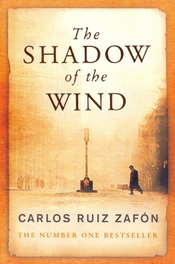
The Shadow of the Wind by Carlos Ruiz Zafón

Phoenix, 2005, 506 p, plus i p summary, i p about the author, ii p “For discussion”, x p “A walk in the footsteps of The Shadow in the Wind” including ii p maps. Translated by Lucia Graves from the Spanish La sombra del viento, Editorial Planeta, 2002.

The Shadow of the Wind cover

Well, this all started out promisingly enough with ten year old Daniel Sempere being taken by his father to the secret Cemetery of Forgotten Books to pick one out for himself, to keep it alive. This conceit hinted that the novel would be one of those books about books and the importance of the word like The Name of the Rose, especially since Daniel is told, “Every time a book changes hands, every time someone runs his eyes down its pages, its spirit grows and strengthens,” but the novel soon veers off into more conventional unravelling a mystery territory.

The book Daniel picks is titled The Shadow of the Wind by one Julián Carax. Daniel reads it and is enthralled, wishing to find out more about its author and any other books he may have written. But Carax is an elusive creature. Very few of his books (most of which sold in pitifully small numbers) survive. In addition a mysterious man going under the name Lain Coubert, a character in Carax’s Shadow of the Wind, is going around buying them up – in order to burn them. Already we are in a recursive situation, a loop which is in essence claustrophobic. Too many of the characters in the book are bound up either with Daniel, Carax or both.

Daniel’s first infatuation is with the blind Clara, quite a few years his senior. Their (necessarily) chaste relationship – and her entanglement with her piano teacher – is somewhat reminiscent of Gabriel García Márquez but as if off-key, though paradoxically, given Marquez’s magic realism, none of this aspect of Zafón’s novel feels natural. It appears forced, occurring only at Zafón’s will. Other backstories read like information dumping and there are too many parallels between Carax’s life and Daniel’s; between his friend Tomás Aguilar and Carax’s, Jorge Aldaya, between his first lover Beatriz Aguilar and Carax’s, Penélope Aldaya.

As an example of an authorial misstep Zafón has Daniel tell Bea about Carax’s The Shadow of the Wind that, “This was a story about lonely people, about absence and loss, and that that was why I had taken refuge in it until it became confused with my own life,” inviting us to draw a parallel that had been obvious long before. Yes, Daniel’s friend, Fermín Romero de Torres, is a memorable character but the villain of the piece, Inspector Francisco Javier Fumero, tends to the cartoonish, his obsession with Carax insufficiently founded – at least to me. There are, too, frequent recapitulations of the story to other characters. The Aldaya mansion on the Avenida del Tibidabo, though, is a gothic enough creation, along with the statues in its grounds.

Attempts at background verisimilitude also fall down at times. An old quack’s “sole remaining wish was for Barcelona’s football team to win the league, once and for all, so that he could die in peace.” This is an odd observation for someone to make in 1954 as Barcelona had most recently won La Liga in season 1952-3 and also the one before. Again in 1954 a restaurant manager apologises for poor service by saying, “‘But s’afternoon, it being the European Cup semi-final, we’ve had a lot of customers. Great game.’” The first European Cup semi-finals did not take place till 1956. Similarly there is a mention of the League Cup – but the La Liga Cup did not start till 1984 (and only lasted four years.) Did Zafón perhaps have the Copa del Rey in mind?

Still, “‘Mysteries must be solved, one must find out what they hide,’” and I suppose this is what keeps us reading but while it may be true that, “People tend to complicate their own lives, as if living weren’t complicated enough,” I’m not sure I agree with the assertion, “‘When we stand in front of a coffin, we only see what is good, or what we want to see.’”

Set where and when it is The Shadow of the Wind could not avoid touching on the fallout of the Spanish Civil War but it does so only tangentially. It is eminently readable but in the end it doesn’t manage to achieve the stature that the author is clearly striving for. Quite simply in this book Zafón is trying too hard.

Pedant’s corner:- “a couple of nuns …. mumbling under their breath” (ought really to be breaths,) polanaises (polonaises; this correct form is used later in the book,) “froze the blood in my veins” (really? Especially when followed on the next page by “my blood froze,”) the Barcelós apartment (Barceló’s,) for goodness’ sake (goodness’s,) automatons (okay it’s acceptable in English – as well as automata, the plural from the Greek,) “none of the drawings were more than rough sketches” (none was more than a rough sketch,) faggotry (a USianism,) “‘It’s my fault,’ I said. I should have said something…’” (missing open quote mark after “I said.”) “An act of charity or friendship on behalf of an ailing lady” (‘on the part of’ is meant,) “which violated at least five of six recognized mortal sins,” (shouldn’t that be “five or six”? – and violated here seems to mean committed,) morgue (mortuary,) with sudden heartfelt hug (with a sudden,) catlike smile the smile of a mischievous child (a missing comma after the first smile,) garoted (garrotted,) Jacintaʻs vision (has a backward, and upside down, apostrophe,) “so that he can have a brain scan” (a brain scan? In 1954?) Barnarda (her name everywhere else in the novel is Bernarda,) passion (passion,) a benzine lighter (the term used in English is cigarette lighter,) “and whose specialty was Latin, trigonometry, and gymnastics, in that order,” (that’s three specialties.)
Plus points for “not all was lost”.

free hit counter script