Archives » C J Cherryh

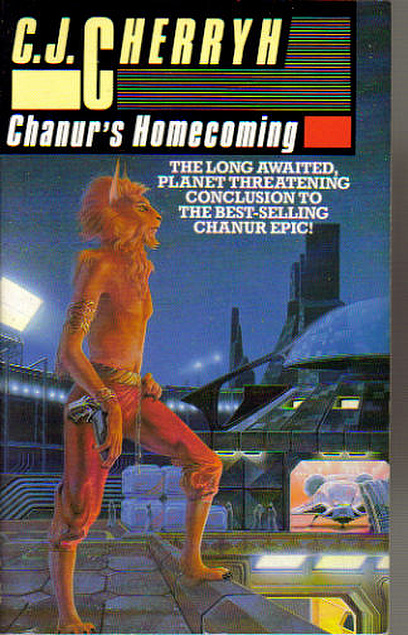
Chanur’s Homecoming by C J Cherryh 

Mandarin, 1988, 394 p.

This is the fourth in Cherryh’s pride of Chanur sequence, featuring the leonine Pyanfar Chanur as a protagonist. I reviewed the previous books here, here and here.

Chanur’s Homecoming seemed to me to be more densely written than the others in Pyanfar’s story so far, with much more of her thoughts and worries on the ongoing situation in the worlds of the Compact. Her main preoccupation here, though, is the threat to her homeworld Anuurn, and to the survival of her han race, represented by the kif Akkhtimakt, who has taken his ships off presumably to attack the planet. Pyanfar has an ally of sorts in another kif, Sikkukkut, who has gifted her one of his slaves, Skkukuk and is a sworn enemy of Akkhtimakt. Other characters familiar from the previous books are Pyanfar’s niece, Hilfy, the rest of the crew of her spaceship The Pride of Chanur and the human Tully – but he takes much less part in the action and the plot than before.

That action takes some time to come to the fore and it is only in the book’s latter stages when the pace ramps up. It is what happens in this book though which sets out why Pyanfar will later become a revered elder in hani society.

Pedant’s corner:- focussed (x 2, focused,) “I can’t shake if off” (it off,) “in common” (common,) unladed (unladen,) “none of them were in the mood” (none of them was in the mood,) touble (trouble,) shortfocussed (shortfocused.) “Neither of us are” (Neither of us is,) Pasarimi (elsewhere Pasarimu.)

The Kif Strike Back by C J Cherryh

201 p, in The Chanur Saga, Daw Books, 2000, (which has an 11 p Appendix on Species of the Compact.) Originally published 1986.
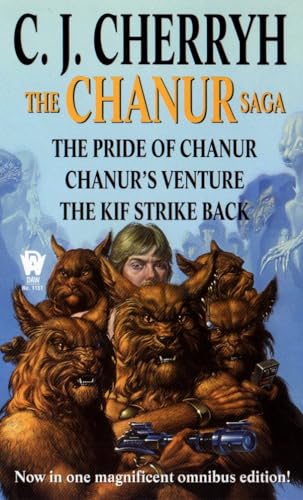
This is the third of Cherryh’s novels featuring Pyanfar Chanur, a hani from the planet Anuurn, itself a member of the interstellar trading system known as the Compact. For my thoughts on the earlier two instalments see here and here.

Pyanfar’s first task in this book is to gain the release of both her niece Hilfy and the human Tully from their captivity by the kif, Sikkukkut. For this she has travelled to the station of Mkks, which is under Sikkukkut’s control. The exchange involves her agreeing to an arrangement with Sikkukut to aid him in his contest with another kif, Akhtimakt, for supremacy among their kind. Part of this is a gift to her of Skukkuk, a kif whose presence on Payanfar’s ship The Pride of Chanur causes grave misgivings among her crew. An alliance such as this is also thought by other hani undesirable, even treasonous, and may have repercussions for Payanfar’s family back on Anuurn.

The agreement requires Pyanfar to journey deep inside kif territory to Kefk station, where most of the action takes place. The nature of kif beliefs and behaviour is emphasised by the entrance to Sikkukkut’s headquarters being flanked by his enemy’s heads on poles. So far, so mediæval. Pyanfar manages to bargain for the release of another hani ship’s crew from Sikkukkut’s custody but on the way back to the Pride they get caught up in the struggle between kif factions which provides the book’s only ‘battle’ scenes.

I note here that the kif language is heavy with (often doubled) percussive consonants and seems to lack the vowels a and e. Apart from Pyanfar’s hani, the only other language represented on the page in this volume is that of the tc’a, who communicate in cryptic seven by three matrices.

Though bearing in mind that hani are essentially lion-like (certainly in appearance, apart from what I assume – there being no indication to the contrary – is their bipedalism) Cherryh may have been making a comment on human affairs when in the context of hani social arrangements she tells us “Hilfy had known all her life that men were precious things; and their sanity precarious; and their tempers vast as their vanity.”

While all the action and intrigue Pyanfar witnesses and takes part in is going on a lot of stuff has been occurring in the background. Pyanfar’s mohendo’sat friend Goldtooth has, without Pyanfar’s knowledge, been manœuvring to leverage the impact of human accession to the Compact. Tully has less of a central role in this book than he had previously but he does let slip that human culture is more factional and complicated than the species of the Compact had perhaps assumed.

I suppose these books are technically space opera but their emphasis is less on spaceships battling each other than on political matters in the Compact, inside kifdom and amongst the hani. There is, too, frequent reference to domestic life on board the Pride. In this regard the procedures on board make the hani seem more human than leonine.

Pyanfar, Hilfy and even Sikkukkut have become more rounded the more the story develops and we also learn more of the other members of the crew than before.

Since there are five books in the overall Chanur story arc it is a little odd that this omnibus has cobbled together Books 2 and 3 with Book 1, which was more of a stand alone. Indeed Cherryh’s tale is by no means resolved by The Kif Strike Back’s end, which in a three book volume I would have thought the reader has a right to expect.

However, I found Pyanfar’s company (both that on her ship and in my head as I read) very congenial. I will look out for the next in the sequence.


Pedant’s corner:- “whether that this was a kif’s humour or…” (no ‘that’ required,) Mkks’ (several times, Mkks’,) “‘You sure about this’ Pyanfar said” (needs a question mark after ‘this’,) strategem (stratagem – used later,) asyet (as yet,) “which had shed their v and began a sedate return” (had shed their v and begun a sedate return,) focussed (x 2, focused.) “Smoke skirled and billowed in the shock” (smoke does not skirl, it might swirl but it doesn’t make a sound,) “undernHaral’s pushbutton command” (under Haral’s.)
Chanur’s Venture by C J Cherryh

173 p, in The Chanur Saga, Daw Books, 2000. Originally published 1985.

After her banning due to her actions in the first book of the Chanur Saga, Pyanfar Chanur and her ship The Pride of Chanur are once again at Meetpoint Station. As she steps off the ship an old acquaintance, the mahendo’sat, Goldtooth, offers her a present. This turns out to be Tully, the human Pyanfar rescued from the kif in the earlier book and he carries with him a valuable contract for trade with humans, a contract the kif would have for themselves thus necessitating a quick exit from the station. Before this can happen, though, Pyanfar’s crew has to extricate her husband, Khym, from a bar fight which turns out to have been set up by kif. That Hani males like Khym are widely known to be unstable off-planet provided the perfect excuse for the brawl.

Internal factions among the Hani force Pyanfar to allow Tully and his escort, Pyanfar’s niece Hilfy, to be taken to a supposedly safe holding space at the station’s administrative centre but on the way they are abducted by kif.

The ship also needs repair and new drive vanes of mahendo’sat design and manufacture are fitted as part of the deal with Goldtooth.

Cherryh knows how to spin a story, her plotting and intrigue are intricate and the characters, albeit with their alien habits, recognisable psychological types. She does however have a tendency to overdo Pyanfar’s Hani imprecations. “By the gods “ is very much overused.

Unfortunately, this instalment doesn’t so much finish as just stop mid-plot. At its end Hilfy and Tully are still in kif hands and the Pride is about to launch into space using the new, and to Pyanfar’s mind untested, drive vanes.

Since I bought this as part of a trilogy I wasn’t too miffed at this lack of resolution but had I thought it was a stand-alone I would have been seriously dischuffed.

Pedant’s corner:- Pynafar (Pyanfar,) “before the door closed between” (between them,) a missing comma before a piece of direct speech, “as well as well as kif” (only one ‘as well’ needed.) “There was long, frozen silence” (there was a long, frozen silence,) a missing end quote mark after a piece of direct speech. “She went there the guard motioned” (She went where the guard motioned,) “it clambered up the t’ca wrinkled side” (the t’ca’s wrinkled side,) “to their unladed mass” (unladen mass.)

The Pride of Chanur by C J Cherryh

230 p, in The Chanur Saga, Daw Books, 2000. Originally published 1981.

The Pride of Chanur is a spaceship trading within the Compact. Its captain is Pyanfar Chanur, one of the oxygen-breathing hani race from the planet Anuurn, on which there are various factions. The descriptions of hani in the book depict them as being like lions in appearance, with claws, manes and mentions of ear position indicating emotions, though we must assume, there being no references otherwise, that they are bipedal. They were introduced to the Compact by fellow oxygen breathers the Mahendo’sat and mainly use that race’s technology. However only female hani go into space. Their males are too unstable when off planet. Pyanfar’s niece, Hilfy, is a newby on this voyage.

Other oxygen breathing members of the Compact are the Kif and the Stsho, while methane breathing species called Tc’a, Chi, and Knnn (who communicate in a manner akin to whalesong) are also traders.

The action starts at Meetpoint Station in Mahendo’sat space where an alien intruder, mostly hairless but with a golden mane, sneaks onto The Pride of Chanur. On trying to apprehend him Pyanfar wounds him but he is of little threat. He speaks little to no hani but with a mahendo’sat symbol translator communication becomes easier. It is soon obvious to the reader that he is a human. More so when we learn his name is Tully. His presence on the Pride is disputed by a kif trader named Akkukkakk who claims Tully as his own. His ship and crew were captured by Akkukkakk and ill-treated. The presence of this alien race was hitherto unknown to the Compact and contact with him will be a significant advantage in setting up trading terms to whomever has access to Tully.

So is set up the source of conflict for the novel as Pyanfar makes Tully a member of the Pride’s crew and tries to return to Anuurn, having to dodge contact with kif vessels and those of their allies on the way. Interstellar travel is by some sort of hyperspace jump but different ships can achieve this at different rates. After each jump the book tells us mass has to be shed but the way it reads sounds much more like velocity. Actual mass on board seems to slow interspace jumps down as Pyanfar has to dump most of the Pride’s cargo (and therefore profit) to make her escape from the Meetpoint system.

A sentence on the cover blurb claims that here it is a mark of Cherryh’s success that it is the human who seems alien. Well, yes and no. Tully’s speech is halting and hardy more than single words making him appear strange. However, the details of life on board the Pride, mention of meals and suchlike, the hani crewmembers’ use of sheets on their sleeping places, bedecking themselves with jewellery, their interpersonal relationships, make them almost indistinguishable from the habits of a human reader. They, not Tully, might as well be human. Only their appearance, the claws and so on, the importance of grooming, signals any difference.

It was a decent story well told, though. And I have two instalments of the Chanur Saga still to come. (Plus, having looked it up, a further two beyond those should I care to continue.)

Pedant’s corner:- “now amd again” (now and again,) “ears pricked up ad she drew in a breath” (and she drew in.) “There were a finite number of opacities in the quadrant” (There was a finite number,) “scantly clad” (scantily.) “‘You know more that that?’” (than that,) “the translater” (even though it’s a machine I still think it ought to be spelled translator.) “there was long silence” (a long silence.)  “‘No one species’ way’” (species is singular here so; species’s.) “He belonged with his own, that was what” (that was that.)

SF Bookshelf Travelling for Insane Times (xi)

A meme as started by Judith and now collated by Katrina.

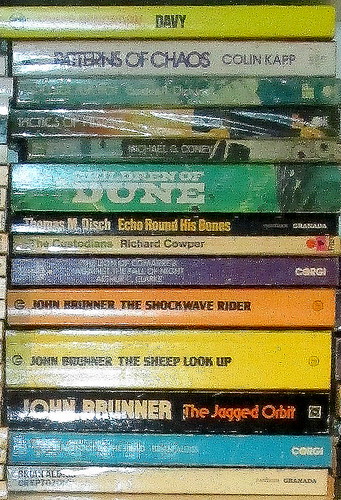
Since these are SF paperbacks mostly published several decades ago they are on the shelves housed in my garage. The photos are zooms in on the ones of the whole bookcases and so are a bit fuzzy.

On view are books by the excellent Michael Bishop, several by my friend Eric Brown, three by Algis Budrys, five (or seven since one is an omnibus of a trilogy) by C J Cherryh, but most of the books shown here were written by John Brunner. I remember fondly Stand on Zanzibar, The Dramaturges of Yan, Telepathist and The Squares of the City, in which the characters are in effect avatars of chess pieces whose moves were taken from a real game.

SF Books by John Brunner

Brunner’s The Shockwave Rider (in which he more or less predicted computer viruses but due to the storage medium of computers at the time he called them tapeworms,) The Sheep Look Up and The Jagged Orbit are shelved in another bookcase in the garage for arcane reasons.

Science Fiction Books

His Timescoop is on my hardback shelves.

free hit counter script