Archives » Behind the Scenes at the Museum

Human Croquet by Kate Atkinson

Doubleday, 1997, 347 p.

This was Atkinson’s second novel and it exhibits many of the traits which would come to dominate her fiction. The family dynamic here is reminiscent of the one in Atkinson’s first novel, Behind the Scenes at the Museum, and of the Todds in Life After Life and A God in Ruins. In this one our heroine Isobel finds herself slipping backwards and forwards in time and there is here the first adumbration of the thought found in the Todd books that it would be a boon if somehow we could live our lives over again in order to get them right. There is a Scottish flavour; neighbour Mrs Baxter – I was irresistibly reminded of the old soup adverts, especially since her daughter is named Audrey – lards the text with Scots aphorisms, though the prominence here of trees and forests is more of a preoccupation of English fiction. The house Isobel lives in is even called Arden.

We begin with a literary allusion, “Call me Isobel.” Implicitly to compare herself to Herman Melville is quite a statement by Atkinson of confidence in her abilities. But the book as a whole is dense with allusion or references – and also repetition, but repetition with a purpose, not merely saying the same thing over again in slightly different ways. For example, “The beginning is the word and the end is silence. And in between are all the stories. This is one of mine.” There is also a reversal of Tolstoy’s Karenina Principle in, “I suppose all unhappy families resemble one another (but all happy families are happy in their own way of course)” along with the addition of “But then, do happy families exist, or happy endings come to that, outside of fiction?”

After a starting chapter headlined ‘Beginning’ there are several sections each of ‘Present’ and ‘Past’ narratives outlining Isobel’s story, her family’s and Arden’s, before we end with ‘Future’. ‘Beginning’ is a history of the land on which Arden stands ‘Present’ is narrated by Isobel in first person; ‘Past’ is in the third person.

In the ‘Present,’ Isobel (Fairfax) is a sixteen-year-old schoolgirl mooning after the desirable Malcolm Lovat who, to Isobel’s chagrin, sees her as a friend. Her father, Gordon, vanished for seven years after mother Elizabeth was said to have absconded ‘with a fancy man’ but the circumstances are barely ever mentioned by their grandmother, the Widow, and the getting on for elderly spinster aunt, Vinny, in both of whose care they have been left. Both Isobel and her brother Charles try to make the most of things. When Gordon returns it is with a new wife.

The three primal motivations in literature, love, sex and death are well to the fore here. Gordon met Elizabeth by rescuing her from a bombed house during the Blitz, “My hero,” and was thereafter besotted by her feminine dazzle (the widow and Vinny are not so easily taken in.) There are incidents of murder and reported incest and Isobel imagines her part in Malcolm’s death over and over again but is unable to prevent it each time. A rational gloss to these experiences and her apparent time travelling is provided as symptoms of possible fly agaric poisoning.

While Human Croquet is exceedingly well written and intricately plotted – as well as diverse – a tangled web of relationships is revealed during the novel, to not all of which is Isobel privy; possibly too many connections between the characters to be fully convincing. (This is a trait I also noticed recently in Joseph O’Connor’s Star of the Sea.)

The game of Human Croquet, rules and a picture of which act as a three page appendix, is one of the pastimes Isobel has read of from an illustrated book of Home Entertainments. It involves a blindfolded person being aurally guided through hoops formed by two people making an arch between them.

In Human Croquet, the novel, Isobel has no such guide and has to make it on her own. As we all do.

Pedant’s corner:- hot-bed (does it need that hyphen? – ‘hotbed’,) Charles’ (many times Charles’s,) “help me Boab” (at least twice. This Scottish phrase is actually not an invocation to someone called Bob to provide assistance but rather an expression of disbelief or disconcertment, and is written ‘help ma boab’,) Keats’ (Keats’s,) beseeched (an apparently acceptable alternative to ‘besought’.) “‘Who understand them?’” (understands,) “CO2  + 2H 2A + light energy – (CH 2) + H2O) + H2A” (supposedly the equation for photosynthesis. It isn’t. And in any case CO2, H2O and H2A, OHOHO) Zeus’ (Zeus’s,) Ysggadril (Yggdrasil,) “the cries of the baby upsets my” (upset my,) “they bid their mother one last terrible farewell” (they bade their mother,) “less discretely” (not less separately [discretely,] but rather less inconspicuously, ‘less discreetly’,) aureoles (x 2, areolas; or areolae,) “to staunch the throbbing” (stanch,) “would he chose for a consort” (would he choose,) “smoothes the sheets” (smooths,) Glebelands’ (Glebelands’s,) de’el (usually spelled ‘de’il’, or deil,) “the amoeba and bacteria” (if it’s supposed to be plural then ‘amoebae’ – or even amœbae.)
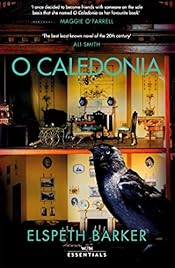
O Caledonia by Elspeth Barker

Weidenfeld & Nicolson Essentials, 2021, 212p, plus vi p Introduction by Maggie O’Farrell. First published 1991.

From the outset we know where this tale of growing up as a misfit is going; Barker shows us in her prelude, titled Janet. This is not foreshadowing as such – it goes beyond prolepsis even – but it does set up an intriguing question. Why will what Barker tells us happened, happen? Why was Janet’s misadventure so easily glossed over? What was it about her that made her dismissable? But this is arguably fairer on the reader than Kate Atkinson’s revelation in A God in Ruins which turned upside down what we thought we had learned in all its pages up to that point.
Some reviewers have observed similarities to Dodie Smith’s I Capture the Castle (written much earlier than O Caledonia) but the characters of Cassandra Mortain and Janet are very different and Barker is a much subtler writer but I did wonder while I was reading O Caledonia if Kate Atkinson was familiar with Barker’s novel. I found the weird incidents of Janet’s childhood oddly similar to the manifold earlier days of Ursula Todd in Life After Life; there were perhaps even greater similarities to Atkinson’s first novel Behind the Scenes at the Museum (from 1995.) Still, it allows Barker the acid observation “The subject was closed in favour of the living, who offer continuous material for persecution.”

Janet is a child in wartime living in the manse inhabited by her grandfather and subject to many an admonitory sermon. Scotland’s religious heritage, though never pushed, is an intermittent drum beat through the book as in, “At this time there were many Polish officers in the village. The Marine hotel had been requisitioned for them. They were popular with the lonely girls and the more flighty wives, so that after the war some stayed on and married, while others left behind girls who were even lonelier now, alone with tiny children in the unrelenting chill of a Calvinist world.” (This sort of memory of Polish soldiers was familiar to me from the tales told by an acquaintance who had lived in Kelso during the Second World War.) Barker also has Janet remark, “There seemed no place for gallantry and romance among Calvinists,” and, in a particularly self-flagellating moment “the nature of Caledonia was a pitiless nature and her own was no better.” That it had unintended effects is illlustrated by a passage wherein nannies asked children if they had done what they should today (ie moved their bowels) and unwittingly unleashed dissembling – “a horde of artful dodgers on the world.”

It is when the family inherits Auchnashaugh, a crumbling pile in the Highlands, that Janet’s alienation blossoms. She resents her younger siblings, fails to comprehend adult concerns or live up to their expectations and when older, retreats into books, having an appetite for things beyond her age, Latin and Greek tags and the like. Her experience is summed up by Proust’s phrase ‘l’étouffoir familial’ the family suffocation chamber. Of how many sensitive souls has that been true.

She similarly fails to fit in at St Uncumba’s, the boarding school she is sent to far south in England where her distaste for, and inability at, games and liking for literature are mocked. Until she learns to dissemble.

The signal feature of her otherness is her adoption of a not yet fledged jackdaw whom she names Claws and who is her constant companion at Auchnashaugh.

O Caledonia is far too little known for a book so accomplished. How it did not get onto the list of 100 best Scottish books is beyond me. Perhaps its reissue far too late (2021) could explain it.

Pedant’s corner:- The young Janet sees the beam of a lighthouse sweep her bedroom (but this was in wartime; the lighthouses were switched off as part of the blackout precautions,) “she sucked a vengeful Pandrop” (a pan drop,) “the baby prone within” (the baby supine is more likely,) “golden rod” (goldenrod,) “je men fous” (je m’en fous,) “Miss Wales’ grizzled hair” (Wales’s,) “the gaping maw of the furnace” (stomachs do not gape,) standing in a great Victorian cemetery in Glasgow for her grandfather’s funeral (at that time in Scotland women did not go to interments, still less children,) clipe (usually spelled clype,) “Sir Patrick Spens’ lords (Spens’s,) Sawney Bean is said to have carried out his cannibalistic activities on the Aberdeenshire coast (most accounts put this legendary tale in Ayrshire,) “True Thomas’ faery queen” (Thomas’s,) “Euripides’ Medea” (Euripides’s,) “Barr’s Iron Brew” (the proprietary name is Irn Bru,) “came Francis’ voice” (Francis’s,) “the war memorial” (War Memorial – used later,) “‘a wee Doc and Doris afore ye gang awa’!’” (usually spelled Deoch-an-Doris,) Kiichen (a manuscript misreading of Küchen?) “Watt and Grants” (Watt and Grant’s,) swop (swap,) “Francis’ voice” (Francis’s,) “she was couched out there” (crouched makes more sense,) “Propertius’ poem” (Propertius’s,) “Tiresias’ description” (Tiresias’s) “Claws’ residence” (Claws’s,) “jeune jille” (jeune fille,) “passage from the Georgies” (the Georgics that would be,) “Orpheus’ final loss” (Orpheus’s.)

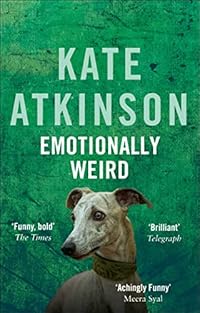
Emotionally Weird by Kate Atkinson

Black Swan, 2015 reprint of a 2000 publication, 489 p

 Emotionally Weird cover

During this, Atkinson’s narrator (by implication Atkinson herself) is at pains to emphasise that it is a comic novel. It is mainly the tale of the student life in 1972 of Effie Stuart-Murray (Effie Andrews as she had thought of herself) ostensibly narrated to, and frequently interrupted by, her mother (who is not her mother) interleaved with said (not)mother’s relation to Effie of her convoluted origins. Extracts from the ongoing novels of some of the characters – including Effie’s own, which Emotionally Weird as a whole is not – appear at odd intervals. All this requires the use of seven or so different fonts (not including italics) to differentiate the various strands.

This is fine as far as it goes – and it is always welcome to find in a novel those fine Scottish words rammy, stushie and stramash (the use of which indicates Atkinson can truly be considered a Scottish writer,) not to mention a Dundee setting – but it is not enough to defuse analysis of a book’s faults by including criticism of it within it. “Too many characters” Effie’s not-mother tells her, and later, “a welcome piece of exposition” to which the reader can only say “indeed.”

Effie’s ongoing failures to deliver essays when they are due is a backdrop to various comings and goings between members of the University staff, students and a private investigator called Chick. There are some wry observations but few if any laugh out loud moments. The intrusion of fantasy elements – possible ghosts, pseudo magic realism, the use of authorial omnipotence to rewind and change events – only adds to the rather unfocused feel. Comic, after all, does not mean anything goes. Curious foreshadowings of Atkinson’s Life After Life and echoes of Behind the Scenes at the Museum exist in her predilection for scenes depicting drowning.

At the sentence level the writing is fine, good even, the characters’ interactions are well observed, their motivations psychologically plausible. The trouble is Effie’s student days are really entirely separate from the circumstances of her birth. While the two story strands are intermingled, sometimes with extremely short jump cuts, they are not really connected except that they both involve Effie. A lampooning of early 1970s campus culture is all very well and might not have been enough to carry the novel on its own – especially when it is elongated beyond its ideal length as it is here – but Effie’s unusual beginnings and relationship with her not-mother do not distract from this. In the end Emotionally Weird just goes on too long to too little effect but within it some seeds of Atkinson’s future triumphs can be discerned.

Pedant’s corner:- still caked in Monro mud (these hills are called Munros,) Cousins’ (Cousins’s,) “and the Hun were” (the Hun was,) “Murdo fell at Mons” (in the previous paragraph he had signed up at age fifteen, three months after his brother “crossed to France”. The battle at Mons was in August of 1914, was followed by a retreat and the British Army did not get back there till November 1918,) “‘if you can’t manage the math’” (the British usage is maths and this USian character had been in Britain long enough to adapt but to be fair to Atkinson I suppose she wouldn’t have,) Descartes’ (Descartes’s; it’s pronounced “day-cart” for goodness’s sake, and its possessive therefore must be “day-cart’s”,) a range of…. farm buildings were (a range was,) primeval (I prefer primaeval,) one of the instances of jumping from strand to strand is a transition which adopts the new font one sentence too early, bouef bourguignonne (bouef bourguignon, or bouef à la Bourguinonne) “‘Jings, crivens and help me Boab’” (jings, crivvens and help ma boab,) Jenners’ carrier bags (Jenners’s,) Scalectrix (it’s spelled Scalextric,) tapsie-teerie (I thought at first this might be a mishearing by Atkinson of the more usual tapselteerie/tapsalteerie but I checked and the Dictionary of the Scots Language has it as a variant,) men-o’-wars (men-o’-war,) Effie Andrews’ (Effie Andrews’s.)

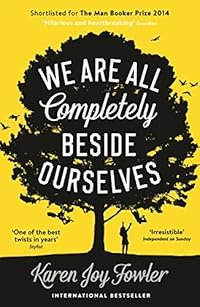
We Are All Completely Beside Ourselves by Karen Joy Fowler

Serpent’s Tail, 2014, 341 p. Borrowed from a threatened library.

 We Are All Completely Beside Ourselves cover

Firstly, this is a very good book indeed; and a consciously literary endeavour. Fowler’s first person narrator, Rosemary Cooke, frequently addresses the reader, digresses, makes asides, approaches her story obliquely, moves it forward and backward in time. She tells us in the prologue what she is about to do. Start in the middle. And later, in a cell, awaiting interrogation by the FBI she reflects on what she will say, “I would not only tell the tale but also comment on it.” Quite. By the end, though, she has decided that stories can begin and end anywhere.

When she was young Rosemary never stopped speaking. The reasons why, and why she gradually stopped doing so, are revealed over the course of the novel. Up until she was five years old Rose had lived with her mother, father, brother and sister. On returning from what she perceived as a banishment to her grandparents’ house she discovers her own family has moved house but it is her sister who has been sent away. This central circumstance is so essential to the novel that any discussion of it beyond generalities would reveal too much but it is its ramifications, the nature of her sister, Fern, and the effects both of these have on Rosemary and her brother, Lowell, which drive Fowler’s story.

Unsurprisingly, tensions abound. Rose tells us, “Antagonism in my family comes wrapped in layers of code, sideways feints, full deniability. I believe the same can be said of many families.” This is most likely a nod to Tolstoy’s similar phraseology. Through Rosemary, Fowler tells us elsewhere, “In most families, there is a favourite child. Parents deny it and maybe they truly don’t see it, but it’s obvious to the children. Unfairness bothers children greatly.” Incidentally, the Cooke family had a dog called Tamara Press. Quite why Fowler chose the name of a 1960s Russian shot-putter for this is obscure (to me at least.)

Much play is made of the unreliability of memory. Rose recalls an incident from her childhood where she remembers her father deliberately driving over a cat but he was not the sort of person to do such a thing. She both believes it happened and also that it didn’t and refers to it as her own personal Schrödinger’s cat. She also says that language “simplifies, solidifies, codifies, mummifies” memories and remembers her father telling Lowell that language and communication are two different things. In a neat line connecting Rose’s use of contact lenses with her sister’s disappearance she says, “It’s what you do with disposables; you get rid of them.”

Rose twice emphasises her experience that, “Where you succeed will never matter so much as where you fail” and refers to the rift in the family as “A monkey on my back….” but in what seems an authorial interpolation, “When I run the world, librarians will be exempt from tragedy.” Her father was a researcher into animal behaviour and the book is run through with references to such research. “‘You can train any animal into any behaviour on cue if it’s a natural behaviour to begin with. Racism, sexism, speciesism – all natural human behaviours… triggered any time by any unscrupulous yahoo with a pulpit… Mobbing…Bullying. Empathy.’” The book is very much Rose’s story, her umwelt (the world as it is experienced by a particular organism.) Humans it seems are much more imitative than other apes.

For various (and different) reasons I was reminded of both William Boyd’s Brazzaville Beach and Kate Atkinson’s Behind the Scenes at the Museum.

There are not many novels which go into detail on the concept of theory of mind or discourse on embedded mental states and imputation. Yet these discursions seem a natural part of the narrative making for a tremendously well worked out and impressively rendered novel.

Pedant’s corner:- A flock of seagulls were grazing (a flock was grazing,) hieroglyphic (hieroglyph.) Fowler does, however, receive plus points for culs-de-sac.

free hit counter script