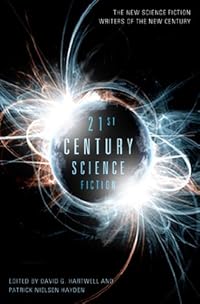
Robinson, 2013, 572 p. Borrowed from a threatened library.
The book cover and spine has 21st Century but the title page Twenty-First Century. The editors choices were made from those writers whose rise to prominence came after 1999 – in a world where they say SF is no longer marginal but a part of the cultural landscape. So to the stories.
In Vandana Singh’s Infinities Abdul Karim is fascinated by mathematics. Visions of beings he calls farishte and sees out of the corners of his eyes lead him to ponder the variety of mathematical infinities and the intersection between transcendental numbers and primes. But life wears him down and his glimpse of the connections does not mesh with the troubles of a divided India. Rogue Farm by Charles Stross is set in a depopulated future and features trees which can store nitrate (effectively making them rockets/bombs) and collective farms composed of several people melded into some sort of tank-like vehicle. I know it was originally published in a US magazine but it’s located in Cumbria yet not only the prose but also the dialogue – with a few exceptions – was written in USian. The exceptions were some unconvincing “ayup”s and a sudden splattering of “Northern” speech in the second last paragraph.
Paolo Bacigalupi’s The Gambler sees an exiled Laotian struggle to get enough click-bait on his news stories, Neal Asher’s Strood features more or less beneficent invading aliens and their pets, which have unusual eating habits. In Eros, Philia, Agape by Rachel Swirsky, Adriana seeks love from and marries a robot called Lucian. Things go wrong when she lets Lucian have free will and their adopted daughter begins to believe she’s a robot. “The Tale of the Wicked” by John Scalzi is an updated version of Asimov’s Three Laws of Robotics stories when the brains of two spaceships in a hot pursuit start to communicate. Bread and Bombs by M Rickert is a post-apocalypse, post twin towers, tale where no-one travels by air, indeed any sighting of an aeroplane is accompanied by fear, and outsiders are treated with suspicion.
Taking its inspiration from a Biblical text and the Uncertainty Principle, Tony Ballantyne’s The Waters of Meribah is set in a universe shrunk to only tens of miles across where a group of scientists is engaged in a bizarre experiment to create an alien in order to break out again. Tk’Tk’Tk by David D Levine features the experiences of a hereditary salesman on a planet inhabited by excessively polite aliens. He comes to an epiphany, as you do. Genevieve Valentine’s The Nearest Thing is the closest to a human an artificial entity can get but the process is neither morally nor emotionally simple for its software designer. In Ian Creasey’s Erosion the comparison evoked by its title is perhaps a touch over-egged in his tale of an augmented human about to leave for the stars out for a last hike along the North Yorkshire coast. Marissa Lingen’s The Calculus Plague tells of the beginnings of transfer of memories by viral infection. One of our Bastards is Missing by Paul Cornell is set in a future where early eighteenth century Great Powers have lasted into the space age, the balance of power is kept steady but they still plot against each other.
A damaged war machine, the last of its platoon, roams the seashore in Elizabeth Bear’s Tideline, collecting material to make memorial necklaces for the fallen. Finistera by David Moles is set on a giant planet with a nitrogen-oxygen atmosphere where floating creatures as large as mountains form homes for people and exploitable resources for the less scrupulous. In Mary Robinette Kowal’s Evil Robot Monkey an augmented chimpanzee wants only to make pottery; but humans – especially schoolchildren – remain humans. The junior of The Education of Junior Number Twelve by Madeline Ashby is the twelfth offspring of a kind of self-replicating android, designed so as not to allow harm to humans. They make perfect lovers though. Even if humans themselves remain as messed up as ever. Toy Planes by Tobias S Buckell sees a Caribbean island join the space-faring nations. Ken Liu’s The Algorithms of Love is curiously reminiscent of Flowers for Algernon in its tale of a designer of truly interactive dolls coming to believe she herself, and all humans, are merely reacting to inbuilt instructions. The Albian Message by Oliver Morton speculates on just exactly what is contained in a pyramid left by aliens in the Trojan Asteroids hundreds of millions of years ago while Karl Schroeder’s To Hie From Far Cilenia supposes layers of “cities” – or at least organised groupings of people – only existing in a kind of online virtual reality parallel to the real world. Brenda Cooper’s Savant Songs is about the search by a brilliant (but socially awkward) female physicist for her counterparts in the multiverse of worlds. Ikiryoh by Liz Williams is reminiscent of Le Guin’s The Ones Who Walk Away from Omelas in that the eponymous child is the repository of all the darkness that would otherwise be present in the goddess who rules. The Prophet of Flores by Ted Kosmatka is set in a world where Darwinism was disproved in the 1950s by dating techniques. Yet on the Indonesian island of Flores unusual bones have been discovered in a cave. The protagonist’s conclusion sticks neatly to the logic of his world.
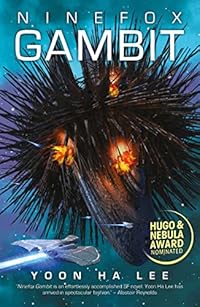
According to Catherynne M Valente’s How to Become a Mars Overlord each solar system has its own Red Planet and the author provides a stepwise guide to its overlordship but the piece overall is less of a story than a disquisition. In Daryl Gregory’s Second Person, Present Tense Therese has taken an overdose of a drug called Zen, which alters her persona. Her parents don’t accept this. Third Day Lights by Alaya Dawn Johnson features a shape-shifting demon and a human looking for the afterlife of the afterlife. James L Cambias’s Balancing Accounts has a robotic/AI protagonist plying a living for its owners by trading in the Saturn system. An unusual cargo brings problems. A Vector Alphabet of Interstellar Travel by Yoon Ha Lee is another disquisitive story about various different cultures’ star drives. Hannu Rajaniemi’s His Master’s Voice stars a dog (and, yes, it’s called Nipper) seeking the return of its master who has been “condemned to the slow zone for three hundred and fourteen years” for illegally producing copies of himself and, since Rajaniemi sojourned for a while in Edinburgh, could just perhaps have been inspired (a bit) by the tale of Greyfriars Bobby. Plotters and Shooters by Kage Baker is set on a space station dedicated to spotting and destroying Earth threatening asteroids. The station’s hierarchies are disrupted by a new arrival. In The Island by Peter Watts a never-ending mission to seed the universe with jump gates threatens the existence of a millimetre thin organism surrounding its sun like a gossamer Dyson sphere. Escape to Other Worlds With Science Fiction by Jo Walton is set in a world where not only did the New Deal fail but the Second World War did not occur as we know it. By 1960 the US is becoming fascistic. Cory Doctorow’s Chicken Little posits a future where the rich are utterly cut-off from even the wealthy but a drug called Clarity can enable true assessment of risk to take place.
On the whole, strong stuff. There is enough here to suggest that SF is a vigorous culture still.
Pedant’s corner:- “the cluster of competing stories are growing” (the cluster is growing,) metastized (metastasised – I have also substituted s for the USian z,) remittance (remission,) minutia (minutiae,) her sisters’ ability to overcome her fear of their father (their fear?) rung (rang,) “I hate to come out of that jump (I’d hate to,) none of the …. have (none has,) a they as an antecedent to an it, and the killed (and killed,) the architecture of the brains are different (the architecture is different,) a yearning gap (the context suggests yawning gap,) “where his regiment were dining” (his regiment was dining,) a Queen Mother is addressed as “Your Royal Highness,” (I suspect that would still be, “Your Majesty,”) “the Queen Mother’s Office are asking” (is asking,) “the unit are still in the fold” (is still in the fold,) the start quote mark is omitted at a story’s beginning, stripped off (stripped of,) Becqurel Reindeer (they are radioactive, so I presume Becquerel,) borne (born,) Hitchens’ (Hitchens’s – which is used later,) jewelery (the USian is jewelry, in British English it’s jewellery,) the total affect (the noun is effect,) goddess’ (goddess’s, which is used 12 lines later!) equilibriums (equilibria,) Deluvian Flood Theory (Diluvian? – which means flood, so is this Flood Flood Theory?) “Hands were shook” (shaken,) a phenomena (phenomena is plural; one of them is a phenomenon,) “It’s the circulating domain of their receptors that are different” (is different,) sunk (sank,) rarified (rarefied,) talk to the them (no “the”,) none of us get (gets,) aureoles (context suggests areolae,) “that whole series were built” (that series was built,) “a great deal of time to attempting” (no need for the “to”,) “The chained aurora borealis flicker and vanish,” (if its one aurora borealis that should be “flickers and vanishes”; otherwise it’s aurorae boreales.) “We sweeped over the dark waves,” (I think that really ought to be “swept”,) hemi sphere (hemisphere,) the Van Oort belt (a confusion of Oort Cloud with Van Allen Belt?) infered (even USian surely has inferred?) borne of parents (born of; definitely born of.)