Archives » Virginia Woolf

Between the Acts by Virginia Woolf 

Wordsworth Classics. (In The Years & Between the Acts.) 2012, 256 p, including x p Notes and a xix p Introduction to both books by Linden Peach. Between the Acts was first published in 1941.

This was Woolf’s last novel, published posthumously. A prefatory note by her husband said it was completed but not corrected nor revised, though he believes she would not have made any large alterations. I beg to differ.

Like The Years (with which it is combined in this edition) this is more straightforward than Woolf’s earlier novels To the Lighthouse and Mrs Dalloway. That doesn’t do much to recommend it though as what we are given here is a portrait of tiresome upper-middle class people doing and saying upper-middle class things but that could perhaps be borne were it not for the fact that the main part of the book is a struggle to get through as it contains a blow-by-blow account of a local pageant in all its lengthy tediousness.

In Linden Peach’s Introduction to Between the Acts he asserts that the novel is interrogating Englishness. If it does, it is only Englishness of a very narrow sort.

The text mentions an incidental character by describing him as “a Jew”, as if that said all there was to say about him.

Sensitivity note: as well as the gratuitous remark about “a Jew” we also encounter the phrases “worked like a nigger” and “white man’s burden.”

Pedant’s corner:- again the Notes explain references of which a British reader would be aware; Somerset House etc. Otherwise; “said Mrs Manresa ogling Candlish, as if he were a real man” (would be better punctuated as ‘said Mrs Manresa, ogling Candlish as if he were a ….’,) “it was a mellay” (usually spelled melé or mêlé,) “Mrs Rogers’ chin” (Mrs Rogers’s.) In the Notes: Sohrab and Rustum is said to be by Matthew Arnold. While he did write such a poem (and Woolf’s characters would undoubtedly have been familiar with it) the original story was in fact from Shanameh, (https://en.wikipedia.org/wiki/Shahnameh) an epic poem by the Persian  Ferdowsi (Abul-Qâsem Ferdowsi Tusi,) (https://en.wikipedia.org/wiki/Ferdowsi) Daladier is said to have been Prime Minister of France from 1838-1840 (it was 1938-40.) “Il Rissorgimento” (Risorgimento.)

The Years by Virginia Woolf

Wordsworth Classics. (In The Years & Between the Acts.)  2012, 302 p, including vi p Notes and a xix p Introduction to both books by Linden Peach. The Years was first published in 1937.

This is another book with an unusual chapter structure. Here the sections – of varying length –  are dated 1880, 1891, 1907, 1908, 1910, 1911, 1913, 1914, 1917, 1918 and Present Day (which would be 1937) and overall offers us fragments from the life of Eleanor Pargiter. It’s not quite a family saga but getting on for it. While spanning the years, the novel is not broad in scope (the Great War for example happens off-stage) and – though wider events are referred to in passing – the narrative limits itself to goings-on within the family.
Each chapter/section starts with a description of the weather on the day concerned (except for the first section, events confine themselves to that day.) The narrative is accompanied by Notes which explain things or institutions of which the reader is presumably assumed to be unaware though it is hard to see how anyone British would not understand references to the Palace, the Bar, the Bodleian, Balliol, Gladstone, Whitehall etc.

Eleanor is one of the daughters of Colonel Pargiter. He has one hand restricted in use due to losing fingers in the Indian Mutiny. In 1880 the family lives in comfort in Abercorn Terrace but Mrs Pargiter is dying. The Colonel has a mistress, Mina, about whom he feels a degree of guilt but who is necessarily kept secret from his children.

Deaths toll through the first few sections, of Mrs Pargiter, of Charles Stewart Parnell, of the King (Edward VII,) and of a servant’s dog, but in a novel titled The Years how could it not? The emphasis on personal life indicates that though history sweeps on people get by and do what they have to, live their lives regardless. Some of the family fall into reduced circumstances after the colonel’s death but most carry on their resolutely middle-class existence.

Social attitudes of the time are signalled by use of the word Jewess, the comment “‘They do love finery – Jews,’” a reference to dagos – the relevant note does say that’s offensive – and the description “‘burnt as brown as a nigger.’” We also have that Victorian use of a line in place of someone’s, or a place’s, name, as in “Miss —.”

As a portrait of a certain stratum of society in the late Victorian, Edwardian and post-Great War eras this is fine but it’s not startling, nor indeed particularly memorable.

Pedant’s corner:- staunched (stanched,) “rigging thing’s up again” (rigging things up,) “the grisled, crumpled red-and- yellow face” (grisled is an obsolete form of grizzled,) “the metre” (of a taxi. That’s spelled ‘meter’,) “he sunk his head” (sank.)

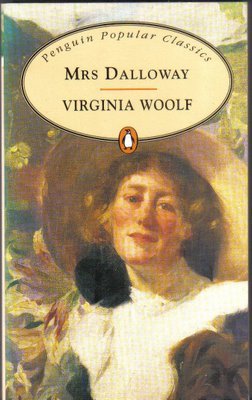
Mrs Dalloway by Virginia Woolf

Penguin, 1996, 211 p.

 Mrs Dalloway cover

This tells the events of one day leading up to the throwing of a party by the titular Mrs (Clarissa) Dalloway which may, or may not, be being attended by the Prime Minister. That title might lead you to believe that the book’s main focus will be Clarissa but it is not. It is written in the stream of consciousness style but that too is a misnomer as what we have here is really streams of consciousnesses since the narration flits from one character to another like a gadfly, rarely settling down for long. This is immensely irritating to begin with but in time, with familiarity, becomes less so.

As well as Mrs Dalloway we enter the thoughts of Peter Walsh, recently returned from India and a failed marriage but declaring himself to be in love for the first time, and Rezia and Septimus Smith, wife and husband. Walsh it seems had a thing for Clarissa in their youths, later musing he had been so in love with her then. (So what was that “first time” declaration all about?) Septimus has not recovered from his experiences in the Great War and his disturbed state has tragically not been recognised by various medical practitioners, nor by his wife.

I know Woolf has received praise for her writing and was an early user of stream of consciousness (a pioneer, indeed) but there is something detached about her style which I find difficult to engage with. My reaction to this book is the same as it was with To The Lighthouse.

This copy was loaned to us by a friend who has written in the margin that Woolf was trying to erase the narrator as a persona. On this evidence, replacing a narrator with many personas isn’t much of an improvement. I’ll not be in a hurry to read any more Woolf.

Pedant’s corner:- sprung (sprang, which was used later,) waggons (wagons,) Hatchards’ (either Hatchard’s or Hatchards’s,) Jorrocks’ (Jorrocks’s,) plaguy (plaguey?) a missing full stop, missing commas before pieces of direct speech (too numerous to count,) Kinloch Jones’s (this was a plural, hence Kinloch Joneses,) “They rose .And Richard” (They rose. And Richard”,) “Mrs Peters’ hat” (Mrs Peters’s,) campare (compare,) “did not use to rouge” (did not used to rouge.)

To The Lighthouse by Virginia Woolf

Penguin, Reprint of 1964 edition, 237 p. One of the 100 best Scottish Books.

To The Lighthouse cover

Quite why this is on any list of Scottish books is something of a mystery. Yes, the nominal setting is somewhere in the Western Isles but it could really be anywhere. There is nothing intrinsically Scottish about the subject matter nor the characters and certainly not their speech patterns. I always suspected that Scottishness would be a false premise under which to read the book. Granted, there are references to the Waverley novels, but that is not enough to make a book Scottish. Neither are there sufficient descriptions of the landscape to bring it under the umbrella.

I understand Woolf is revered by some (a cover quote from Jeanette Winterson says, “Woolf is Modern. She feels close to us. With Joyce and Eliot she has shaped a literary century.”) Yet I found this novel to be …. odd.

To The Lighthouse is structured in three sections, The Window, Time Passes and The Lighthouse, of which the first is the longest and the second not much more than a placeholder but mercifully more cogent than the other two. We begin eavesdropping on the Ramsay family and their acquaintances as they contemplate a visit to the titular lighthouse the next day. There is little conflict between the characters (except in their unspoken thoughts) – certainly none that is dramatised, only Mr Ramsay saying he doubts they will be able to make the trip. Not a lot happens. Arguably the most important event in the book occurs offstage in Time Passes and is only reported – but people reflect on the little that does happen either at length or a tangent.

I have no problem with stream of consciousness as a technique – Jenni Fagan’s The Panopticon uses it well – but without a focus it can reel off into irrelevance. The narrative viewpoint here can flit from mind to mind within the same paragraph (sometimes it felt like the same sentence.) As a result any insight into the human condition ends up drowned in the deluge. Any wood here is difficult to distinguish amongst all the trees. The copy I read was the good lady’s and she has told me she didn’t take to the book either.

I note from the entry on Woolf in The Oxford Companion to English Literature that she co-founded Hogarth Press – the original publishers of To The Lighthouse and others of her works: this is surely tantamount to self-publishing – and from her Wikipedia entry that her first novel was published by her half-brother’s company; which smacks of nepotism to me.

It’s the first of her works I have read and maybe I ought to sample more but I’d be delighted if someone could tell me just why Woolf is supposed to be good. On this evidence, and as that advert used to have it, her writing is dull, dull, dull.

Pedant’s corner:- galoshes (galoshes,) stood (x2, standing,) trapesing (I had not previously come across this alternative spelling of traipsing,) a comma at the end of one paragraph, shrunk (shrank,) waterily (what an ugly word; “like water” would have conveyed the sense,) sunk (sank.)

free hit counter script