Archives » Thomas Carlyle

Dunbar Battlefield

The last major act in Scotland of the Wars of the Three Kingdoms – still known to some as the (English) Civil War – was the Battle of Dunbar in 1650.

We’ve been to Dunbar many times and I had spotted a signpost pointing to the battlefield but at the time had an appointment elsewhere so couldn’t stop.

Last year the good lady and a friend had signed up to FutureLearn history course on the battle, their interest triggered by the discovery at Durham Cathedral of human remains which turned out to be those of Scottish soldiers captured during the battle, and taken to Durham to be kept imprisoned (under atrocious conditions) in the Cathedral, where some died.

So it was that last summer we made a concerted effort to find the battlefield. Yes, there was that signpost but there’s not much in the way of information boards at the battlefield itself or on the road the signpost pointed along. This very recently erected stone was set back from the road and commmemorates those taken prisoner at the Battle of Dunbar, 1650.

Dunbar Prisoners Memorial

However, I am not sure if the two pictures below are of the battlefield or not. (North Sea in background.) After we came home I read up a bit and found the site of the battlefield straddles the main A1 road but does lead down towards the sea.

Dunbar Battlefield

Dunbar Battlefield

Once back at the road from which the signpost points we discovered this memorial. On it is an inscription, “3rd September 1650,” and a quotation from Thomas Carlyle, “Here took place the brunt or essential agony of the Battle of Dunbar.” (In the background is a modern cement works – and a horse):-

Dunbar Battlefield (1650) Marker Stone

Close-up:-
Battle of Dunbar, Carlyle Stone 1

A museum in Dunbar had a display about the battle including a piece of tapestry commemorating the Battles of Dunbar 1650, and Worcester 1651:-

Tapestry Panel, Dunbar Museum

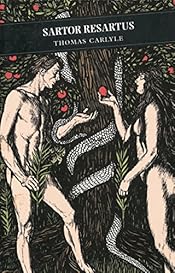
Sartor Resartus by Thomas Carlyle

Canongate, 2002, 320 p (including 2p biographical note on Carlyle and 10p Index,) plus x p Summary of Contents, viii p Introduction by Alasdair Gray, iii p Letter of Introduction from the Illustrator, (Edmund J Sullivan, for the 1898 edition,) ii p list of illustrations, viii p Testimonies of Authors. (One of the 100 best Scottish Books.)

 Sartor Resartus cover

To call this a novel (as the book’s Wikipedia page does) is stretching things a bit. It contains none of the things usually associated with the form, human interaction, character development, anything that could reasonably be called a plot – plus there is no dialogue to speak of. Rather it is a member of that sub-genre of literary endeavour; the book about a non-existent book.

The text adopts the stance of a commentary by an unnamed editor – who may be thought to be Carlyle but who refers to himself as English (as distinguished from the putative British reader he envisages, in which Carlyle seems to me to be emphasising the difference) – on a book supposedly written in German by one Diogenes Teufelsdröckh, whose name translates as God-born devil-dung. Teufelsdröckh is professor of “Things in general” at Weissnichtwo (“Know not where”) University. His book’s title is Clothes, Their Origin and Influence, in effect a philosophy of clothes, and this conceit enables Carlyle, through Teufelsdröckh, to animadvert on any subject he pleases, to point up, mock and highlight the folly of human society and attitudes. As befits his supposed source our ‘editor’’s text is spattered with German phrases most of which are translated either in the text or as footnotes.

How seriously we are meant to take all this is debatable. Teufelsdröckh’s uncertain origins could be taken from a fairy tale, his childhood home Entepfuhl (duck pond in English) is a microcosm of mediocrity.

Sartor Resartus is an acknowledged classic, not only of Scottish but of world literature. Reading it in the twenty-first century it does seem of its time, though.

Pedant’s corner:- In the biographical information; Jeffries’ (Jeffries’s,) briliant (brilliant.) In Alasdair Gray’s introduction; “Gold in the vaults of banks …. represent the wealth of nations” (gold … represents.) In Testimonies of authors; a capital letter when a sentence takes a new direction (this is an early nineteenth century habit though and is also to be found in the main body of the text.) Otherwise: Sanhedrim (Sanhedrin,) quoting Shakespeare “‘We are such stuff as dreans are made of’” (I believe the line reads ‘such stuff as dreams are made on’.)

My Latest Publication

…. was an emailed letter of comment in yesterday’s print edition Guardian Review on a piece called A Door into Wonderland which was the lead article in last week’s edition.

Unfortunately my letter doesn’t seem to be on the online version. (Or if it is I couldn’t find it.)

But the text was in my email’s “sent” folder:-

The idea of a “wonder-land” has certainly – as Robert Douglas-Fairhurst said – also attracted English and American authors but his point was perhaps a little undermined by the first example quoted, Thomas Carlyle, not actually being English. Ecclefechan may be near to the border but it’s still on the northern side.

Jack Deighton.

free hit counter script