The Mandelbaum Gate by Muriel Spark
Posted in Other fiction, Reading Reviewed, Scottish Fiction, Scottish Literature at 12:00 on 15 April 2023
Polygon, 2018, 376 p, plus iv p Foreword, ix p Introduction by Gabriel Josipovici and i p Contents. First published in 1965.
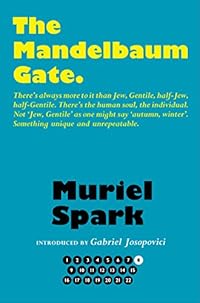
Spark’s eight’s novel is much longer than any of its predecessors (and successors.) It is set in Jerusalem during the Eichmann trial at a time when the city was divided between Israel (which the Arabs never name as such) and the Kingdom of Transjordan; the only transit point between them is the Mandelbaum Gate of the title.
The story is mainly concerned with the desire of Barbara Vaughan, a half-Jewish teacher from England, to visit the Holy sites in Jordan and also see her fiancé, Harry Clegg, an archaeologist excavating the Qumran scrolls sites. Since she will have to travel from Israel through the Gate to do this there is a danger she will be regarded by the Jordanians as spy. The first Chapter though – along with many others – is seen through the eyes of Freddy Hamilton, a British consular official who has a fascination with poetry (both in the abstract and in composing verse himself) and who frequently travels through the gate to see friends Joanna and Matt Cartwright.
Barbara’s firm Catholic faith means an annulment needs to be sought from Rome of Clegg’s previous (non-Catholic) marriage, a process which seems interminable and likely fruitless. The fact of her engagement would be a shock to her relations back home if they could have conceived of it and is, when she hears of it, a shock to her headmistress, Miss Rickward (Ricky,) who had assumed the pair of them would live together in perpetual harmony, though not necessarily sexually. Ricky’s pursuit of Barbara to Israel and Transjordan is, I think, meant to confer an element of humour onto the proceedings as is Barbara’s disguise beneath a chador as an Arab servant on her eventual trips to the Holy places.
Several times Spark tells of incidents which will be described more fully later in the narrative, promising potential confrontations which do not actually fully materialise. In his Introduction, Gabriel Josipovici dignifies this practice with the literary term prolepsis. It isn’t; it isn’t even legitimate foreshadowing; it’s just telling us things before their due time and is very irritating.
Freddy is more of a cipher than Barbara but with an impending tragedy to his overbearing mother in Harrogate lurking in the background, though his various contacts, a shopkeeper called Alexandros, a fixer and womaniser named Joe (Yosif) Ramdez, his son, Abdul, and daughter Suzi are important to the working out of the plot.
A bout of amnesia on Freddy’s part on a return from Israel after a visit to the Cartwrights’ at which Barbara was present is convenient to complicating the story, though not to Freddy. This helps to muddy the timescales as we are at various intervals drip fed Freddy’s recollections from when he recovers the memories.
Overall, though, the novel doesn’t seem to know quite what type of tale it wants to be, a comedy of manners, an examination of faith – and then, about three-quarters of the way through, it suddenly (with the only foreshadowing being some toing and froing about the diameter of the water pipes of an Israeli project) becomes a spy story.
Sensitivity note: contains the word “Wog” – not unheard of in 1965, but offensive just the same.
Pedant’s corner:- In the Introduction “‘I am that I am’” (in the novel’s text is ‘I am who I am’,) “Miss Rickwood” (in the text it’s Rickward.) Otherwise; “outside of” (just ‘outside’; no ‘of’,) nannie (nanny,) philaphel (usually spelled ‘falafel’.)
