Ancestral Machines by Michael Cobley
Posted in Michael Cobley, Reading Reviewed, Science Fiction at 12:00 on 28 November 2022
Orbit, 2016, 459 p.
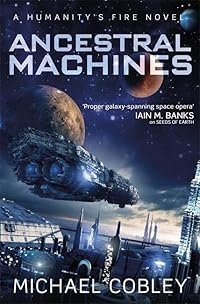
On the face of it Space Opera is about the grand scale – a galaxy spanning sweep, ultra- advanced technology, a clash of cultures, an indisputable villain or species thereof. Yet to every tale there must be the small scale, a human, or at least intelligible to human, consequence to it; individuals at risk, conflict meaningful to them, struggles and enemies to be overcome. Getting the balance right, not letting the imposing overpower the down-to-earth or having the colossal so remote as to be intangible, is tricky. In Ancestral Machines Cobley has had fun with the trappings, let rip the invention, but tagged it to a time-honoured plot, with a few extras thrown in for good measure. It reads as an extravagant pastiche of all that is good – and some that isn’t – of the sub-genre.
To satisfy the sense of wonder which Space Opera strives to evoke we have here planets being whisked away to be substituted by others then lined up in a huge array lit/powered by an artificial sun, a supposedly impregnable habitat inside a star, portable wormhole generators. The humans caught up in this are the crew of the smuggler spaceship Scarabus, captained by Brannan Pyke and separately (to begin with) Earthsphere drone Rensik Estemil, delegated along with female Lieutenant Sam Brock to infiltrate the domains of The Great Harbour of Benevolent Harmony – now taken over by dastardly aliens – and, if possible, thwart their designs.
As is common in this type of thing we have apostrophously named aliens such as G’Brozen Mav and T’Loshkin Rey; extravagantly titled soldier types – Akreen, First Blade of the Zavri, whose head is filled with the thoughts of ancestors/previous inhabitants of his body; all but unpronounceable would-be masters of the universe, the Xra-Lords. These latter have an utterly preposterous bodily modification. The whole is larded with information dumps and infilling of background. Some conversations take place purely to relay information, Pyke communicates almost solely with would-be drollery, others use arch knowingness.
The prose is also redolent of the less serious end of the sub-genre with turns of phrase such as “strange roseate ripples began rippling across the sky” repeating a word in close proximity and sentences such as, “The Shadow Bastion was suddenly revealed in almost all its entirety,” which don’t quite cohere. Characters aren’t clothed but garbed, battle descriptions are over-wrought and over-written, and there are innumerable neologisms. Fans of this kind of Space Opera will lap it all up.
Pedant’s corner:- “Time interval” later – or equivalent count; over 50. Otherwise; Moja (elsewhere Mojag,) a missing end quotation mark, “a woody slope” (wooded,) “and a handful and his Shuroga scout” (and a handful of his Shuroga scout,) “limbs akimbo” (it would be interesting to see legs resting on their own hips. Later there was a “legs akimbo”,) “and was about duck under” (about to duck under,) “their armed escort were remaining outside” (was remaining,) miniscule (minuscule,) “the noise level reached a crescendo” (a crescendo is a process, not that process’s end – ‘reached a climax’,) “building the cacophony to a crescendo” (ditto,) maw in the sense of mouth (a maw is a stomach.) “Second later” (either ‘A second later’ or ‘Seconds later’.) “The only ocean life currently visible were small paddling creatures and shoals of tiny swimmers” (the only ocean life … was …,) staunching (stanching.)
Tags: Ancestral Machines, Michael Cobley, Science Fiction, Space Opera
