Voyageurs by Margaret Elphinstone
Posted in Reading Reviewed, Scottish Fiction, Scottish Literature at 12:00 on 6 February 2020
Canongate, 2004, 474 p.
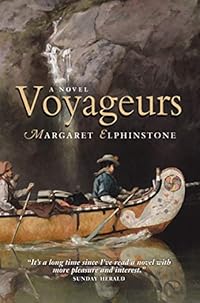
This formidably researched novel is set mainly in North America before and during the War of 1812 which was fought between the US and Britain (plus its Native American allies) but it is not concerned with that conflict except peripherally. The book is an example of a found manuscript, as supposedly written by Mark Greenhow, a Quaker from Cumbria – topped and tailed by an Editor’s Preface and Afterword, signed MNE, January 2003.
Greenhow was a Quaker from Cumbria. Most of his life was spent on a farm called Highside where the manuscript was ‘found’ hidden away when the ‘editor’ moved in. It reveals Mark’s life was turned upside down when his family received a letter from Canada telling them that his sister Rachel, previousy disowned from the Quaker Society of Friends for marrying her husband, Alan Mackenzie, before a priest, had disappeared somewhere in what was known as Upper Canada and therefore presumed dead. For Mark the ties of family outweighed the strictures of the Society and he resolved to go to Canada and try to find her. All his voyages (barring his final return home) as well as some incidents of his home life in the time before Rachel left for Canada are described in detail. Like most Scottish writers Elphinstone has a gift for landscape description, here deployed to convey the vastness of the North American continent and the local conditions. The customs of the time and the politics of fur-trading by the SouthWest Company are all necessary ingredients to the tale while the background to the war, whose prosecution, barring one small incident, remains off-stage, forms part of the novel’s plot as does Greenhow’s Quaker pacifism – or, I should say, his refusal to be involved in killing people.
The narrative is unavoidably tinged with Greenhow’s Quaker beliefs, with much talk of Monthly Meetings, the vanity of clothing, his soul-searching about relationships with the opposite sex and his failures fully to live up to the Society’s ideals.
A serious injury to Alan, who had additional reasons for undertaking once more the arduous journey to the island where Rachel disappeared, forces the three-man expedition to over-winter in the climate of north Lake Michigan, which even the indigenous peoples find inhospitable, and whose exigencies end up with Mark accommodating to what he considers pagan beliefs. They also bring home the unlikelihood of Rachel having survived. The sojourn also allows the three trapped men the opportunity to tell each other their life stories and so expand Elphinstone’s portrayal of their times. And far from being a hindrance Mark’s refusal to kill people ends up as an asset.
The ‘manuscript’’s text is peppered with Scots words – feart, clarty, grat – which I suppose could easily have been in the Cumbrian vocabulary in the early 19th century but will have to take on trust. And we have footnotes! Always a delight.
It is the characters, though, that shine through. Even the least is given careful consideration and expression. The puzzlement and, on being informed of its significance, the subsequent acquiescence of a local Ojibwa Chief when Mark extends his hand for shaking to seal a deal is a lovely vignette. Elphinstone makes you believe that this is really how people of this time were, and how they lived.
Pedant’s corner:- In the Acknowledgements; a capital letter after a semi-colon. Otherwise; “our line of the family have lived” (our line … has lived,) “if I ever I did” (only one ‘I’ needed,) “cost me Jaques favour” (Jaques’s,) “Kerners’ agent” (Kerners’s, though I concede it would probably not be pronounced with two ‘s’es,) Roberts’ (Roberts’s, ditto,) wigwam (from the limited descriptions in the text of the structures concerned it isn’t entirely clear whether these were in fact tepees,) a missing comma before a piece of direct speech, “that we’re used to here” (that we were used to,) span (spun, as used later,) James’ (James’s,)

E Mary Andrews
19 August 2025 at 11:05
I first read this book some years ago and have recently reread it. As a Quaker, I am impressed by the depth and accuracy of research into Quaker belief and history which is, however, relatively easy to obtain because of the meticulous preservation of records and Minutes from the earli
est days. The 18th centurywas very much a period of retreat into a more inward and in many ways more intolerant group, followin
g the fraught struggles
of the 17th. I didn’t find the character of Mark Greenhow entirely convincing;
The end of the story too,left one a bit flat and I would have quite happy for him to return home alone and just a bit sadder and wiser.
Thankfully, by the end
of the 19th century, galvanised by the urging by the efforts of young Friends who, by that time were able to enter the professions a much more liberal but equally faithful to the traditional Quaker testimonies mindset emerged.
jackdeighton
19 August 2025 at 17:23
E Mary Andrews,
It’s good to know my favourable impression of Elphinstone’s research are borne out by someone with more knowledge of the subject than me.
Thanks for looking in and commenting.