Places in the Darkness by Chris Brookmyre
Posted in Reading Reviewed, Science Fiction at 12:00 on 20 September 2018
Orbit, 2017, 414 p.
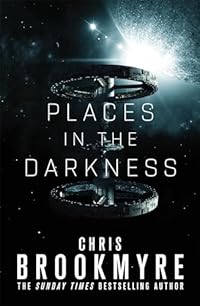
A space station, the city in the sky known as Ciudad de Cielo, shortened to CdC or Seedee, has the ostensible purpose of preparing for and building a generation starship, the Arca Estrella, to continue humanity’s history of exploration. Run by the corporate Quadriga, it is the subject of jealous regard from the Federation of National Governments (FNG) down on Earth. Despite widespread corruption and venality, CdC has never had a murder, not officially anyway.
The narration focuses on Alice Blake, the new representative of FNG on the station, and Seguridad member Nikki Freeman. Like most on the station Nikki has to supplement her income with underhand dealings of various sorts. Pay rates are low, decent alcohol hard to obtain, hustling is a way of life.
This is a depressingly familiar scenario, the worst aspects of capitalist society extrapolated into the future. Granted it gives ample scope for the darker side of human nature to be displayed (and to depict acts of violence) but some authors seem to revel in it. For a long while Brookmyre also appears to do so. By the time he does emphasise the co-operative, law-abiding, anti-exploitative, do-as-you-would-be-done-by side of things it is almost too late to make the point. His good guys are really only guys who are slightly less bad. Then again, I don’t suppose a novel that is relentlessly upbeat would sell.
On Seedee people are equipped with mesh, a device for inserting memories. But there is a distancing from them, referred to as watermarking, so you know they aren’t yours. Also prevalent is the grabacíon, a kind of video clip from your vision recording system that can be uploaded instantly to Seedee’s web equivalent. (I note the abbreviation Seedee is probably only in the text in order to enable the pun “The Seedee underbelly.”) Part of the mix is a musing on the part of Alice on the nature of androids and advanced AI tech.
Since she was once a cop down on Earth Nikki finds herself called in to investigate human remains (flayed and eviscerated) floating in a “gravity-free” area of CdC. Her job is made more difficult by being saddled with Alice Blake – masquerading under a pseudo-ID – as a side-kick.
That “‘consciousness is a lie your brain tells you to make you think you know what you’re doing,’” the brain fabricates a narrative that makes us believe we experience the world objectively, is one of the drivers of the plot. On Seedee people have begun to do odd things, like a woman stripping off and demanding any random stranger has sex with her on a bar top, or a man continuing a knife fight with ridiculous abandon. All of this is connected to a leak from the mysterious Project Sentinel, knowledge of which seems to mean death.
I found Brookmyre’s use of information dumping utterly intrusive. Most of the time it wasn’t at all well integrated into the text and the time where he used supposedly naïve kids to enable it was a particular low point.
I also took exception to the sentence, ‘Humanity is born from somewhere messy and bloody and stinky.’ The first and third of these adjectives probably only apply when the second does – and that’s by no means all the time. The third in especial is a misconception promulgated by advertisers in order to sell deodorant. Taken in all, this is an extremely sexist sentiment Brookmyre should be embarrassed by. Especially since he put it in the mouth of a woman.
Brookmyre does nod to previous SF by naming the halfway station from Earth to orbit (at the top of a space elevator) Heinlein, and having a character say, “‘Find the puppet master.’” Whether or not he’s a true fan is difficult to say on this evidence (I assume he must be or he wouldn’t try to write the stuff) but it was a nice touch to have a plot point dependent on the notion of refractive index. I can’t recall that in an SF story before.
Brookmyre has never steered away from violence but in a space station environment where utter disaster is never more than a thin metal plate away surely co-operation and teamwork are much better bets for survival than a constant round of competition and one-upmanship. (Even with a wee bit of smuggling on the side – which would still be scratching each other’s backs.)
I suppose Places in the Darkness makes a fair enough fist of what it’s trying to do but it also doesn’t really distinguish itself from a swathe of like-minded SF, and panders too much to the free-market, individualist, bloodthirsty constituency. It’s far too uneasy a blend of SF and the crime novel and consequently fails to do justice to either.
Pedant’s corner:- USian usages (airplane, she could use, leastways etc) but then, manoeuvres, “the rest of today’s audience fully appreciate” (appreciates,) a missing comma before a piece of direct speech (x2,) “she is aware that that” (only one “that” required,) “a standard container …. These are…” (This is,) “where Habitek assemble and demonstrate their test modules” (where Habitek assembles and demonstrates,) “was a soccer player” (Brookmyre is a buddy!* A season ticket holder no less. He knows it’s football, never soccer.) “There is no more screaming, no more cries or moans” (can’t help feeling there ought to be an “are” in there somewhere,) jerry-rigged (it’s jury-rigged,) “the Quadriga aren’t” (isn’t,) Gonçalves’ (Gonçalves’s,) “to home in in on” (only one “in”.)
*St Mirren supporter.
Tags: Chris Brookmyre, Science Fiction
