Hide Me Among the Graves by Tim Powers
Posted in Fantasy, Poetry, Reading Reviewed at 12:00 on 19 August 2017
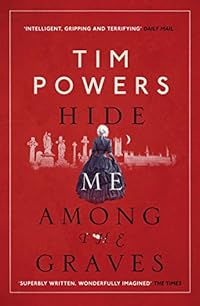
Corvus, 2012, 521 p.
Powers has form with poetry and poets, especially those of the nineteenth century. In The Anubis Gates he even, in the form of William Ashbless, deployed one of his own (and that of James Blaylock) invention. Fantastic Fiction even lists some of “Ashbless”’s works.
Here Powers concentrates on the Rossetti family, Christina and her brother Dante Gabriel, but Algernon Swinburne also features as a character as does Edward Trelawny.
In Hide me Among the Graves sublime poetry is an expression of a kind of demonic possession by (or more accurately a close association to) the Nephilim, a semi-vampiric type of creature. The affliction is partly hereditary but can be transmitted by biting. Two of these creatures (one is Byron’s friend John Polidori, the Rosettis’ maternal uncle, the other embodies the spirit of Boudicca – though the characters of course call her Boadicea) are the background drivers of the plot. Uniting their two strands in one body by the union of the two bloodlines will awaken such power that Boadicea will again be able (as she did in Roman times) to destroy London in an earthquake. Byron, Shelley and Keats are said to have shared the nephilitic tendency, Tennyson and Ashbless not. The loved ones, especially the children, of those close to the Nephilim are in danger of death, or – worse – a lingering half life as a diminished ghost. The prologue involves the awakening of the spirit of Polidori, by Christina rubbing her blood into a small statue belonging to her father. (There it is, blood again.)
The lesser known (ie totally fictional) protagonists of the book are Adelaide McKee and John Crawford who unknown to each other (at first) are host to the relevant spirits. When they are passing by chance on a London bridge at night they are attacked by an avatar of Boadicea. Only Crawford’s quick thinking in hurling them both into the water saves them. (For some reason both salt water and almost drowning repel the vampires, exposure to the open air increases the danger.) The same night though they conceive a child. Since McKee had earlier been trapped into prostitution they do not meet again for seven years, by which time McKee thinks Johanna, their daughter, may be dead. She is not, but has fallen into the clutches of Polidori and they and she spend the rest of the book trying to evade a forced union of Johanna with one of Boadicea’s creatures.
Powers is good with characters. McKee, Crawford and Johanna are very well drawn and their story is much the most compelling in the book. I was less taken with the doings of the Rosettis though. This is perhaps due to my distaste for the incorporation (it might as well be traducing) of real people in such a distortion of history. It is only the fantastical elements which disturb me here, however; I have no quarrel with the practice in a straightforward altered history. In this context, in Hide me Among the Graves, Powers purports to give us the real reason why Gabriel’s wife Lizzie Siddal’s grave was exhumed.
While Powers does write like a dream bits of this are ridiculous. Like vampires, the Nephilim – or their agents – can be deflected by garlic, killed by silver bullets, and their reflections trapped by mirrors. (I know it’s a staple of vampire stories but …. garlic? Really?) It is a measure of Powers’s facility that despite my reservations I continued reading. He can certainly spin a yarn and people it with apparently living, breathing characters. The book is too long though. I could quite happily have stopped reading at the end of Part One and still felt satisfied; but there was still over half the book to go.
Pedant’s corner:- remarkably few instances for a book this long. And the copy I read was an ARC (or proof as they used to be known.) It shows it can be done.
Nevertheless we still had “to lay low” (lie – but it was in direct speech,) missing opening quote marks when direct speech started a chapter, “had strode” (stridden, surely?) “‘the effect requires parents from two continents’” (Powers’s geography is off here. A Roman, no matter how consecrated to an Alpine Goddess, who raped one of Boadicea’s daughters – similarly consecrated to the old British Goddess known as Andraste, Magna Mater or Gogmagog – was not from a different continent to that of his victim.) An electric doorbell (in 1869?) Octopi (the plural is octopodes or octopuses,) “in front of one in the long row of houses” (it does make sense but “one of the long row of houses” is a more natural construction.)
Tags: Algernon Swinburne, Christina Rossetti, Dante Gabriel Rossetti, Edward Trelawny, James Blaylock, Lizzie Siddal, Tim Powers, William Ashbless
