Empress of the Sun by Ian McDonald
Posted in Ian McDonald, Reading Reviewed, Science Fiction at 12:00 on 18 April 2016
Everness Book III, Jo Fletcher, 2014, 397 p.
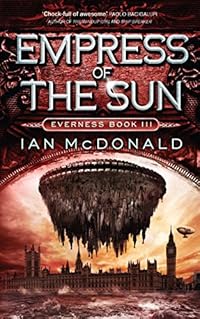
The airship Everness has jumped, more or less blind, through a Heisenberg Gate into a parallel world. Unfortunately it seems Everett Singh has made a mistake in his calculations as it is in immediate danger of crashing. “Yellow lights flashed. Horns blared. Balls* rang, klaxons shrieked.” The damage sustained means the airship and its Airish crew will be marooned for a while on a strange two-thirds gravity world peopled with lizard-like creatures. It is only when Everett recognises that the sun is descending straight downwards, not in an arc, that he realises the source of his miscalculation; they have jumped to a discworld, constructed from all the material orbiting its sun. Here the Chicxulub meteor never hit Earth and the dinosaurs have had millions of years to evolve and reconfigure the system. These inhabitants, who call themselves Jiju, are warlike, though, and periodically almost wipe themselves out. They are still knowledgeable and powerful enough to manipulate the sun: it moves through a hole in the middle of the disc, so that it illuminates either side of the world sequentially. Only Everett, in an explicit reference to Terry Pratchett, thinks of it as a discworld. To the Plenitude of Worlds it’s known the Wheelworld, but such are the dangers of the Jiju, contact has been avoided. Till now.
Everness’s crew is instrumental in allowing a Jiju, Kakakakaxa, to win her battle with her sister to be heir to their mother, the Empress of the Sun. In a fateful step Everett feels he has no option but to surrender his Infundibulum, which controls the Heisenberg Gates, to the Empress.
Meanwhile the deliciously vicious Charlotte Villiers is still scheming to procure Everett’s Infundibulum so that she will have dominance over the Plenitude of Worlds and elsewhere the Thryn Sentience-enhanced Everett M Singh from Book II tries to eliminate the traces of the Nahn he has brought to Earth 10 from E1, all the while pretending to be the original Everett, befriending Everett’s friend Ryun and forming an attachment to classmate Noomi. It is only in this third of the Everness series that McDonald begins to address the sexual politics and uncertainties of adolescence that have been latent in his scenario, but it’s done with sensitivity and as ever with YA fiction this does not interrupt the copious action to any great degree. There is too a cautionary note about how easy it is to be misled by superheroes. “… the real problems aren’t like that. You can’t solve them by hitting them. The real supervillains were ….. people in suits who met in rooms and decided things. ” We also get a sly nod to McDonald’s background with the phrase, “‘The Sunlords’ adversity may be the Airish opportunity.’”
What gives the Everness series a unique flavour is the Palari argot the Airish use, a light note amongst all the world-threatening plot happenings. I note both Everett and Everett M come to dislike the extremes they have been forced to by the exigencies of their situation, what those actions have turned them into, what they reveal about themselves, which is a timely metaphor for the journey into adulthood.
In not one, but two codas (which together suggest more books in this sequence may be forthcoming) we are shown what seems to be the source of Charlotte Villiers’s motivations and that Everett’s father Tejendra is alive and well somewhere in the Panoply of Worlds. I had thought the Everness books would end with this third instalment but if there were to be more to look forward to they wouldn’t come amiss.
Pedant’s corner:- * Balls rang (that must have been painful! Context suggests “Bells”,) “you certainly don’t want us enemies” (us as enemies,) wain (a Scots word for child) is usually spelled wean, “she had never struck ball like that before” (struck a ball.) “The two of them haunted the dead-ball line, directly behind Everett M in his net” (strictly speaking the dead-ball line is in front of the net,) “what the crew were running from” (the crew was running.) “They were only machine” (they were only machines,) “Mrs Abrahams the principle” (x 2, principal,) “But for you I would be me dead in the crechewood” (it would be me dead in the crechewood; or I would be dead in the crechewood,) Victorian terrace houses (the designation is usually terraced houses,) “was a endless droop” (an endless droop.) “Have you see anything of this Earth, …” (seen.)
Once again no doubt due to its main intended market there were USianisms:- hoods (as in cars; we say bonnets,) ass (though arse is used at least once,) diskworld.
Tags: Everness, Ian McDonald, Science Fiction, Y A
