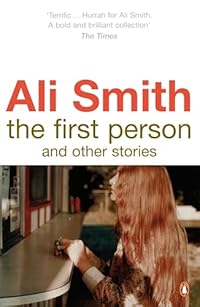
the first person and other stories by Ali Smith
Posted in Reading Reviewed, Scottish Fiction, Scottish Literature at 20:00 on 28 December 2015
Hamish Hamilton, 2008, 252 p. Borrowed from a threatened library.
true short story is about short stories. The narrator overhears two men in a café discussing the differences between the novel and the short story. She calls her friend – in hospital with breast cancer, the one who had sparked her interest when she dared to ask questions during a lecture in their University days.
the child appears in a woman’s supermarket trolley when she comes back to it after searching for items elsewhere. She tries to tell Customer Services it’s not hers but the child acts as if it is. She has to take it with her. But it then speaks to her in racist, sexist and foul-mouthed terms.
present features a woman trying to have supper in a pub whose only other occupants are a barmaid and the man chatting her up. The man’s prattle about Christmas drives her to the warmth of her car and reminiscences of Christmas past.
As a story the third person morphs inexplicably from season to season, scene to scene, characters to characters, life to life. The third person is a device to represent the world.
In fidelio and bess a woman whose (married – though partner is the word used) lover has introduced her to Beethoven imagines a mash-up of Fidelio with Porgy and Bess.
the history of history is narrated by a schoolgirl forced to write a piece on the death of Mary Queen of Scots as homework but disturbed because her mother now wishes to be treated as a person.
no exit is two (or even three) stories in one, concerning a woman who is seen leaving a cinema by a fire exit which the watcher knows leads nowhere and moreover shuts itself firmly and a man who fell between the new soundproofing wall he was building and the exterior wall, so was trapped. Both stories keep the watcher awake.
the second person manages to mix in a discourse on the songs Ella Fitzgerald performed about a lost (then found) yellow basket with the tale of two ex-lovers who used to share a house, but are apparently still friendly enough, telling each other what they’re really like.
In i know something you don’t know a woman’s son retires to his bed and no-one can find out what’s wrong. She even contacts complementary therapists (who turn out to be fraudulent.)
writ has a woman’s fourteen year-old self suddenly appear in her house. They end up arguing over whether writ is a word or not.
astute fiery luxurious are three of the words turned up Tarot style by one of the protagonists’ childhood friends while trying to predict the future. The memories are precipitated by the arrival of a strange parcel at the protagonists’ house. No less than six ways are given of the way in which the parcel was disposed of.
In the first person two lovers make up stories about how they met. This is full of doggerel-like repetitions of I say and you say (none of the dialogue in the whole book is enclosed in quotation marks but here it became extremely irritating) and also the phrase, You’re not the first person.
Pedant’s corner:- Except on the contents page (and then only the first word) none of the stories’ titles is capitalised. Once more in a Smith book the right hand margin is not justified.
