Passing for Human by Jody Scott
Posted in Reading Reviewed, Science Fiction at 12:00 on 28 November 2015
Women’s Press, 1986, 192 p. First published in 1977.
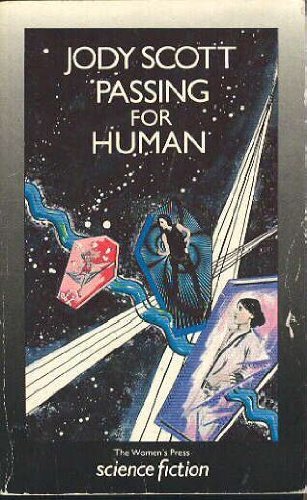
From the publisher and the title of this book it can be inferred that this is a satire. While men may be its principal targets, “Male bodies are incomplete, because of that stunted Y chromosome, hence males lack intuition (which merely means they’re less intelligent, having a closed-off awareness)” and “There should be no lightness in the male life: only a bossy arrogant machismo,” the human race as a whole is found wanting, with all its primitive instincts, sex-obsession and reprehensible customs. “They commit advertising on each other. And as you know advertising is a crime against nature.” Sadly, though, Passing for Human has dated badly since its first publication.
Consider the plot. Dolphin-like creatures from the planet Rysemus are nearing completion of a Rapid transit system, The Mousehole, in the vicinity of Earth. This project might be put in jeopardy by the actions of the Sajorian, Scaulzo, aka the “Prince of Darkness” for, despite his machinations, humans feel well disposed towards him and are said to be easy prey to his evil ends.
The Rysemians have on their ship, Vonderra, a supply of bodies identical in every respect to their originals; bodies into which they can transfer at will. Our main protagonist, Benaroya, appears variously in the book as Brenda Starr, Emma Peel and Virginia Woolf. (I note here that two of these are actually fictional in our real world.) Other Rysemians inhabit the bodies of Abraham Lincoln, George S Patton, Heidi’s grandfather and countless Richard Nixons.
To a modern reading there are several problems with all of this. One is that, despite Rysemians having telepathic powers, none of the human characters ever rises above the caricature, not even Adrian Resnick who is being kept in captivity by Scaulzo and whose consciousness we roam for a while. The other is the pulpy nature of the plot and the treatment – which comes over more like a piece of pulp SF from the 50s or earlier. Both these elements lend the book a cartoonish quality at odds with any claim to seriousness. Moreover, I know the tale is supposed to be picaresque but there is still a certain lack of internal logic when Rysemians excoriate humans for experimenting on and killing animals but have no qualms about contemplating the extinction of humanity as a punishment, have indeed carried out just that sentence on the main life form of the planet Hogue. Yet what grated most was that for a piece pointing out supposed cultural peculiarities the text seems blithely unaware of its own cultural specificity. An Italian refers to a limey, another says “way to go babe” (I also wondered if 7-Up was available in Italy in the 1970s,) there is a comparison to over-civilized field goal kickers and Benaroya’s interminable interjections, “Jeeps! Holy Moses! Holy croakers! Wowzereeno, holy mackerel,” are unmistakably USian. Her reactions are supposed to be a result of culture shock but these authorial tics encapsulate an attitude arising from within (one of) the culture(s) she is supposed to be shocked by.
File under historical curiosity.
Pedant’s corner:- a thick-molecule “water” planet (what on – or indeed off – Earth is a thick-molecule?) deoderant (deodorant,) “can you imagine this is Scaulzo’s hands?” (in Scaulzo’s hands,) Earthie’s (Earthies,) sprung (sprang,) shizophrenic (schizophrenic,) skelton (skeleton,) a gargoyles’s head (gargoyle’s,) envison (envision,) the the (one the is enough,) as done (has done,) Sojorian (Sajorian,) a cluster of crones were (a cluster was,) knawed (gnawed,) aureoles (areolae,) humilation (humiliation,) comfty (comfy.)
Tags: Jody Scott, Science Fiction, The Women's Press, Women's Press
