Powers by Ursula Le Guin
Posted in Fantasy, Reading Reviewed, Ursula Le Guin at 14:53 on 21 October 2010
Orion, 2007. 391p
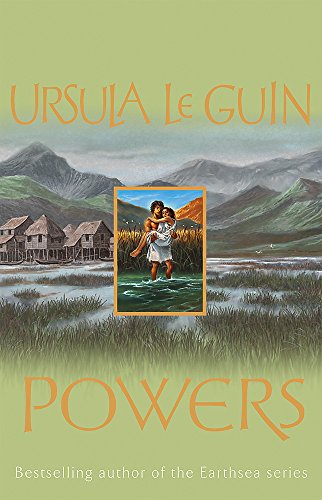
Powers is the third in the Annals Of The Western Shore, Le Guin’s latest story cycle for young adults. Gavir is a boy slave in the Household of Arcamand in the city of Etra. He and his sister are Marsh people stolen from their real home when they were very young. Gavir has visions of the future (the ability to remember things before they happen) but has to keep this talent secret as the city people don’t like those who have such powers.
Le Guin’s description of the relationships in the Household is masterful. The imbalance between the children of the house proper and the slaves is particularly well done. However there seems to be a default antiquity to the scenario – and pre-echoes of Le Guin’s Lavinia which I read recently but was published after Powers – which is perhaps a little too pat. (This could be a criticism of the Annals as a whole.) The inevitable tragedy occurs as Gav’s sister is killed and, in a daze after the burial, he wanders off and becomes a runaway. The remainder of the book is more or less a travelogue as Gav falls into one person’s orbit or another.
The various authorities (powers) with whom Gav comes in contact and in whom he trusts till he learns not to – The Father of Arcamand; Cuga, the hermit who first takes him in; Barna, leader of the runaway slave enclave Gav joins for a while; the elders of his Marsh people to whom he eventually returns – all have different flaws, faces to them which we can see but Gav doesn’t, till changed circumstances force his hand.
Gavir’s power is on the face of it a clever method of foreshadowing but is ultimately unsatisfying as it lessens tension. As a result, though others most certainly are, Gav himself never seems to be in jeopardy. Also, his ability as a seer is never really a focal point of the story, which does rather diminish the (ahem) power of the book’s title.
Not as convincing, then, as the previous instalments in the Annals Of The Western Shore, Gifts and Voices, but Powers is still a Le Guin and consequently a cut above the average.
Final aside. The book’s cover shows a figure, presumably Gavir, fording a river carrying a girl. When he finally does this in the story the girl is actually disguised as a boy.
Tags: Fantasy, Ursula Le Guin
