Nero’s Heirs by Allan Massie
Posted in Allan Massie, Other fiction, Reading Reviewed at 19:16 on 18 November 2009
Sceptre, 1999, 248p
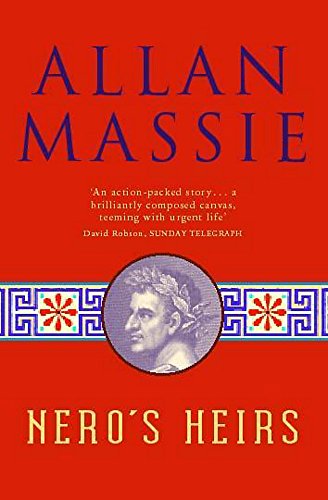
This comes with an encomium from Gore Vidal on the front cover, “Master of the long ago historical novel.” Since Vidal’s own Roman excursion Julian was no petty achievement this is high praise.
The book is essentially the reminiscences of Scaurus, an offshoot of ancient Roman aristocracy; in his youth an intimate of Vespasian’s son Titus and friend of Titus’s brother Domitian – all of whom were to become Emperor – as well as an admirer (and, much later, lover) of their sister Domatilla.
Written as a series of letters to Tacitus in reply to requests from that historian to provide background for his endeavours, interspersed with the narrator’s own reflections on his early life, it provides a close-up view of the turbulent Year of the Four Emperors that followed the death of Nero. Accordingly, the focus is not quite as sharp as it was in some of Massie’s other Roman novels; events are sometimes related at a distance. Hence, while Nero’s Heirs is always readable, there are some passages which read more like history than the dramatisation usual in a fictional narrative.
I suppose they are only to be expected in a work set in this period but the asides on early Christianity struck a wrong note for me. I would have thought that someone of Scaurus’s upbringing would most likely have paid scant attention to the doings and beliefs of a then minor, not to mention proscribed, religious sect whose adherents were mainly slaves. (No matter how beautiful his slave was.)
Massie is certainly in control of his subject matter, though, and his knowledge of the times shines through.
The novel concentrates more on Scaurus’s relationship with Domitian than either Titus or Vespasian, as he is present in Rome, with Scaurus, at the appropriate time while the others are busy quelling the Jewish rebellion in Judæa. The traits which would come to the fore when Domitian succeeded to the imperial purple are well foreshadowed by Massie, a study in the jealousy of a younger son for an older, apparently more favoured, brother.
A finely written example of the novelist’s art, Nero’s Heirs is also a painless way of immersing yourself in the history of the early Roman Empire.

Review: Nero’s Heirs by Allan Massie « Alex In Leeds
9 October 2012 at 12:25
[…] Thoughts: A Son Of The Rock, Roman History […]