Black Man by Richard Morgan
Posted in Reading Reviewed, Richard Morgan, Science Fiction at 23:03 on 12 February 2009
Gollancz, 2007
This novel is published in the US as Fearless.
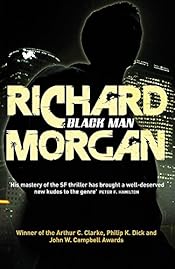
The first thing is to ponder on the reason for the alternative title. Black Man obviously does not carry the same freight in Britain and Europe as it would have in the US. I do not know for sure but suspect that Morgan’s US publisher took fright at the thought of a restricted readership had the title been the same in the US as in Europe. Perhaps now, with the change of President, that reasoning may no longer hold so true, but only time will tell.
In the book, the US has fragmented into several parts including the Angeline Freeport, the Rim States (most of the seaboard) and the Confederated Republic (or Jesusland, effectively a fundamentalist version of the old Confederacy) and a rump Union.
Carl Marsalis is a variant thirteen, part of the Osprey programme, a human genetically modified to be in essence effective fighting machines, a throwback to an earlier form of human supposedly bred out when agricultural settlement took place. In this world other genetic modifications exist, such as hibernoids (who sleep for four months but are active the other eight) bonobos (sexually compliant females) but because of their nature (unnature?) all such “twists” are looked down on by “normal” humans but it is variant thirteens who are feared by the general populace. As a result they are either exiled on Mars or quarantined in areas called tracts. That Osprey and its American equivalent Lawman failed in their attempts to gengineer effective soldiery was because thirteens do not like obeying orders.
Marsalis also happens to be black, and British, though the action is set almost wholly in the Americas. He is employed by UNGLA to track down other thirteens who have escaped the reservation and to kill them if they do not surrender. Returning from one such mission he is arrested in Florida – part of Jesusland – held for months and released only when agents of the Western Nations Colony Initiative (COLIN, who seem to run the tracts and Mars colonies) need him to help find a renegade thirteen from Mars, with an interesting sideline in cannibalism, who has been brought back to Earth as an assassin.
The book is intricately plotted; indeed a less complex novel than this would have finished about 7/10ths of the way through when Marsalis finally catches up with the quarry. It is a measure of Morgan’s confidence that the book does not stop there. The viewpoint characters are various and varied with believable (mostly) motivations.
Given the scenario it is not surprising that there is violence here similar to Morgan’s Takeshi Kovacs novels. (I must say however that I preferred the, to me, more grounded and slightly less visceral Market Forces.)
Having said that, in Black Man Morgan is more assured than in any of his previous outings. This world seems deeper, richer, more textured. One of his (non gene-enhanced) characters states that there is no more war because humans have learned the cost is too high. This is notwithstanding the assertion by another thirteen that they, not the milque-toast cudlips (the pejorative name variants use for normals) are the true humans. The high body count in the book also runs counter to the argument.
However, there seems no good reason why Marsalis is black. Other thirteens do not seem to be – or at least are not described as such. Is it solely as a metaphorical representation of the menace inherent in thirteen status? If true, that decision is surely worthy of examination. But I will trust Morgan’s intentions as stated in his dedication that he hates bigotry, cruelty and injustice with an unrelenting rage. His sympathy for the variants does shine through.
This was a world I was immersed in and did not want to surface from. As an example of the SF thriller Black Man is seriously good stuff.
Tags: Richard Morgan, Science Fiction
