The Blind Geometer by Kim Stanley Robinson/The New Atlantis by Ursula K Le Guin
Posted in Reading Reviewed, Science Fiction at 20:47 on 22 December 2008
Tor, 1989

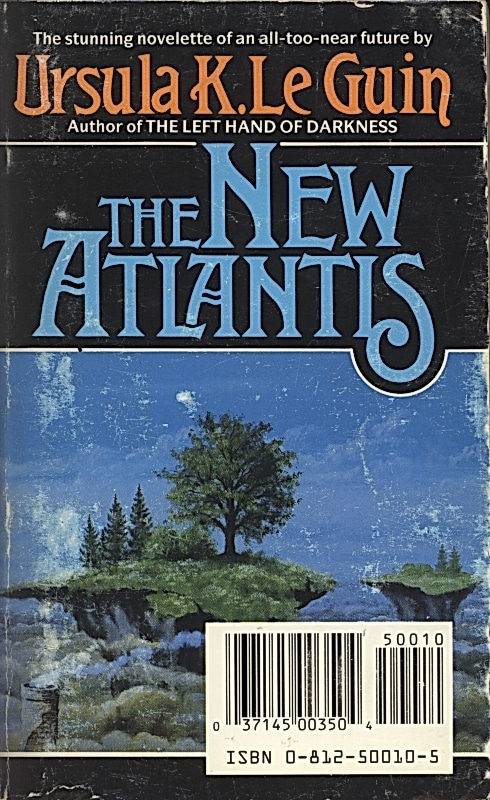
For those of you unaware of the concept this is one of those Tor Doubles books that twins novellas (puffed as double novels on the cover) by different writers and puts them between the same endpapers; except one story is read from the “front” of the book and the other – upside down in relation to the first – from the “back.” You therefore also get two covers for the price of one. Unfortunately there’s not an easily available picture of either on the internet and Amazon has no copies!
(Edited to add I’ve now found one/two.)
Robinson’s The Blind Geometer was a delight; an example of a story that illustrates one of the reasons why I read Science Fiction. In what other area would you find a piece of fiction featuring n-dimensional geometry and turning on Desargues’s Theorem? The sections are headed by letters (A, AB, AC, BA, O, AO etc) as if they are points or lines in a geometrical drawing. Robinson makes extensive use of (parentheses) [brackets] and {braces} and makes a point of relating this to the language of Geometry. The story even has diagrams. Fantastic.
Okay, the characterisation may not be all that rounded, but the story makes up in brio for any lack in that department. It features a blind narrator, Carlos Oleg Nevsky, a mathematics professor working in the above mentioned field of geometry. This allows Robinson to explore the world view of an unsighted person and the compensations they make, the enhancement of their other senses. An acquaintance asks him to help out with a problem involving a woman who has language difficulties but draws diagrams to communicate with him. This leads Nevsky into a trail of intrigue and danger in which he turns his blindness to advantage in the denouement. I loved it: but it’s not for those who are put off by Maths.
A bonus in this Tor Double is a further Robinson story, The Return From Rainbow Bridge, which could be interpreted as a ghost or doppelganger story or, more science-fictionally, as a two-places-at-one-time story. It is set on a Navajo reservation (Robinson spells it Navaho) and concerns the strange experience of its narrator who tries to take an off-trail short cut back from Rainbow Bridge (the largest natural arch in the world and important to the Navajo in a sacred sense) on his own but eventually receives help from his Navajo guide. Or does he?
Ursula Le Guin’s The New Atlantis is no more than a longish short story set in a corporate state America where marriage is illegal, in a world which is mired in environmental catastrophe, with volcanic eruptions, the old continents sinking and new ones rising from the oceans. Curiously, Le Guin also mentions Navajo (with this spelling.) The protagonist is, of course, married and nothing good results. Le Guin is never less than interesting, though.
This Tor Double’s print size is rather large so you don’t actually get that much content but what a relief to polish off in short order a volume from my not-yet-read shelves.

Ian Sales
23 December 2008 at 08:54
There’s a couple of low quality cover scans here: http://www.librarything.com/work/1577659/covers/16904807
Incidentally, the later books in the series dropped the upside-down back-to-back, and printed both novellas the same way up.