Archives » Young Adult

Infernal Devices by Philip Reeve

Scholastic, 2012, 388 p. Returned to a threatened library.
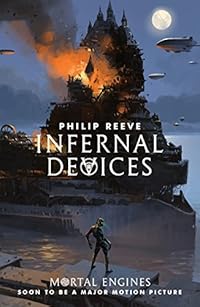
 Infernal Devices cover

The action in this novel takes place sixteen years on from the events in Predator’s Gold the previous (and second) of Reeve’s YA “Predator Cities” books. Tom Natsworthy and Hester Shaw have been living in the safety of Anchorage-in-Vineland for all that time. Their teenage daughter, Wren, however, has known no other life and is bored. As a consequence, when one of the burgling “Lost Boys” comes secretly to Anchorage in search of a relic from before the Sixty Minute War which led to the rise of the traction cities she is beguiled into helping him. This results in her abduction. Hester wades in rather heavy-handedly to try to prevent her kidnap but fails. The book follows Wren’s (mis)adventures and her parents’ search for her. Along the way we remake acquaintance with Professor Nimrod Pennyroyal, the anti-tractionist Green Storm and the Stalkers Anna Fang and Shrike.

The book is full of neat touches which may pass its YA readers by. Aeroplanes called Visible Panty Line or JMW Turner Overdrive or Itsy Bitsy Teeny Weeny Yellow Polka-Dot Machiney? An aviatrix calls to her sidekicks, “Algy? Ginger?” The slave-dealing Shkin corporation is “An Investor in People.” Hester seems more hard-bitten here than she did in the earlier books though it could be she is merely demonstrating she is her father’s daughter. Wren’s naivety can be a bit wearing but she has led a sheltered life. As is usual with YA there is plenty of action but also recognisable characterisation (even if its portrayal can be a bit over the top at times.)

Pedant’s corner:- into t he night (the night,) “I’ll pop the book back in my safe” (on the previous page the speaker had said “It’s in the safe in my office.”) Nabisco Shin (Nabisco Shkin,) casters (castors,) inside of (inside,) a missing end quote. In the publisher’s puff at the end (before extracts from Reeve’s GUIDE TO THE TRACTION ERA):- “The quartet are all available” (the quartet is.) In those extracts:- “with all both the” (no all, I think.)
But… plus points again for the diæresis used in aërobatics and aërodrome.

Mortal Engines by Philip Reeve

Scholastic, 2002, 295 p.

Mortal Engines cover

For a thousand years cities have been mobile, traversing the dried up land in search of smaller urban entities to consume. This system is known as Municipal Darwinism and apparently has a set of rules. (There are, though, pirate towns which disregard these.) There is, too, an Anti-Traction League, settled towns safe in Asia behind an impregnable wall. The League has agents who work against the Traction towns.

Reeves has some fun with his premise. Panzerstadt-Bayreuth is a wonderful name for a predatory city, as is Tunbridge Wheels for a smaller ambulatory town. The text is also peppered with adapted phrases such as, “a rolling town gathers no moss,” with a curious emphasis on Hull; “like a bat out of Hull,” “Bloody Hull!”

Tom Natsworthy is a lowly member of the Guild of Historians in London, in thrall to the principles of Municipal Darwinism. His encounter with his – and London’s – hero, Chief Historian Valentine, draws him into a series of adventures after he witnesses an attempt on Valentine’s life by a mutilated young girl, Hester Shaw. In the aftermath both he and Hester are thrown out of London – Hester by her own hand, Tom at another’s – on the so-called Hunting Ground, forced together by this circumstance. In typical children’s book fashion both Hester and Tom are children (young adults here) who have lost their parents. By contrast the other main narrative focus in the book – apart from Valentine – is his daughter Katherine; but she has lost her mother.

Told in a mixture of past and present tenses, the book tracks the evolution of Tom’s and Katherine’s awareness of Valentine’s character (Hester was never in doubt) and even the principles of Municipal Darwinism itself – all among a welter of airships, men resurrected as machines, bullying pirates with pretensions to civility, and rediscovered weapons. As with many a Young Adult novel the pace is relentless, the pages incident packed.

Throw aside any notions of doubt about how a predatory system such as the Municipal Darwinism portrayed here could last for a hundred – never mind a thousand – years and also any quibbles about the level of characterisation (London’s Mayor, Magnus Crome, is a little one dimensional,) the piling on of incident and an occasional lack of subtlety. Broad brush strokes are arguably necessary in YA fiction. Mortal Engines is totally engaging, while still carrying the monitory subtext that appearance and demeanour are no clue to underlying character.

Pedants corner: Reeves has the resurrected man named the Shrike tune his ultra-red sensors. This turns out to be a heat-seeing system. That would be infra-red, below red, then; ultra-red, beyond or above red, is just plain green (in terms of primary colours) – or at a pinch, orange.

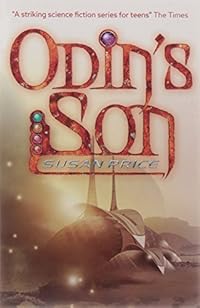
Odin’s Son by Susan Price

Simon and Schuster, 2008, 243 p.

Odin’s Son cover

This “Young Adult” book was in the book sale section at my local library. The good lady suggested I read it to see “what is getting published now.” It wasn’t till I’d finished it I realised it was the third in a trilogy. (To avoid spoilers I hadn’t looked at the back cover blurb.)

The trilogy aspect perhaps accounts for the lack of explanation in Odin’s Son of the system of indenture which underpins part of the narrative. The indentured, known as bonders, are legally sub-human, and – on Earth – are treated as if they were in fact actually less endowed with feeling and sentiment. (This is, of course, the way the privileged always behave towards the less fortunate.)

The book is mainly set on Mars where a religion based on the Norse Gods is in a subordinate position to that of the ancient Greeks. A now-dead bonder woman called Odinstoy had been smuggled up from Earth by another bonder, Affroditey Millington, but their status is in legal limbo. Odinstoy claimed her son, dubbed Odin’s Gift, was fathered by Odin – hence the title – and the story unravels both his fortunes and his true origins. The head of the “Greek” religion has the curious name of Zeuslove Thatcher. Is this to signal he is the baddy?

Remarkably, for 100 pages the novel was unmarked by typos or infelicities of any sort – then we had icanthus for acanthus and things began to run downhill. Price seems to think there is an asteroid belt between Earth and Mars. There may be some asteroids in such orbits, but the belt is usually considered to lie between Mars and Jupiter. An ascension by space elevator is said to be accompanied by “no G-forces, no thrill. Other ships were descending on the other side of the El, and their weight lifted (them) upwards.” From ground level the feeling would be exactly that of ascending by any sort of lift mechanism – most of which are counterbalanced in a comparable manner. Flint is “formed from the skeletons of sea-creatures dissolved in sea water.” If they’ve dissolved they’re no longer skeletons. And material precipitating out from sea water into the spaces the skeletons left is more likely.

While the characterisation can be thin at times (Zeuslove Thatcher) others are drawn more fully – but at least one plot thread is left dangling. Whether Odin’s Son represents a satisfactory conclusion to the trilogy I can’t say but for the most part it worked on its own terms and a late development nibbled at the edge of questioning what it means to be human.

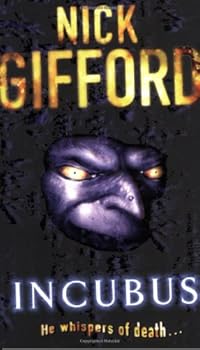
Incubus by Nick Gifford

Puffin, 2005, 225 p.

Danny Smith’s secret is that his father is a multiple murderer. His mother has taken the family to a new home far from those who know their background. His reticence about himself is tested by Cassie Lomax, a bright classmate who finds him interesting. As the book unfolds Danny’s worst fear, that the voices in his head that drove his father to murder would manifest in his own, comes to pass. These belong to a family kobold, a Hinzelmännchen called Hodeken, legacy of Danny’s German grandparents – they amended their surname from Schmidt when they came to England. The weirdnesses build up only gradually as the book follows Danny’s burgeoning relationship with Cassie (both of these developing in a chat room) and his struggle against the kobold’s influence, during which the story ranges from modern England to Berlin (both of the Second World War and of the erection of the Wall in 1961) as Danny learns more about his family’s past.

Writing for young adults is not easy but Gifford handles all this very well, with clear lucid prose and a pleasing level of complication with the adults around Danny. He also finesses the necessity of information dumping about kobolds by having Cassie and Danny perform internet searches.

Caveat:- I know I have a bee in my bonnet about this sort of thing but it jarred that at one point the kobold says, “aren’t I?” Kobolds are Germanic. Rather than “aren’t I?” Hodeken would surely have thought, “nicht wahr?” – which would have made the rough translation “isn’t that so?” a better choice.

free hit counter script