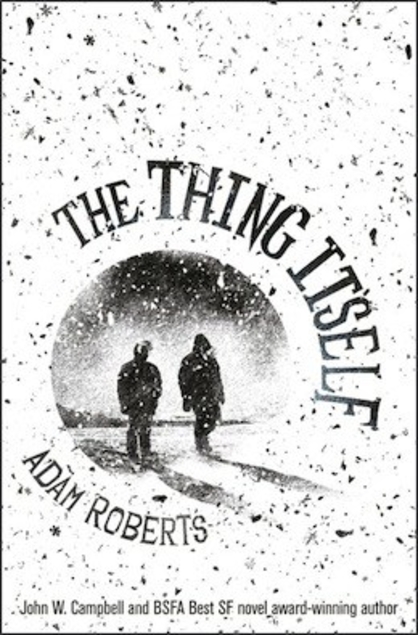
The Thing Itself by Adam Roberts
Posted in Reading Reviewed, Science Fiction at 16:00 on 19 November 2016
Gollancz, 2015, 333 p
I’ve read quite a few novels by Roberts now and there was always – New Model Army perhaps excepted – something lacking about them which nagged a little but what exactly that something was hadn’t crystallised till partway through this one when he alluded to a famous Joseph Conrad phrase. Then it struck me. He was telling the reader what to feel. But, and this is the point, he hadn’t managed to evoke that feeling in me. It was all too distanced, too formalised, not emotionally compelling. Admittedly this novel is one of Roberts’s more abstruse efforts, being an attempt to render Immanuel Kant’s Critique of Pure Reason into fictional form, to speculate on the Dring an sich, the world as it is – as opposed to the one we perceive through our senses.
It may be Roberts has an inkling of this himself as he has posted about the novel’s lack of award nominations or indeed much notice within the SF community and has said he intends in future to produce fiction that is less challenging to the reader. He may be slightly off-beam there. It’s not the challenge that niggled me, it’s the lack of connection. I still haven’t got round to Roberts’s Yellow Blue Tibia from 2009 (which Kim Stanley Ronbinson opined ought to have won the Booker Prize that year.) It’ll be interesting to read it with this thought in mind.
As to the plot here, Charles Gardner and Roy Curtius are on an Antarctic research base in 1986 when something weird happens. The effects of this are to dog Gardner for the rest of his life as he becomes gradually less employable before he is finally embroiled into a (deniable) government attempt to render Curtius and a recently evolved AI named Peta harmless. Breakthrough into the Dring an sich is way too dangerous to allow uncontrolled access. As it is, ripples backward and forward through time from the events of Gardner’s life have already occurred.
Gardner’s story chapters are alternated with others with settings ranging from Mayence (Mainz) in 1900 to a future time war via 19th century Gibraltar (where the rock changes its dimensions every time a couple has sex,) the late 1690s, a list of 89 numbered paragraphs and the days of Kant’s dotage.
With many allusions – the novel’s first sentence, “The beginning was the letter” suggests the first sentence of the Gospel of John, there is a Joycean section, a chapter in Restoration style, that reworking of Kant’s last days – the novel is undeniably dense; but it is not difficult to read. Emotionally, though, it is scanty.
There is a lot to admire in Roberts’s work, it is certainly impressive; but I suspect it is much more difficult to love it.
Pedant’s corner:- “Say what?” (I don’t recall people using this formulation in 1986,) sprung (sprang,) scilla (cilia made more sense,) protruberances (protuberances,) nineties and naughties (noughties, but then again it may have been a sexual pun,) “I was in the verge of something” (on the verge is more usual,) “not eager to say” (to stay.) “And her she held up a single finger,” (And here,) my stomach clenches sharply (all the other verbs here were past tense so; clenched.) “Spaces is,” (Space,) “the torn stitched removed” (stitch,) shuggle (this Scots word is usually spelled shoogle) another Scotticism was “fair” as an amplifier, as in, he fair shrieked. “The sole window right beside the door I had just come in through, and so I took a look outside.” (??) “didn’t phase the clerk” (faze,) Curtus (Curtius,) “who can do as the please” (as they please,) meters (metres, but this was in a future scenario along with the spelling vodka,) Valzha (spelled twice this way, otherwise Valzah,) sphereoids (spheroids,) “in which both paries were male” (parties,) he is sat (seated.,) appeared drunken (appeared drunk, surely?)