A Wrinkle in Time by Madeleine L’Engle
Posted in Reading Reviewed, Science Fiction at 12:00 on 26 August 2019
Puffin, 2014, 262 p.
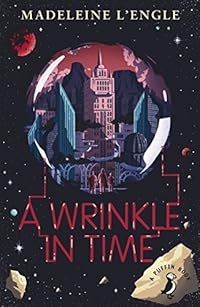
Meg lives a more or less normal life with her family of three brothers, twins Sandy and Dennis and the younger Charles Wallace, one of those children who are slow to speak but when they finally do so it is in complete sentences. Normal that is, apart from her mother having a chemistry lab in the back room, and a physicist father who has disappeared (accompanied by all sorts of rumours as to where; and with whom.) Meg, Charles Wallace and her friend Calvin meet three odd women who are secretly inhabiting the local “haunted” house. Mrs Whatsit was once a star in the sky, Mrs Who speaks in quotations (Latin, Greek, French, Italian, Spanish, as well as Shakespearian,) and Mrs Which talks in ddoubblle cconnssonnannttss with the occasional double vvoowweell. Mrs Which can also ‘wrinkle’ space-time and so is able to send Meg, Charles Wallace and Calvin off to battle the forces of evil which have trapped Meg’s father.
On their interstellar journey they encounter a Black Thing in the interstices of space, which almost draws the life from them, strange multi-tentacled creatures who restore them to health, eventually moving on till they reach the planet Camazotz, where Meg’s father is captive and which is home to a large pulsating brain dubbed IT (which nowadays reads slightly differently to how L’Engle would have intended it) bent on total control of the universe.
Meg is disappointed that, once freed, her father can not set the universe right by himself. It is she and her love for Charles Wallace that is the key to overcoming IT’s baleful influence.
Regarded as something of a children’s classic, this was first published in 1962, making the descriptions of card- or tape-fed computing machines, with dot-dash punched print-outs somewhat quaint to modern eyes. Mrs Who’s quotations and Mrs Whatsit’s comparison of the children’s lives to a sonnet, expression within strict constraints, do not talk down to its intended readership. The resolution, though, is a little forced and more in line with early 1960s attitudes than more modern ones.
Pedant’s corner:- Jenkins’ (Jenkins’s,) “in ITs clutches” (IT here is a proper noun not a pronoun, so ‘in IT’s clutches’.)
