Archives » Trojan War

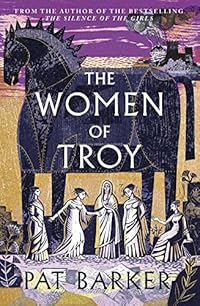
The Women of Troy by Pat Barker

Hamish Hamilton, 2021, 311 p.

This is the sequel to The Silence of the Girls which dealt with the events leading up to the fall of Troy through the eyes of Briseis, a princess of Troy’s ally, Lyrnessus. She had been given to Achilles as a slave in reward for his part in the Greeks’ victory over her city. No familiarity with that first book is necessary as the major details, being relevant to the story line, are gone over again in this volume.

We start inside the Wooden Horse* where Pyrrhus, the son of Achilles, is – almost literally -shitting himself, fearing discovery by the Trojans. This is the first time I can remember reading anywhere a consideration of the logistics of carrying through such a ruse de guerre as the horse. Very few other scenes are shown from his viewpoint though, as most of the narrative is provide by Briseis again, except for one or two sections from the point of view of Calchas, a priest of Athena born in Troy but who had been in Agamemnon’s entourage for years.

This means that, bar Pyrrhus’s killing of Priam, we do not get a first-hand account of the sacking of Troy; though Briseis is aware of the mayhem – all males killed, all pregnant females too on the off-chance their child is a boy – through the tales of the women who survived. War in the Bronze Age was brutal, as in any age.

Through meetings with those women of Troy – Hecuba, Cassandra, Andromache, even Helen herself though of course she was not Trojan – Briseis sees it all and remarks on the ironic relationship between those two prominent figures. “You couldn’t imagine a more feminine woman than Helen nor a more virile man than Achilles, and yet in every way that mattered, they were alike. It was always about them.” Many an imbroglio has been initiated by the actions of people like that.

All the characters, Greeks and former Trojans alike, are kept on the beach by a continuing unfavourable wind preventing the Greek ships from sailing back home. Something has clearly upset the Gods; whether the destruction of Troy itself, the violation of the Temple of Athena wherein Little Ajax raped Cassandra, a virgin priestess, or the refusal by Pyrrhus, in imitation of his father’s treatment of Hector’s body, to have Priam buried. The main plot in The Women of Troy deals with the resolution of this last situation. Its main theme though is the treatment of women, their endurance and (mostly) forbearance, their invisibility to men.

Menelaus had promised to kill Helen on sight or take her back to Greece for the women to stone her. But in the camp he kept her in the lap of what passed for luxury and there were stories of “Helen’s ecstatic cries.” Briseis reflects, “And there’d be plenty of ecstatic cries; Helen was no fool.” But. “The whole camp resented his taking her back. Greek fighters and Trojan slaves united in one thing and one thing only: hatred of Helen.” His slaves know what goes on, “‘All night,’ Hecuba tells Briseis. ‘What’s he trying to do? Fuck her to death?’” In a later meeting with Helen Briseis notices the bruises round Helen’s neck from Menelaus throttling her in the process.

Briseis has no illusions about men. She remarks on her husband Alcimus staying out all night. “Of course he had other women – all men do,” later saying even Trojan men did. Knowing of his imminent death Achilles had had her married to his best friend, confident Alcimus would look after her and the baby she carried. When Briseis asks him if he regrets the marriage he says, “I’m married to the second most beautiful woman in the world – how could I possibly regret that?” This despite him not taking her to his bed – at least not in the text – perhaps because she was carrying his friend’s child. Even so, second most is obviously not the most tactful thing to say to your wife. But people assumed Briseis loved Achilles. After all she’d had the fastest, strongest, bravest, most beautiful man of his generation in her bed. How could she not love him? Simple. “He killed my brothers. We women are peculiar creatures. We tend not to love those who murder our families.”

A certain bitterness, even resignation, is evidenced in Briseis observing that “Achilles’ story never ends: wherever men fight and die you’ll find Achilles,” and she quotes Cassandra (famously endowed with the gift of true prophecy but simultaneously cursed as not to be heeded) saying, “‘I’ve learned not to be too attached to my own prophecies. They’ve only ever been believed when I could get a man to deliver them.’”

Yet the focus, and perhaps unintended hero, of this tale is the dead Priam, a man too compassionate for his own good, whose unburied body means his spirit will be doomed to wander till the end of time. It is the all but insignificant Calchas who comes up with a solution to the problem even if Pyrrhus attempts to subvert it.

One small irritation was that Barker apparently felt the need to explain about laying coins (or, here, a piece of jewellery) on a dead person’s eyes to pay the ferryman. Surely anyone familiar with this era would know that classical allusion. However, that she manages to maintain momentum and interest in a story where its principal character, being both a Trojan and a woman, has little room for manœuvre is an admirable feat of story-telling even if that story’s bones have been available for authors to pick over for millennia. She has filled her novel – both her novels – with characters who ring utterly true, both to their times and to our knowledge of human nature.

(*I refuse to call the horse Trojan. It was built – and used – by the Greeks.)

Pedant’s corner:- The inside cover blurb says “the wind has vanished” (in the text it hasn’t, it is its continual blowing that keeps the Greeks on the beach,) Rufus’ (Rufus’s,) Achilles’ (Achilles’s,) Odysseus’ (Odysseus’s,) Lord Alcimus’ (Alcimus’s,) Lord Pyrrhus’ (Pyrrhus’s,) “are singing hymns of praise to Athena, guardian of cities, as they dragged the horse inside the gates” (as they drag,) “brought to this of Lyrnessus camp” (to this camp of Lyrnessus,) Calchus (elsewhere always ‘Calchas’.) “A big crowd, …., were watching”” (a big crowd …. was watching.)

The Silence of the Girls by Pat Barker

Hamish Hamilton, 2018, 331 p.

The epigraph quotes a character from Philip Roth’s The Human Stain about the urtext of Western literature. “All of European literature springs from a fight.” And what is the quarrel about? “A woman. A girl really.”

That woman, that girl, is not Helen, proximate cause of the Trojan War as she was. Instead, the object of the fight and so that well-spring of Western letters is Briseis, narrator of this novel (most of it anyway,) torn from the life and comfort she knew as wife to Mynes, king of Lyrnessus, to a reduced existence as slave to Achilles and the unwitting pivot on which the outcome of the Trojan War hinged. This novel is an attempt by Barker to retrieve the memory and experience not just of Briseis, who, after all, like Achilles, Hector, Ajax et al, may be no more than a myth, but of all the women whom myth and history have traditionally made incidental.

The novel is made up of Briseis’s recollections and thoughts with occasional interpolations as if from a reader asking her questions. There are some sections which initially seem like missteps on the author’s part when we shift to a third person focus on Achilles at times when Briseis is not present to observe him but they are there to nudge us in the direction of whose story this really is.

The book starts with Briseis and the women of Lyrnessus waiting for their city to fall to the Greeks, the great war cry of Achilles ringing in their ears. They know what is to come, their men and boys killed, visibly pregnant women speared in the belly on the off-chance they are carrying a son, their futures cut off, any semblance of autonomy erased, taken over as chattels at best and in any case degraded to sexual playthings.

Possibly to bring myth down to Earth Barker occasionally deploys anachronisms. The Greek soldiers sing rugby songs around their tables. When the captured women are paraded before them Briseis hears one of them say, “‘Look at the knockers on that.’” Achilles greets his award of Briseis with the words, “‘Cheers, lads. She’ll do.’” From then her life becomes one of service, and she a thing, not a person; a drudge and object of sexual release. Her only solace is to immerse herself in the sea every evening but she finds the smell of seaweed on her skin and hair arouses Achilles. (His mother was a sea-goddess after all.) There and back, she wanders through the Greek camp in all its rat-infested squalor.

Though Briseis doubts the efficacy of prayers she nevertheless implores Apollo to bring down pestilence on the camp. Whether this is an attempt by Barker to give Briseis some agency is left open but one day a priest of Apollo arrives to plead for the release of his daughter, Chryseis, now Agamemnon’s slave. He refuses. A subsequent outbreak of plague in the camp leads the superstitious sodiers to believe it is Apollo’s revenge for his refusal and Achilles is forced to demand Agamemnon give Chryseis up. He will do so only if Achilles yields Briseis to him. This is the source of their quarrel. An enraged Achilles says to his closest friend Patroclus, “He hasn’t earnt it.” Briseis focuses on that one word: “it. It doesn’t belong to him, he hasn’t earnt it.” Achilles is talking about the honour he’d gained by fighting but she experiences the phrase as being about her. And of course it was. She was the embodiment of that ‘honour’, its symbol, a prize – however unwilling – won for being able to kill people. Achilles cries as she is taken away – but it isn’t for her.

Briseis frequently reflects on the lot of women. “There was a legend – it tells you everything really – that whenever Helen cut a thread in her weaving, a man died on the battlefield. She was responsible for every death.” A slave called Tecmessa relays to Briseis what Ajax said to her when he won’t speak about what’s causing his recurring nightmare, “Silence becomes a woman,” and Briseis tells us, “Every woman I’d ever known was brought up on that saying.” A few days after Achilles kills Hector on the battlefield, the Trojan King, Priam, secretly makes his way into the Greek camp to plead for his son’s body for burial. Kneeling before Achilles he says, “I do what no man before me has ever done, I kiss the hands of the man who killed my son.” Briseis can only think, “I do what countless women before me have been forced to do. I spread my legs for the man who killed my husband and my brothers.” She realises though that Trojan songs and stories would survive since their Greek sons would remember what their Trojan mothers had sung to them. (Curiously daughters are not mentioned here, yet they would surely also pass on those tales and songs.)

For this story, however, the pull of myth is too powerful, the legend of Achilles too strong, “make no mistake, this was his story, his anger, his grief, his story…. I was still trapped, still stuck inside his story, and yet with no real part to play in it.”

As for posterity, “They won’t want the brutal reality of conquest and slavery. They won’t want to be told about the massacres of men and boys, the enslavement of women and girls. They won’t want to know we were living in a rape camp. No. They’ll go for something altogether softer.”

This is not a book I’m likely to forget.

Aside: I suppose this is all moot if we’re dealing with myth but I have mentioned before the problems I have with the concept of a ten year long siege of a Bronze Age city. Here they are compounded by the fact that the men go off to fight during the day – seemingly with mayhem occurring, certainly lots of bloodshed (so where do the reinforcements come from?) – leaving a few behind to guard the ships. But the soldiers return to their huts in the evening to eat, to drink, to argue and to do the other things soldiers do. The text does imply the use of sentries but no consideration seems to be given to the possibility of a concerted night attack.

Pedant’s corner:- Time interval/within minutes count: at least ten. Otherwise; Mynes’ (Mynes’s; all names ending in ‘s’ – Patroclus, Achilles, Odysseus, Chryseus, Alcimus, Peleus etc, have their possessives rendered as s’ rather than s’s,) “around out feet” (our feet,) ceasefire (x2. It’s an odd word to describe an agreed temporary interruption to a war in the Bronze Age, carried out in the main by hand-to-hand combat, ‘truce’ would have jarred less.) “The sound rose to a crescendo” (no it didn’t; it rose – crescendoed – to a climax.)

The Song of Achilles by Madeline Miller

Bloomsbury, 2012. 352p plus acknowledgements.

 The Song of Achilles cover

I would not normally have read this perhaps but the good lady had just finished it and I caught Natalie Haynes, when reviewing the Orange Prize nominees on BBC 2’s Review on 11/5/12 saying it had made her cry!

Well there were no tears from me but I must say the book is very well written. In many ways it is a standard historical novel such as has been written about Roman emperors or Julius Caesar but what marks it out as slightly different is the viewpoint. The narrator, Patroclus, is not a warrior, nor a great shaker; he is not an attendant, nor a scribe. Though he is present at the crucial events – including the fateful occasion when all suitors agree to abide by her decision and to combine against anyone who tries to overturn it as Helen chooses Menelaus for her husband – he is a bystander, powerless to affect them. But then, that is by and large the human condition; even Achilles, half-human son of the sea goddess Thetis – a pale, chilling presence throughout the novel – is unable to change his own fate. Her antipathy to Patroclus is not merely because he is Achilles’s lover but that it makes her son vulnerable. (Miller would have written – Achilles’ lover, why she attributes plural characteristics to singular nouns whose spelling ends in “s” escapes me.)

We do of course encounter characters such as Agamemnon, Menelaus, Ajax, Odysseus. These are figures of myth, or if not they may as well be. Some of them claim descent from the great god, Zeus. Fair enough if the Greeks thought so. To render them human rather than plot enablers is one of Miller’s accomplishments. But when it comes to centaurs (Achilles and Patroclus are trained by one) we have strayed firmly into fantasy territory, hence my categorisation above.

Yet did the ancient Greeks really believe these tales they told themselves? There is an uneasy match here between their apparent acceptance of the living presence of gods, their literal presence as forebears and as agents in the story, and the necessity of their propitiation, which perhaps makes the latter more urgent.

Patroclus has what feels like an anachronistic anti-war sensibility but he is given a rationale for it; when young he accidentally killed another boy and, despite being a prince, was disgraced and exiled for it. Thereafter he has an aversion to the spilling of blood. In illustration of his compassion he even becomes a medic as the Trojan War drags on. It doesn’t stop him, though, from donning Achilles’s armour and joining battle to save his lover’s honour after Achilles has a disagreement with Agamemnon.

There are a few other niggles.

The Achilles at the start of this story has not been in battle, not killed anyone, yet his reputation as the best of the Greeks precedes him. He is sought out by the Greek army, greeted by the Myrmidons as an all-conquering hero. And he has done nothing to justify this. We, as readers, know his legend; they could not. Would they have set quite such store by prophecy? (And would these mythical creatures really call a midday meal lunch?)

It wasn’t at all Miller’s focus as, paradoxically you might think, the Trojan War was mainly in the background but the mechanics of this conflict nagged at me. In the book it lasts ten years! All that time with men being killed left, right and centre. The Trojans are reinforced from their Anatolian hinterland – but in that case the Greeks weren’t making a good fist of their siege. The logistics of it all are troublesome. How were the Greeks reinforced and resupplied? How were they fed? From where would they have found the hundreds of sheep and cattle for the necessary sacrifices to the gods when things did not go well? The surrounding farms would have been stripped bare rapidly.

This is by the by and a problem with the source material, not its treatment. The novel is excellent – though structurally a bit off-kilter in its flits between past and present tense narration; and the final chapters do strain somewhat against suspension of disbelief. Despite its mythic connotations it is rooted in human concerns; the love of Achilles and Patroclus for each other, the ties that bind, the actions they drive us to. About life, in other words. And of course, death.

free hit counter script