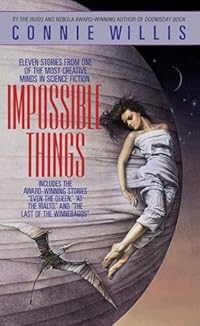
Impossible Things by Connie Willis
Posted in Reading Reviewed, Science Fiction at 12:00 on 26 April 2021
This is a book of short stories by the person who has won more Nebula and Hugo Awards than any other writer.
Bantam, 1994, 471 p, plus vi p Introduction by Gardner Dozois Plus vi p of Acknowledgements and lists of contents and illustrations.
The Last of the Winnebagos sees a near future where a mutated parvovirus has killed off all species of dog. Only jackals are left and even those are vanishingly rare. The Humane Society monitors and polices any animal deaths. The roads are dominated by water tankers servicing the city of Phoenix and the like and travelling very fast to blur the speed cameras. Our narrator is a photojournalist who sees a dead jackal on the road while on his way to photograph the last Winnebago, and is drawn into a web of suspicion.
Even the Queen was apparently written in response to complaints that Willis never wrote about women’s issues. (Her view is of course that there ought to be no restrictions on what a writer writes about.) In the story a device called a shunt disseminates a drug called ammenerol which prevents periods. The narrator’s daughter causes a stushie in the family when she announces she wishes to join a group called the Cyclists, who see shunts and ammenerol as instruments of the male patriarchy seeking to deprive women of their natural functions. Nevertheless, the story is played for laughs.
Schwarzschild Radius combines the theory of a star’s gravitational collapse into a black hole with the memories of a Dr Rottschieben who apparently served with Schwarzschild in the Great War. It’s beautifully written and its embedded metaphor ingenious but doesn’t really hold up under retrospective scrutiny.
Ado imagines a future (very litigious, very USian) in which everybody complains about everything and so teaching is made almost impossible. Hamlet consists of only two lines.
Spice Pogrom is Willis’s tribute to Hollywood screwball comedies but also reminded me of one of James White’s Sector General stories. Aliens called Eahrohhs have come to Earth, or, rather, to a space station called Sony which has an idiosyncratic housing policy. One of them, Mr Ohghhifoehnnahigrheeh, has promised to deliver NASA a space program (sic) and narrator Chris’s Nasa employed fiancé has billeted him/it on her and told her to allow it/him whatever it wants. There is plenty of the incidental happenings the screwball comedy enshrines to complicate the story-line. This one turns on whether Mr Ohghhifoehnnahigrheeh actually understands the English words they are all using but the story’s pay-off doesn’t really reward the time investment required by the reader.
Winter’s Tale riffs on the theory that since Shakespeare was low-born he could not have written all those magnificent plays and poems. Told as by Anne Hathaway it plays with that notion (which Willis’s foreword insists is surely incorrect,) and with the possibility that Christopher Marlowe’s murder in a Deptford Inn was faked while also providing a reason for Shakespeare’s famous bequest to Anne.
In Chance a woman has moved back to the town where she attended college (where everything is the same but everything is different) because her husband, who is interested only in career advancement, has a new job there. She starts to see the students as people she knew back in her youth and wonders on the chance happenings that change lives for the better – or worse.
In the Late Cretaceous is a satire on neologisms and academia, with the institution where it’s set also riddled with an over-officious set of traffic wardens, ticketing anything that doesn’t move. The professor of palæontology is a metaphorical dinosaur, still using chalk on blackboard. Willis’s preface to this laments what she calls political correctness, as being inimical, or at least antithetic, to comedy and moans about “every anti- (Choose one: smoking, animal research, logging, abortion, Columbus.)” Well she did include anti-abortionists, so she’s not a complete lost cause.
Time Out centres round a project to produce a “temporal oscillator” with which to manipulate “hodiechrons” (quantum units of time which Willis has presumably named from the Latin for today and the Greek for time.) An anatomy of both the quotidian routines of marriage and parenthood – the domestic detail is thoroughly true to life – the vicissitudes of not well resourced research and nostalgia for youth it suggests a mechanism for the origins of déjà vu. The whole is intricately plotted but leans a bit too heavily on light-heartedness.
Jack returns to the subject of the London Blitz which Willis explored in her short story Fire Watch and novels To Say Nothing of the Dog, Blackout and All Clear. As in those (and The Doomsday Book) it is marred for a British reader by a failure to get details of life and usages in the UK correct. The story concerns a new member of an ARP unit who shows an uncanny knack for detecting bodies buried by rubble. He also disappears sharply to his day job. The narrator develops suspicions.
At the Rialto’s title has a different meaning to Sons of the Rock of my generation compared to those who hail from elsewhere. It was the name of the local cinema. The Rialto here is a hotel in Hollywood hosting (or not) a meeting of quantum physicists. The plot revolves around a series of uncertainties.
Pedant’s corner:- flack (x3, flak,) “the Queen of England” (was of course not crowned as such but as Queen of Great Britain and Northern Ireland – and is of course Queen of many other places besides,) gladiolas (gladioli,) Russian Front (in the Great War it was called the Eastern Front,) LaGrangian points” (Lagrange points,) a missing comma before a piece of direct speech. “‘The seasons’ just started’” (season’s.) “‘Five years and no sex have made desperate’” (have made me desperate’,) “I don’t’” (I don’t,) a missing full stop, “setting her cap for you” (setting her cap at you,) liquor (the British usage is booze, or drink,) a character is said by another to be from Yorkshire but himself says he’s from Newcastle (all British people know Newcastle [either of them] isn’t in Yorkshire,) ME 109s (it’s Me 109s – and the text implies that type of plane was a bomber. It was a fighter,) bannister (banister,) oleo (the word used in the UK for this type of spreadable butter substitute is margarine,) a missing comma before a piece of direct speech, automobile jack (‘car jack’, or just ‘jack’,) row houses (terraced houses,) the Duchess of York (by this time [1941] the said woman was the Queen and was only ever referred to as ‘the Queen’,) a medal is said to have been awarded at a military HQ (investitures are [and were even during the war] held at Royal Palaces,) a recipient’s father is said to have pinned the medal on his son himself (medals are conferred by a member of the Royal family or perhaps, in extreme cases, by a representative such as a Lord Lieutenant,) the Duchess of York kissed the award recipient on both cheeks (absolutely not,) “and said he was the pride of England” (the ‘pride of Britain’ possibly, ‘England’ I very much doubt. The Queen [formerly Duchess of York] was Scottish,) an inland revenue collector (a taxman,) “had gotten married” (had got married,) the award recipient had shot down fifteen German planes so must have been in Fighter Command but is later said to be flying nightly bombing missions over Germany – a Bomber Command task.) “‘meaning’ or possible ‘information’” (or possibly.)