Archives » The Young Team

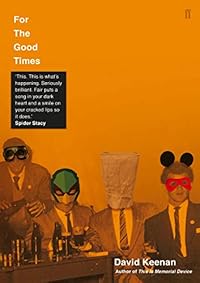
For the Good Times by David Keenan

Faber and Faber, 2019, 358 p.

How do you follow up a novelistic debut such as This is Memorial Device, a book about an imaginary rock band told from a kaleidoscope of multiple viewpoints? Keenan’s answer is to write about something totally divorced from that. 1970s Northern Ireland. “The best decade what ever lived.” (Except for the lack of oral sex.)

For the Good Times is another odd concoction, though. Larded with “Irish” jokes, it is essentially the story of three laddies, Tommy, Barney and narrator Samuel, held together by a linked love for the songs of Perry Como whom they have been told is absolutely clean-living, and who slip into nationalist activism almost by accident.

Their first project is to carry out a shooting and they narrowly avoid capture, running a roadblock with Tommy on the car roof spraying gunfire while singing For the Good Times. Their second is to recover an old arms stash, their third to kidnap the wife of a comic book store owner who they are told owes The Boys money. Her name is Kathy and she disappears leaving only her high heels behind. Sammy later sees her dancing in a bar, pursues her to the toilets where, unbidden, she fellates him. He can’t decide whether or not the relationship they then enter is because she wants to protect her husband from retribution but goes along with it, meeting her after her work in the Europa Hotel. The three lads take over the book shop in lieu of the supposed debt. Cue various riffs on comic books and superpowers.

This is Belfast as a surreal place. One of the characters is nicknamed Miracle Baby. He is “a retard” but one who knows the truth of everything. Kathy’s husband turns out to look exactly like Tommy. The three each imagine themselves as a different superhero. The most potent power? Invisibility; “being invisible is the greatest power you could ever have in Ireland,” a cloak which IRA membership conforms on them.

There is some stark realism. Local IRA boss Big Mack when the lads are joking about a bomb he’s demonstrating, tells them not to act like clowns, adding, “‘see if the IRA could dispense with Irishmen altogether, we’d be one fuck of a formidable fighting unit.’” Joining The Boys was motivated by “protection, resentment, ambition, revenge, honour, sex, money, style, class,” plus a history of violence “that ran through our veins and (let’s face it) was one of the only things holding the generations together,” and moments of recognition. “In Ireland history isn’t written. It’s remembered.” As it is in all sad countries.

Eventually escape becomes necessary. “Fucking Glasgow, my friend, it’s just like Belfast, the same rivalries, the same segregated pubs, the same flags, the same halls, the same murals, the same fucking teams; a friendly city once you get to know it. Plus you’re just as likely to get stabbed for your colours as back home, so as you know where you stand as soon as you’re off the boat. …. It was just like being back in the Ardoyne only with blow jobs aplenty.” But even life in Glasgow becomes too hot.

However nothing in this world is as it seems. Even Kathy. “It’s a web of lies we were all caught in. It’s the default position of the Irish. If in doubt, lie; if asked, make it up; if questioned deny it … tell them fucking nothing.”

In a passage that might be true to the book’s milieu but could equally well be there because Keenan thinks he ought to say it, Sammy tells us, “that was the one thing we never did: we never asked ourselves any questions, in fact we lied. We lied to ourselves more than we did to anyone else. You had to. How else do you do this stuff, day in day out? If you had a working brain you would be finished.” He says he “realised that Belfast is full of ghosts, that Belfast is haunted in the daytime and that nobody pays attention to any of them.” It’s the perfect place to indulge in mayhem. “If you were a daemon where would you go to do your work? Belfast.”

The novel partly comes across as a kind of cross between Michael Chabon’s The Amazing Adventures of Kavalier and Klay and, in its observation of casual violence, Graeme Armstrong’s The Young Team. It is, though, made problematic by its illustrations of violence (admittedly difficult to avoid in any novel dealing with this subject) and flawed by some overblown passages rendered in italics illustrating the adventures of the superheroes the three have imagined for themselves. It also contains an aside on the erotic connotations of the ladies’ silk handkerchief.

Pedant’s corner:- The epigraph attributes the song It’s Impossible to Perry Como. (He did sing it but the English lyric was written, as noted in the Acknowledgements, by Sid Wayne, Spanish words and music by Armando Manzanero.) Otherwise; “a beautiful delicate labia” (labia is the plural, no ‘a’ then,) “a flappy disk” (floppy disc, but this may have been trying to convey the speaker’s argot.) “‘Does that not gives you a shiver?’” (give,) “a dice” (x 3, dice is plural; one of them is a die,) fit (fitted,) “lay low” (several times; lie low,) “so as” (frequently; used where ‘so’ would be sufficient,) “faraway lochs” (I know Keenan is Scots but the narrator is Irish, shouldn’t that be ‘faraway loughs’.)

The Young Team by Graeme Armstrong

Picador, 2020, 391 p.

No question of cultural appropriation could possibly be held against Graeme Armstrong in this his debut novel. The Young Team is firmly rooted in his background and experience of growing up in a working class housing estate in Airdrie in the West of Scotland. The book is written in language steeped in those surroundings. Raw, visceral and confident, it is profoundly demotic and could be called dialect (some may even dub it slang) but is certainly far from the genteel prose of the usual literary novel. Yet it is also undeniably expressive, and capable of handling all the nuances of a novel.

The first person narrative follows Alan Williams (aka Azzy Boy,) member of the Young Team Posse gang, from the brash bravado of barely teenage youth, “Obviously, A’ve hud ma hole,” looking up to the previous generation of gang members, through young adulthood, the creeping influence of hard drug dealers and a more reflective sense of time passing, of putting away childish things, “Yi huv tae break free fae aw these demons n live tae the fullest yi kin.”

There are several accounts of violent confrontations with the Young Team’s rivals the Toi (‘defendin yir scheme’.) Here we might comment on the narcissism of small differences; one West of Scotland housing estate is much like another, to construct rivalries on the basis of which side of a road you live is an exercise in nit-picking, but nevertheless the thing that gives the Young Team – Wee Broonie, Kenzie, Azzy, Danny, Addison, Finnegan and Wee Toffey – a focus for living, for anticipating Friday night. Girls, while part of the extended gang, are peripheral to its main activities but still strange creatures, with their own motivations. Azzy holds a lingering torch for Monica Watson, a bright girl flickeringly receptive to Azzy’s charms but always destined to leave the estate and not willing to settle for less. (Late on in the book when the prospect of a new life beckons Wee Broonie tells Azzy, ‘Yi pure luv her so yi dae.’)

Music is a more constant companion. Many passages refer to the sound track to Azzy’s life.

In one brilliant descriptive passage Azzy expresses what it’s like to be at a rave. “Everycunt is yir pal in here. Maybe it’s cos we’re aw fuckin oot oor nuts on pills that we’re feelin the love. The ecktoplasmic euphorian fellowship wae our common man. Harmony wae aw humanity. A love the strangers next tae me n they love me back. Peace n love tae aw mankind. Utopian society,” where there is, “No a sea, but a fuckin ocean ae people aw bobbin n weaving, knitted together by sound, ecstasy and passion fur the tunes. … The crowd is a single entity, a cult, n our deity behind the decks,” and the effects of the drugs and adrenaline on cognition, “A’m pushin against the current, goin against the grain, The rain in Spain falls mainly on the plain. Pure random thoughts n mince n tatties in the brain.”

Azzy doesn’t ignore the down side of such indulgence, depicting the aftermath of imbibing a cocktail of drugs and alcohol – “A come down is beyond roughness. Stomach cramps, cracked lips, a white sandpaper tongue, a blocked nose, chest pains and feelings ae total run-down deterioration. Yi feel sad, depressed n on the verge ae total misery, cripplin longin and melancholy. It’s a confusin n paranoid pathos tappin intae hardwired emotional issues, fears and desperation ae aw forms. There’s nae escaping the ecstasy blues” – more terminal velocity than gentle drift back to earth. “Yi sink further doon than the place yi left fae. …. Ironic, in’t it? The place yi were so desperate tae escape wid noo be a near paradise.”

The indulgence eventually takes its toll and Azzy succumbs to panic attacks, forswearing drugs and seizing the chance of the always likely tragedy to move to Gateshead with Nicola, who’d always had her eye on him. When the inevitable happens and he comes back, “Aw the normal folk hud been driven oot ae the town centre, fadin one by one. The rest ir stuck here, forever wheelin roon this nightmarish carousel ae degradation that used tae be a proud n thrivin market town. Any dreams ae that huv vanished.”

Background is not so easy to avoid, gang culture sucks him in again, made more dangerous by the intrusion of drug cartels and the concomitant brutal enforcement of their will, culminating in a hospital vigil. “This is where it always ends. Sittin in a fuckin magnolia room, waitin.”

Azzy, like Armstrong, comes to the understanding that, “Our conditionin, two hundred years ae hard labour, made us believe this shite is aw there is fur us – our lot, the drink n drugs, anaesthetic n elixir tae this social nightmare. A didnae believe that.”

The content and language of The Young Team may not be to some readers’ tastes but Armstrong’s illustration of that conditioning, his use of a means of expression totally true to its origins, his depiction of characters normally dismissed by literature, is eloquent demonstration that their, his, language is as expressive – and nuanced – as any other, as capable and worthy of delineating the world.

Pedant’s corner:- Williams’ (x2, Williams’s,) “in elder cunts motors” (cunts’,) “bang tae rites” (rights,) “takin mare pills” (mare is usually spelled ‘mair’.) “A’m thinking A’ve just huv a brush wae death” (just hud a brush.) “The polis’ words” (polis’s.) “‘How yi hoddin up, son?’” (hoddin is usually spelled ‘haudin’.) “The rumours aboot developers building flats hus finally come tae pass” (huv finally come to pass.)

free hit counter script