Archives » The Whispering Mountain

The Cuckoo Tree by Joan Aiken

Jonathan Cape, 1971, 249 p. Illustrated from drawings by Pat Marriott.

Sixth in “The Wolves of Willoughby Chase” sequence, (though seventh if counting The Whispering Mountain which acts as a prequel to the series,) The Cuckoo Tree sees Dido Twite returned to England with Captain Hughes of HMS Thrush, carrying a warning to the Admiralty of a Hanoverian plot to blow up St Paul’s Cathedral during the planned coronation of Stuart King Richard IV.

Their carriage is wrecked and Captain Hughes badly injured. Did has to solicit help from a group of men she meets on the road, who point her towards Tegleaze Manor. (The men are smugglers, using canals to ferry their wares to London, a route later used by Dido.)

At the manor Dido is treated with some disdain by Lady Tegleaze but befriends her mollycoddled grandson, Sir Tobit. Lady Tegleaze allows Captain Hughes to be housed and nursed in a tenant cottage by the unlikeable and hostile Mrs Lubbage.

Dido wants to send the Captain’s dispatches to London but mistrusts the post and goes to the smugglers’ rendezvous at The Cuckoo Tree to enlist their help. There she meets orphan Cris, a slightly uncanny child who plays a part in thwarting a plan to swindle Sir Tobit out of his heritage. Mixed up in all the shenanigans is Dido’s Pa, but Dido’s presence gives him some pause.

This is all good adolescent fun, featuring adventure and mishap, locals with malapropistic speech, mind altering sweetmeats called Joobie nuts, long lost siblings etc, with authorial touches to appeal to adults; a firm of solicitors named Pickwick, FitzPickwick and Wily, the valuable family heirloom, The Tegleaze Luck-piece, a painting by P Breughel stolen in order to be sold to the Margrave of Bad Fallingoff.

However, why King Richard is portrayed as Scottish, with a Scottish accent and speech patterns is beyond me. He would certainly have been brought up as an English gentleman. (I noted this about his father here.) That his coronation takes place in St Paul’s Cathedral rather than Westminster Abbey is excused by the fact it’s an Altered History.

Pedant’s corner:- Bruegel (Brueghel, [used later],) “nobody could take if from him” (take it from him.)
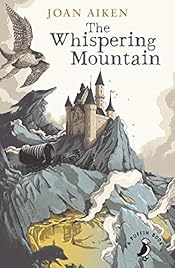
The Whispering Mountain by Joan Aiken

Puffin, 2016, 369 p, plus 2 p Map and 12 p Extras.

This is set in Aiken’s world of The Wolves of Willoughby Chase where the Stuart King James III is the ruler of Great Britain, but being a kind of prequel does not feature most of the characters from those stories.

Our protagonist here is young Owen Hughes who lives in the town of Pennygaff in Wales. His mother is dead and his father serving in the navy somewhere in Asia. As a result he stays with his grandfather, the keeper of the town’s museum whose most precious holding is the golden harp of Teirtu.

Pennygaff lies under the lea of the local mountain Fig-Hat Ben which makes a sound when the wind is up, hence the book’s title. It is also rumoured to be the home of small, possibly magical, humans who are only occasionally glimpsed.

The local laird, Lord Malyn, wants the harp for himself but Owen’s grandfather disputes his title to it since it belongs to the last survivor of an order of monks. Malyn sets two criminals, Prigman and Bilk – who converse throughout in thieves’ cant – to steal the harp. Queering the pitch is the mysterious foreigner, The Seljuk of Rum, prone to speaking like a thesaurus. Sand somewhere in the neighbourhood, incapacitated by a hunting accident, is David James Charles Edward George Harold Richard Tudor-Stuart, the Prince of Wales. Who for some reason speaks in a kind of cod Scots.

Other notable characters are itinerant Tom Dando and his daughter Arabis who make their living by selling herbal remedies and the like and whom Owen met on his way to Wales from London.

When the harp is stolen from the museum Owen is kidnapped by Bilk and Prigman and given the blame for it. Many scrapes and adventures ensue including meetings with the clan who live secretly in the mountain and gave rise to the rumours of people living there. Their Middle-Eastern origins – they use camels for transport – tie them to The Seljuk of Rum.

The text deploys a lot of Welsh words but there is a glossary of them to be found among the Extras. The thieves’ cant might have been a hindrance to a young reader but context usually makes it obvious what is meant.

In these books we are never in any doubt as to who is good and who the baddies are. Aiken characterises the latter in just enough of an over the top way to ensure that while her heroes and heroines are all resourceful and competent they have to struggle to overcome them.

It’s all a jolly good romp and as is to be expected in YA fiction, all’s well that ends well.

Pedant’s corner:- “the castle of Balmoral” (in our timeline the royals did not acquire the Balmoral estate until the mid-nineteenth century and then built the castle there,) Yehemelek (elsewhere always Yehimelek,) “there were numerous opening leading out of the big cave” (openings.) “‘I hope your lassie wisna come to harm’” (willna come to harm.) In glossary of welsh words; perwinkle (periwinkle.)

free hit counter script